Battle of the Bulge 1944 DX
1944 · Europe
16–24 December 1944 · The Ardennes of south-eastern Belgium and northern Luxembourg, from the River Meuse to the German frontier
U.S. Army (with elements of British XXX Corps) — German Army (Army Group B) · 17 turns · 149 units
AI personality: U.S. Army (with elements of British XXX Corps) Manoeuvre / German Army (Army Group B) Berserk
The picture we hope to see
The German spearheads pushing west along the forest roads are blocked by the garrisons left in the crossroads towns, and stop short of the Meuse.
Briefing
16–24 December 1944. The Ardennes of south-eastern Belgium and northern Luxembourg, from the River Meuse to the German frontier
NUTS!
— Brigadier General Anthony McAuliffe, acting commander of the 101st Airborne Division, replying to General von Lüttwitz's demand for the surrender of Bastogne, 22 December 1944 (U.S. Army official history)
At the northern edge of the board there is a ridge: Elsenborn. At the southern edge there is a river: the Sauer. Between them, along nearly a hundred kilometres of forested frontier, stood only the 28th and 4th Divisions, sent there to recover after the Hürtgen, and the 106th and 99th, which had arrived the week before. Before dawn on 16 December, behind a barrage, three German armies come out of the Eifel forest: Sixth Panzer Army in the north, Fifth Panzer Army in the centre, Seventh Army in the south. Their aim is the bridges over the Meuse, and beyond them Antwerp.
This is a board of road junctions. The Ardennes forest lies under snow, and tanks move quickly only on the roads. The roads are gathered at St. Vith and at Bastogne, and those two towns become the dams. The 7th Armored Division held St. Vith for six days. The 101st Airborne reached Bastogne in trucks driven through the night, and saw the year out inside the ring. In the north, Kampfgruppe Peiper raced west along the Amblève valley and halted as the bridges were blown before it. In the south, on T13 (22 Dec), Patton's III Corps turns to the north. On T15 (23 Dec) the sky clears; on T17 (24 Dec) the fuel runs out. The board ends on that turn, the day the head of the 2nd Panzer Division reached Celles.
[Special rules of this board]
- Surprise: on T1 every German armoured unit on the board at the start (the panzer and SS panzer divisions and the 150th Panzer Brigade) is in the surprise box. The first attack pulls the trigger, and at the end of that turn the armour alone moves and fights once more.
- Fortress: the town of Bastogne (one hex). In combat involving the fortress, neither attacker nor defender is obliged to attack. Units in the fortress suffer only elimination or a stand-off.
- The Meuse is a major river, crossable only at the bridges of Givet, Dinant, Yvoir, Namur, Huy and Liège.
[How to win] Points are counted from the objectives you hold and from the difference in combat strength eliminated. The victory line is -140: if the margin seen from the American side is above -140, the Americans win; below it, the Germans. All objectives begin in American hands. The heavy ones are the Meuse crossings at Dinant (50 points) and Namur (25), the road hubs of Bastogne (40) and St. Vith (25), and Marche (25) at the tip of the wedge. The northern shoulder is light (Elsenborn 5, Malmedy 5, Spa 10, Liège 10); Mersch on the southern shoulder is worth 15.
There is no activation limit: both sides may move every unit each turn.
[Commanders] Germans: Dietrich (Sixth Panzer Army), Manteuffel (Fifth Panzer Army), Brandenberger (Seventh Army), and Lüttwitz of XLVII Panzer Corps, who surrounded Bastogne, all off the board. The names on the board are battle-group leaders: Peiper, Hansen and Sandig; Skorzeny of the 150th Panzer Brigade; Remer of the Führer Escort Brigade; Kahler of the Führer Grenadier Brigade.
Americans: Hodges (First Army), Patton (Third Army), Gerow (V Corps), Middleton (VIII Corps), all off the board. McAuliffe at Bastogne; Clarke and Hasbrouck at St. Vith; Robertson and Lauer on the Elsenborn ridge. The British 29th Armoured Brigade guarded the Meuse bridges. Units are regiments and combat commands: the large lettering is the regiment, the small lettering the division.
[Decisions to try on this board]
- (Germans) Where to send the armour in the T1 surprise: west through the Losheim gap, or down the Clervaux road towards Bastogne?
- (Germans) Fortress Bastogne need not be attacked. Surround it and press on until the odds favour you, or mass your forces and storm it?
- (Americans) How many turns can St. Vith hold? Every turn it holds gives the 82nd Airborne and the 3rd Armored more time to form a line in the west.
- (Americans) From T13, use the 4th Armored, 26th and 80th Divisions to open a corridor to Bastogne, or to push back the southern shoulder?
- (Germans) How far can the wedge be driven before the last turn, T17?
[Outcome] Bastogne was never taken. At 16:50 on 26 December the tanks of Lieutenant Colonel Abrams of the 4th Armored Division broke the ring from the south. The day before, the head of the 2nd Panzer Division had run dry at Foy-Notre-Dame and in front of the farms at Celles, six kilometres from Dinant, and was caught and destroyed between the jaws of the 2nd Armored Division. On 24 December Peiper left his tanks at La Gleize and walked back east with some eight hundred men. The salient was not gone until 25 January. Each side lost around eighty thousand killed, wounded and missing, and the German army never again had the strength to attack in the west.
On a misty morning, three armies came out of the forest.
The ridge in the north did not move; the river in the south did not move.
Between them, one wedge went in.
Short of Celles the fuel ran out, and the surrounded town answered in one word: NUTS.
The sky cleared.
It was the last time Germany attacked in the west.
Divisional artillery, tank-destroyer battalions and corps engineers are folded into the regiments and combat commands. The Hürtgen and Roer front is cut at the northern edge, and divisions that arrived after 24 December (75th, 17th Airborne, 11th Armored, 87th, British 6th Airborne and others) are not included. Monschau and Echternach are shown by name only and carry no points. The 12-hour turns do not distinguish day from night.
1 hex = 6 km, 1 turn = 12 hours, 1 CS ≈ 700 men (infantry) or about 30 tanks. T1 = 16 Dec 06:00, T7 = 19 Dec 06:00, T13 = 22 Dec 06:00, T15 = 23 Dec 06:00 (clear), T17 = 24 Dec 06:00 (the last turn; fuel).
Maps
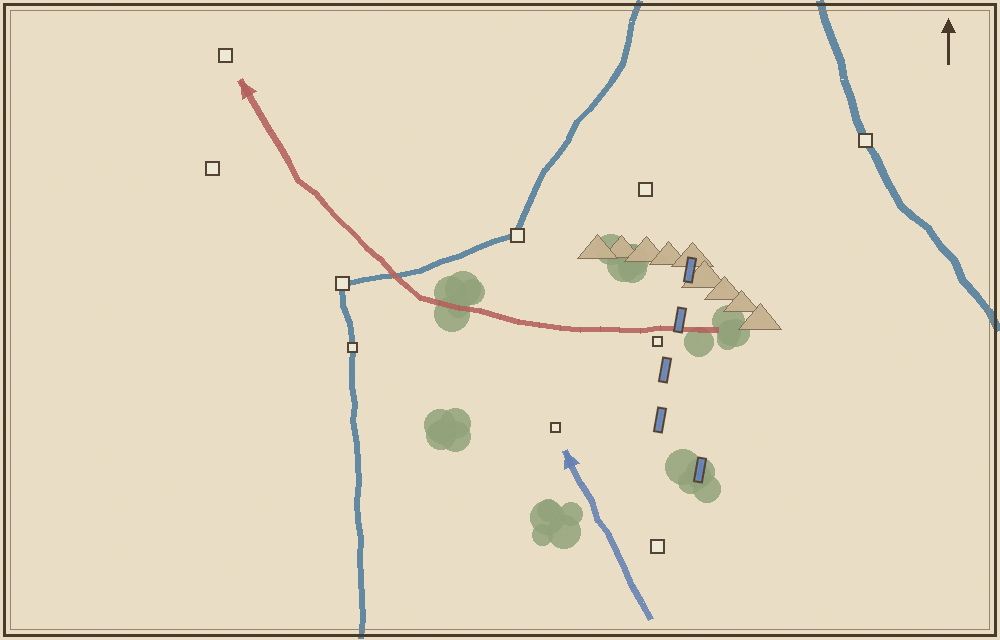 THE ARDENNES
Antwerp (the German objective)
Brussels
Liège
Namur
Dinant
Aachen
Cologne
Luxembourg
Bastogne
St. Vith
River Meuse
Rhine
Eifel (three armies assembled)
the ghost front (four divisions, 100 km)
Patton turns north
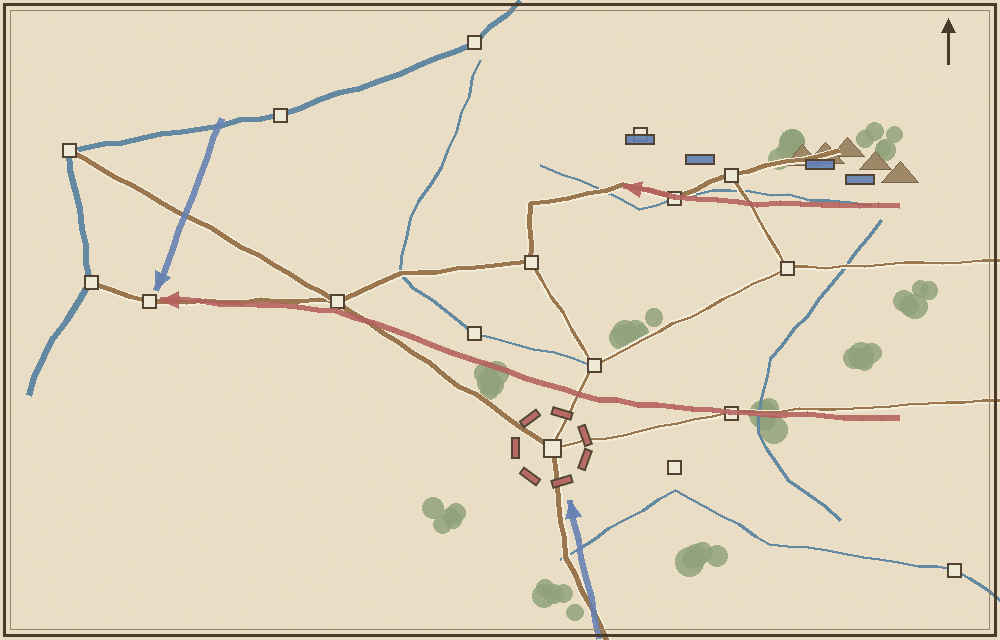 Bastogne
St. Vith
Elsenborn ridge
Malmedy
Stavelot
Spa (First Army HQ, fuel dumps)
La Gleize (where Peiper left his tanks)
Manhay
Marche
Celles (where the 2nd Panzer spearhead stopped)
Dinant
Namur
Liège
Houffalize
La Roche
Wiltz
Clervaux
Echternach (southern shoulder)
Arlon
River Meuse
Ourthe
Amblève (valley of the blown bridges)
Kampfgruppe Peiper
2nd Panzer Division
the ring (20–26 Dec)
4th Armored (26 Dec, 16:50)
2nd Armored Division