Siege of Yorktown
1781 · North America Medium
Allies (Washington and Rochambeau) — British (Cornwallis) · 12 turns · 48 units
Briefing
"Sir, I propose a cessation of hostilities for twenty-four hours, and that two officers may be appointed by each side, to meet at Mr. Moore's house, to settle terms for the surrender of the posts of York and Gloucester." -- Cornwallis to Washington, 17 October 1781, four years to the day after the surrender at Saratoga.
Night of 6 October 1781, at Yorktown, a small port on the south bank of the York River in Virginia. In early September de Grasse's French fleet drove off the British fleet at the mouth of the Chesapeake, and the bay was closed. The sixteen thousand French and Americans under Washington and Rochambeau have marched seven hundred kilometres south from the lines before New York and surrounded the town. Trusting Clinton's letter that a relief fleet would sail, Cornwallis has abandoned his outer redoubts and shut himself inside the inner line around the town. Tonight, in the rain, fifteen hundred men will dig the first parallel seven hundred yards from the British works.
[How to win] The result is decided by a single margin. Margin = (points of objectives you hold - points of objectives the enemy holds) + (losses inflicted - losses suffered). There are seven objectives worth 115 points: Yorktown 40, Redoubt 10 15, Redoubt 9 15, Fusiliers' Redoubt 15, the Hornwork 15 (all British), the Grand French Battery 10 and Moore House 5 (both Allied). The British start with 100 points, the Allies with 15. If the margin seen from the Allied side ends above the victory line (-27 points), the Allies win; below it, the British win. Finish 9 points beyond the line for a tactical victory, 69 for an operational victory, and 137 for a strategic victory. Short of 9, it is a draw. The British win by holding out; the question for the Allies is how many of the redoubts they can take in the time allowed.
[Fortresses] The British redoubts, earthworks and the town are fortresses. Units inside need not attack, and when attacked they suffer no result other than elimination or the elimination of the attackers; everything else is a stalemate. Besiegers who move next to a fortress unit are obliged to attack as usual. The British AI keeps fortress units inside the fortress (holding the works). The Allied AI does not newly close up against the fortress line where it cannot attack at good odds (it does not stop assaults on the redoubts themselves).
[Who moves first] The Allies move first.
[The siege guns] The French and American siege guns in the first parallel (d'Aboville's and Lamb's) are on standby and all open fire together on turn 4 (9 October). Their range is 3. The British guns also have range 3.
[Counters that can move at once] Allies: twelve, with six more on turn 6 (11 October, the second parallel). British: eight.
[Reinforcements] Neither side receives any. The British relief fleet sailed from New York on 19 October and reached the mouth of the bay on the 24th, after the board ends.
[Commanders] Allies: Washington = George Washington; Rochambeau = the Comte de Rochambeau; Lafayette = the Marquis de Lafayette (light infantry division); Hamilton = Lieutenant Colonel Alexander Hamilton; Laurens = Lieutenant Colonel John Laurens; Muhlenberg (the battalions of Vose, Gimat and Barber), Hazen, Dayton (New Jersey), Olney (Rhode Island), Clinton and Van Cortlandt (New York), Wayne (Pennsylvania), Gist (Maryland), Nelson (Virginia militia), Lamb (American artillery), Gouvion (engineers). The French: Viomenil (Bourbonnais, Soissonnais, Saintonge), Deux-Ponts (Royal Deux-Ponts), St-Simon (Agenais, Gâtinais, Touraine), d'Aboville (the Auxonne artillery). British: Cornwallis = Charles, Earl Cornwallis; O'Hara = Brigadier Charles O'Hara (Guards); Abercrombie = Lieutenant Colonel Robert Abercrombie (light infantry); Fuser (23rd Foot, Fusiliers' Redoubt), McPherson (Redoubt 10), Hesse (Redoubt 9), Dundas (43rd), Yorke (33rd), Gordon (80th), Wemyss (76th), McArthur (71st), the 17th, von Voit and von Seybothen (Ansbach-Bayreuth), von Fuchs (Erbprinz), von Ewald (Jägers), Rochfort (Royal Artillery), Symonds (seamen), Johnson (marines). The upper name on each counter is the commander, the lower the unit.
[The decisions this board asks] First (Allied): how to use the three days before the siege guns open. Push too much infantry ahead of the guns, and it will be obliged to attack beside the fortress.
Second (Allied): which redoubt to take first. Redoubts 9 and 10 have few defenders but are covered by the inner line. Fusiliers' Redoubt in the west lies beyond the marsh of the creek.
Third (British): which redoubts should receive your eight moves. Units holding the works do not sally out.
Fourth (British): abandon the forward redoubts to hold the town. Time is on the British side; the Allies must come and take the points.
[Outcome] On the afternoon of 9 October the French batteries opened, and in the evening the American batteries, whose first shot Washington fired himself. On the night of the 11th the second parallel was pushed to three hundred yards, but its eastern end was blocked by Redoubts 9 and 10. On the night of the 14th both were stormed at once: Redoubt 10 fell to Hamilton's four hundred in ten minutes, Redoubt 9 to four hundred French under Deux-Ponts at greater cost. At dawn on the 16th Abercrombie's three hundred and fifty sallied and spiked six guns, but they were repaired by noon. That night Cornwallis tried to ferry his men across to Gloucester Point and was stopped by a storm.
On the morning of the 17th a drummer in a red coat mounted the parapet, followed by an officer waving a white handkerchief. On the 19th the British marched out to surrender. Cornwallis, pleading illness, did not appear; Brigadier O'Hara offered the sword in his place. When the news reached London, Lord North is said to have repeated, "Oh God, it is all over." The war went on for another year and a half, but no great battle was fought on land again.
The mouth of the sea closed, and the awaited ships did not come
On a night of rain, earth was heaped seven hundred yards away
One redoubt in ten minutes, another at the price of blood
On the night of the storm, the boats did not reach the far shore
In the morning, on the parapet, a drum beat for a parley
The board runs from 6 to 17 October. The opening of the siege on 28 September and the abandonment of the outer redoubts come before it, and the surrender march of the 19th after it. The siege of Gloucester Point across the river (Tarleton and the Duc de Lauzun) is not on the board and appears only in the [Outcome]. The works of the first parallel, begun on the night of 6 October, are drawn as complete from the start.
1 hex = 200 m, 1 turn = 1 day, 1 CS = about 200 men. T1 = 6 Oct (the first parallel), T4 = 9 Oct (the bombardment opens), T6 = 11 Oct (the second parallel), T9 = 14 Oct (Redoubts 9 and 10), T11 = 16 Oct (the sally and the failed crossing), T12 = 17 Oct (the drummer).
Maps
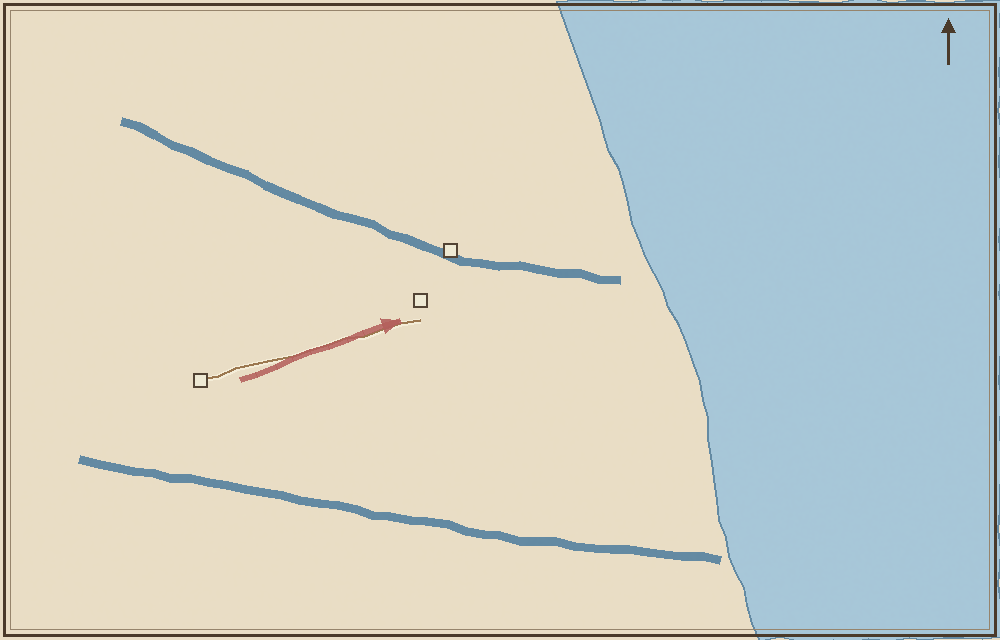 YORKTOWN
Gloucester Point (Tarleton)
Williamsburg (Allies march 28 Sept.)
Chesapeake Bay (de Grasse's fleet)
Battle of the Capes (5 September)
New York (Clinton sails 19 Oct.)
York River
YORKTOWN
Gloucester Point (Tarleton)
Williamsburg (Allies march 28 Sept.)
Chesapeake Bay (de Grasse's fleet)
Battle of the Capes (5 September)
New York (Clinton sails 19 Oct.)
York River
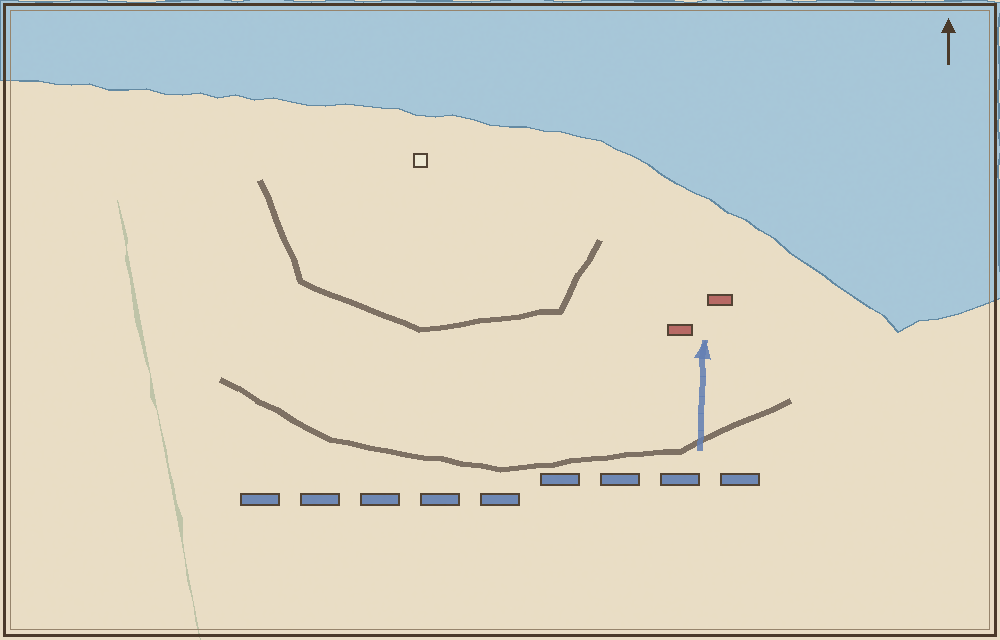 YORKTOWN
first parallel (night of 6 Oct.)
Redoubts 9 and 10 (night of 14 Oct.)
French (Rochambeau)
Americans (Washington)
York River
storm, night of 16 Oct. (crossing fails)
YORKTOWN
first parallel (night of 6 Oct.)
Redoubts 9 and 10 (night of 14 Oct.)
French (Rochambeau)
Americans (Washington)
York River
storm, night of 16 Oct. (crossing fails)