Battle of Ravenna
1512 · Europe Medium
French-Ferrarese Army — Holy League Army · 10 turns · 50 units
Briefing
"Monsieur, si le roi a gagné bataille, je vous jure que les pauvres gentilhommes l'ont bien perdue."
"Monsieur, if the King has won a battle, I swear to you that it is the poor gentlemen who have lost it." -- the Chevalier Bayard, in a letter to his uncle the Bishop of Grenoble three days after the battle (appendix to the Loyal Serviteur)
Sit in the ditch, or come out of it and strike? This board asks the Holy League only that one question.
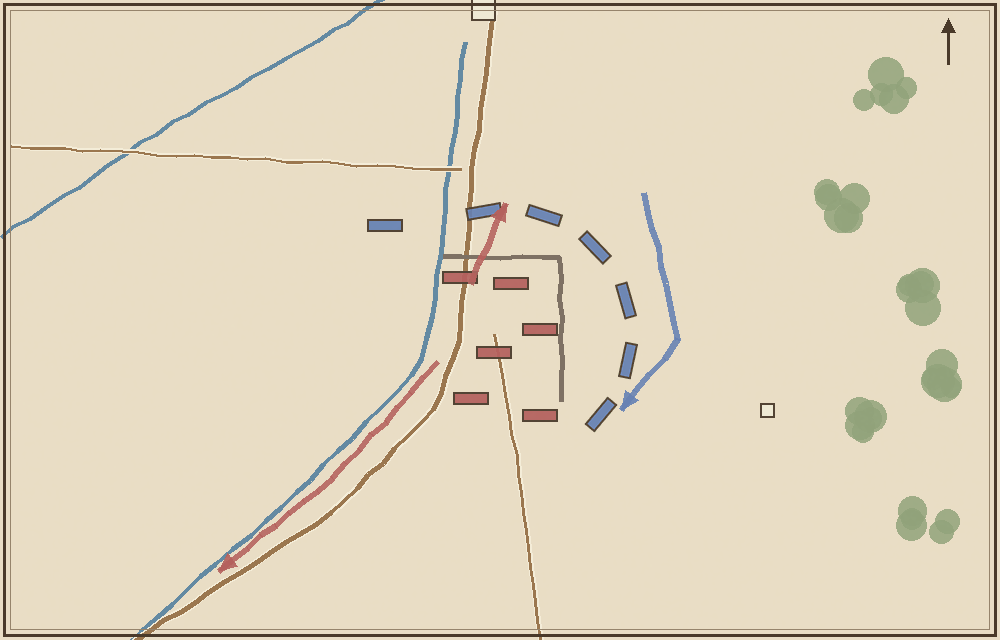
On the right bank of the Ronco lies the League's camp, Molinaccio. The river is on its left; to its front and right are a ditch and an earth rampart, and in front of the ditch stand Pedro Navarro's thirty carts, loaded with scythes and light guns. Every hex of the camp is an entrenchment, and units inside have no obligation to attack. If attacked hand to hand, the defence is doubled. The earth-coloured front row is a fortress, which does not move even on a retreat result. Sitting there, it looks as if you cannot lose. Navarro believed so, and the Viceroy Cardona went along with him.
But the doubling of an entrenchment works only against enemies standing next to it. Against a bombardment with no adjacent attacker, the ditch and the rampart make no difference. The French have fifty-four guns, and the heavy guns of Alfonso d'Este, Duke of Ferrara, have a range of 3; they fire at single strength into the cavalry and infantry packed at the back of the camp. The hexes behind are filled with friends, and a unit that cannot retreat simply vanishes.
The board begins at eight in the morning of 11 April 1512, Easter Sunday. During the night the French bridged the Ronco and crossed, and drew up in an arc before the ditch. On the far side of the river, on the left bank, Yves d'Alègre's rearguard and two heavy guns remain. There are no reinforcements. For both armies, what is on the board is everything.
[How Gaston wins / how Cardona wins] The "margin" on screen is a single number seen from the Franco-Ferrarese side: the difference in points of the places held, plus the difference between losses inflicted and losses suffered. At the start the League holds Molinaccio (30), and the French hold Ravenna (15) on the northern edge and their bridge, Bridge (10). The margin opens at -5, and the victory line is +26. Above the line the Franco-Ferrarese win; below it the Holy League wins; the further from the line, the higher the grade of victory. When Molinaccio changes hands the margin moves by 60, so if the French take the camp, they stand at +55 even with equal losses, above the line. If they cannot take it, the margin stays at -5, and they must build up 31 points from the difference in losses alone. The League must hold Molinaccio, and win back by going out and striking the units it loses to gunfire. The five Spanish infantry units score 6 points each if they leave the board by the salients at Forli on the south-western edge and Cesena on the southern edge. Other League units may leave as well, scoring points equal to their combat strength.
[Counters that can move at once] The Franco-Ferrarese: thirteen of thirty. The Holy League: eight of twenty. The League command remained divided to the end over whether to wait in the ditch or go out.
[Commanders] Franco-Ferrarese: Foix Nemours = Gaston de Foix, Duke of Nemours (in overall command; twenty-two years old) / Lautrec = Odet de Foix-Lautrec (his cousin; badly wounded, survived) / La Palice = Jacques de La Palice (heavy cavalry of the vanguard) / Bohier = Thomas Bohier (lances of the main body) / Bayard = the Chevalier Bayard / d'Ars = Louis d'Ars / Sanseverino Cardinal = Cardinal Federico Sanseverino / Empser = Jacob Empser (captain of landsknechts) / Schlabrndf = Fabian von Schlabrendorf (his second) / Molart = Molart (captain of the Gascons) / Alfonso Este = Alfonso I d'Este, Duke of Ferrara, and his heavy guns / Bozzolo = Federico Gonzaga da Bozzolo (Italian infantry) / Alegre = Yves d'Alègre (the rearguard on the left bank) / Viverois = his son Viverois.
Holy League: Cardona Viceroy = Ramón de Cardona, Viceroy of Naples / Navarro = Pedro Navarro (head of the Spanish infantry and engineers; the man behind the ditch and the carts) / Zamudio = Cristóbal de Zamudio / Paz = Pedro de Paz / F.Colonna = Fabrizio Colonna (the papal vanguard) / Palude = the Marquis of Palude / Carvajal = Alfonso de Carvajal (rearguard) / Bitonto = the Marquis of Bitonto / Pescara = Fernando d'Ávalos, Marquis of Pescara (light cavalry). The five Spanish infantry units are one step stronger as veterans. Not counters: Cardinal Giovanni de' Medici (papal legate; led no troops), Marcantonio Colonna (commander of the town of Ravenna), and Paris Scotto (who held the bridge on the Montone).
[Decisions this board lets you test]
1. Sit, or come out? Inside the ditch you will not lose hand to hand. But the guns keep firing into the hexes at the back. On which turn does the League send out whom? Colonna pushed his heavy cavalry out without waiting for leave, cursing Navarro.
2. Fire, or charge? If the French close with the ditch, the obligation to attack arises, and they must face the fortress front and the doubling together. Stay two hexes off and leave it to the guns, and no obligation arises. How long can Gaston wait?
3. The rearguard on the left bank. D'Alègre's four hundred horse and two guns are across the river. Keep firing over the river, or cross by the bridge and the fords to join the cavalry battle on the right bank? Historically it was these fresh troops that struck the flank of the wavering Colonna.
4. The road along the embankment. Get the Spanish infantry away to the south-west before the collapse, and they score points. But every unit that leaves is one fewer defending Molinaccio.
[Outcome] After more than two hours of bombardment, the League cavalry came out of the ditch, their ranks broken by ditches and hedges, struck the French heavy cavalry, and were routed. The landsknechts crossed the ditch into the camp; Empser and Schlabrendorf fell on the spot, and they were thrown back by the Spanish sword-and-buckler men. In time the French horse entered the camp from every side, and Navarro, Colonna and Pescara were all captured. Even so, two bodies of Spanish infantry kept their ranks and marched away south-west along the road between the river and the embankment. Gaston de Foix pursued them with some fifteen horsemen, was surrounded on the embankment, and died with a lance in his side. At least ten thousand were killed. Ravenna surrendered and was sacked. But the French, having lost their commander, were pushed out of Milan by the Swiss within the year, were defeated at Novara the next year, and went back beyond the Alps. The captured Cardinal de' Medici escaped, and the following year became Pope Leo X. Forty-five years later, a single column was raised by the embankment on the battlefield.
Before the ditch, thirty carts.
Those who sat there were within reach of the guns.
Along the embankment road, two bodies march on in their ranks.
The one who pursued them was the winning side's commander.
The King won the battle, and the poor gentlemen lost it.
On the right bank of the river, a single column remains.
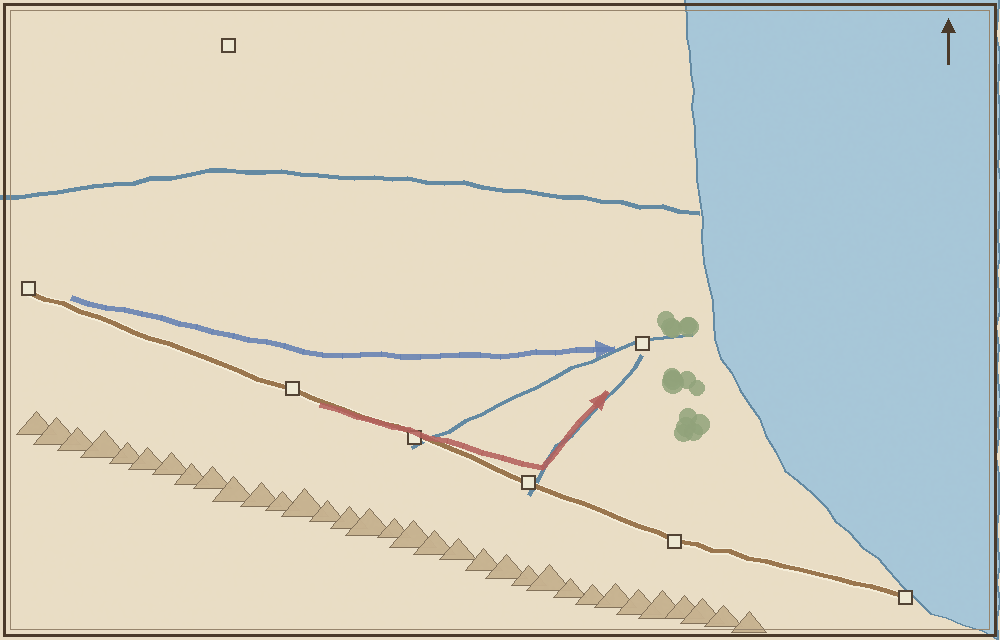
The bridging and crossing in the night, the town of Ravenna and its garrison, and the defence of the bridge on the Montone are not on the board. The board begins at eight in the morning, when both armies had finished deploying. Gaston's death came in the pursuit after the outcome was decided, so it is not a sudden-death condition. The Ronco was diverted between 1733 and 1739, so the watercourse at the northern end of the board is an estimate of the old channel, which ran towards the southern wall of the town. The only times recorded in the sources are "the crossing at dawn", "a bombardment of more than two hours" and "a battle of eight hours"; the time of each turn is an estimate divided from these.
1 hex = 200 m, 1 turn = 45 minutes, 1 CS = about 400 men. T1 = 4/11 08:00 (the bombardment begins), T4 = 10:15 (about when the League cavalry leaves the ditch), T6 = 11:45 (the landsknechts attack the ditch), T9 = 14:00 (the French horse enter the camp), T10 = 14:45 (there is time yet before sunset, but the outcome is decided here).
Maps
 RAVENNA
Ravenna
Forli
Cesena
Faenza
Imola
Bologna
Ferrara
Rimini
Adriatic Sea
Po
Ronco R.
Apennine foothills
Gaston de Foix
Cardona
RAVENNA
Ravenna
Forli
Cesena
Faenza
Imola
Bologna
Ferrara
Rimini
Adriatic Sea
Po
Ronco R.
Apennine foothills
Gaston de Foix
Cardona
 Molinaccio camp
Ravenna
Classe
Ronco R.
Montone R.
French bridge
d'Alegre
Gaston de Foix
Este's guns
Pescara
ditch and carts
to Forli
to Cesena
Pinewood
Molinaccio camp
Ravenna
Classe
Ronco R.
Montone R.
French bridge
d'Alegre
Gaston de Foix
Este's guns
Pescara
ditch and carts
to Forli
to Cesena
Pinewood