Battle of Ichi-no-Tani
1184 · Japan Medium
Taira (Heike) — Minamoto (Genji) · 9 turns · 49 units
Briefing
"This is the Miura riding ground!"
-- Sahara Juro Yoshitsura, before riding down the slope from the hill behind Ichinotani (The Tale of the Heike, Book 9, "The Descent of the Slope")
Between the sea and the mountains there is a place only one hex wide. In the south-west of the board, in front of the stronghold of Ichinotani, the cliffs of Tekkaisan and Hachibuseyama rise to the north, the sea lies to the south, and only one hex of beach remains. The Heike built a gate here, a second at Ikuta Wood to the east, and a third at Yamanote to the north. All three were strengthened on the front only. Their backs, they believed, were guarded by the mountains and the sea.
The 7th day of the 2nd month of Juei 3, snow. The night before, the Genji had taken up positions to close on Fukuhara from west and east, and had fixed the hour of the Hare as the time for the opening exchange of arrows. Beyond the Ikuta River in the east was Noriyori's main force; at Shioya in the west, the flanking force of Yasuda Yoshisada and Doi Sanehira, together with Kumagai Naozane and Hirayama Sueshige, who were hoping to be first into battle. On the mountain path of Hiyodorigoe to the north was Tada Yukitsuna of Settsu. And on the ridge directly above Ichinotani, from the hour of the Tiger, were the seventy-odd horsemen Yoshitsune had chosen. The Heike, for their part, had been told by the Cloistered Emperor the day before that "an envoy will be sent on the eighth; until then, do not give battle", and they had heard that the Genji had been told the same.
The board begins at six in the morning, when arrows began to fly at Ikuta and Ichinotani.
[Surprise] There are three counters on the board with light blue borders: Minamoto Yoshitsune, Sahara Yoshitsura and Miura Clan, the seventy-odd horsemen on the ridge. When any of the three first attacks or is attacked, all three move once more and attack once more. This happens only once, and it does not use the activation limit. The stronghold of Ichinotani is fortified facing west; to the north it is open, relying on the cliffs. The three units have 1 added to their combat strength for the downhill charge.
[How the Heike win / how the Genji win] There are four objectives worth 120 points, and at the start all belong to the Heike: Fukuhara 40, Ikuta Wood 30, Ichinotani 30, Yamanote 20. The margin is a single number seen from the Heike side: the points of the objectives the Heike hold, minus the points the Genji hold, plus the combat strength of units destroyed, minus that of units lost. The victory line is -8. If the Genji take Ikuta and Ichinotani, the difference in objectives is exactly 0, and if they then come out 8 points ahead in the fighting, the Genji win. The Heike need to hold two of the four and not lose heavily in the fighting. Units cannot retreat across the sea or a major river: a unit on the beach with its back to the sea will be destroyed if surrounded. The board ends at ten o'clock.
[Counters that can move at once] Of their twenty-one units, the Heike can at first move only eight. An army that had been waiting for an envoy of peace needs an hour to shift into a fighting posture: from seven o'clock (T3), twelve. The Genji can move fourteen of their twenty-eight, unchanged to the end. In the south of the board, the Owada Anchorage is where the Heike ships lay, and it carries no points. If the Genji take it, the Heike lose three moves.
[Commanders] Heike: Taira Tomomori = the new Middle Counsellor (commander at Ikuta) / Taira Shigehira = the Third-Rank Middle Captain (second in command at Ikuta; taken alive that day on the shore at Akashi) / Taira Tomoakira = Tomomori's son, sixteen years old / Kenmotsu Yorikata = Tomoakira's retainer / Taira Michimori = the Third Rank of Echizen (Yamanote) / Taira Noritsune = Governor of Noto (Yamanote) / Taira Moritoshi = the former Governor of Etchu (samurai commander at Yamanote) / Taira Narimori = younger brother of Michimori and Noritsune (his post is inferred) / Taira Tadanori = Governor of Satsuma (commander at Ichinotani) / Fujiwara Kagekiyo = "Akushichibyoe" / Taira Moritsugu = Etchu Jirobyoe (these two were among the twenty-three horsemen who opened the gate to answer Kumagai and Hirayama) / Taira Tsunemasa, Tsunetoshi and Atsumori = sons of Tsunemori / Taira Moromori = son of Shigemori (defeated at Mikusayama two days before, he had fallen back to Ichinotani). The troops of Saikai and San'in are levies from the western provinces, given names for the board. Not counters: Taira Munemori (commander-in-chief; aboard the ships offshore with the child Emperor Antoku), Taira Norimori, Taira Tsunemori (who left his sons on the beach and went to the ships), and Kazusa Gorobyoe Tadamitsu and Hida Saburozaemon Kagetsuna (of the twenty-three at the gate).
Genji: Minamoto Noriyori = commander of the main force / Kajiwara Kagetoki and Kagesue = father and son (Kagetoki rode in twice to rescue his surrounded son) / Hatakeyama Shigetada / Chiba Tsunetane / Oyama Tomomasa / Takeda Ariyoshi / Shimokobe Yukihira / Inage Shigenari / Soma Morotsune / Sho Ienaga = the Kodama band / Kawara Takanao = the brothers who were first to charge into the gate at Ikuta / Tada Yukitsuna = the Genji of Settsu (the first to take Yamanote, coming from the mountain side) / Inomata Noritsuna = killed Moritoshi (his post is inferred) / Yasuda Yoshisada = the Genji of Kai (killed Tsunemasa and Moromori) / Doi Sanehira / Tashiro Nobutsuna / Ouchi Koreyoshi / Yamana Yoshinori / Kasuya Arisue / Kumagai Naozane and Naoie = father and son / Hirayama Sueshige / Okabe Tadazumi = killed Tadanori / Minamoto Yoshitsune = commander of the flanking force / Sahara Yoshitsura = Juro of Miura. The Miura Clan counter is Wada Yoshimori and the other Miura men who rode down the slope with Yoshitsura. Not counters: Kajiwara Kagetaka (Kagetoki's second son), Genzo Toshitsuna (killed Michimori by the Minato River), and Nakahara Chikayoshi (the civil official of the flanking force).
[Decisions this board lets you test]
1. When do you bring Yoshitsune's three units down? While they are on the ridge, no one can touch them. Do you bring them down after Kumagai and Hirayama are locked in combat at the gate of Ichinotani, or at the start, to take the back of the gate first?
2. Do the Heike leave the north open? Send a unit round below the cliffs north of the stronghold and the exit of the surprise is closed. But that unit must come from a hand that can move only eight units in the first hour.
3. Hold at Ikuta Wood, or fall back to the Minato River? Between the Ikuta and the Minato is open beach, and there are two rivers the enemy can attack across.
4. The Owada Anchorage. Take it and the Heike lose three moves, but the anchorage lies south of Fukuhara, and the only way to it is over the bridge on the Minato.
[Outcome] Ichinotani collapsed. Yoshitsune's men set fire to the buildings, and the Heike ran for the ships on the beach. At the water's edge Kumagai Naozane called back a lone horseman, threw him down, and lifted his helmet to find a youth of sixteen or seventeen: Atsumori, seventeen years old. A flute was tucked in his sash. Tadanori was killed by Okabe Tadazumi as he fled, and his name became known from the poem tied to his quiver. Shigehira's horse was shot under him on the shore at Akashi and he was taken alive; Tomomori swam his horse out to the ships while his son Tomoakira grappled with the pursuers and was killed. Michimori was killed beside the Minato River, and his wife threw herself into the sea from a ship bound for Yashima. The heads taken numbered more than a thousand. Munemori withdrew with the child Emperor to Yashima in Shikoku. A year later the Heike were driven from Yashima too, and perished at Dan-no-ura in Nagato. Yoshitsune, who rode down the slope, was hunted by his brother four years after Dan-no-ura and died at Koromogawa in the far north.
At the hour of the Tiger in the snow, seventy-odd horsemen on the hill behind.
The men of Miura called this cliff a riding ground.
On the beach, a flute of seventeen fell silent,
and only the poem on a quiver told his name.
The ships leave the anchorage of Owada for Shikoku.
A year later, in the same sea, an emperor sinks.
The place of the descent has long been disputed. The Tale of the Heike writes of Hiyodorigoe and Ichinotani as though they were the same place, and the Azuma Kagami calls the "hill behind" Ichinotani Hiyodorigoe. The Gyokuyo records that Yoshitsune took Ichinotani and that Tada Yukitsuna took Yamanote. This board combines the Azuma Kagami and the Gyokuyo, placing Yoshitsune directly above Ichinotani and Yukitsuna at Hiyodorigoe. The numbers of troops are also disputed (the Azuma Kagami gives the Genji more than seventy thousand horsemen, while the Gyokuyo says one Genji force had no more than one or two thousand), so the number of counters has been folded to suit the board. The night attack at Mikusayama two days before and the Heike ships offshore are off the board.
1 hex = 400 m, 1 turn = 30 minutes, 1 CS = about 100 men. T1 = 2/7 06:00 (hour of the Hare; the opening exchange of arrows), T3 = 07:00 (hour of the Dragon; the Heike rise to twelve moves), T7 = 09:00 (hour of the Snake), T9 = 10:00 (the end of the Gyokuyo's "from the hour of the Dragon to the hour of the Snake").
Maps
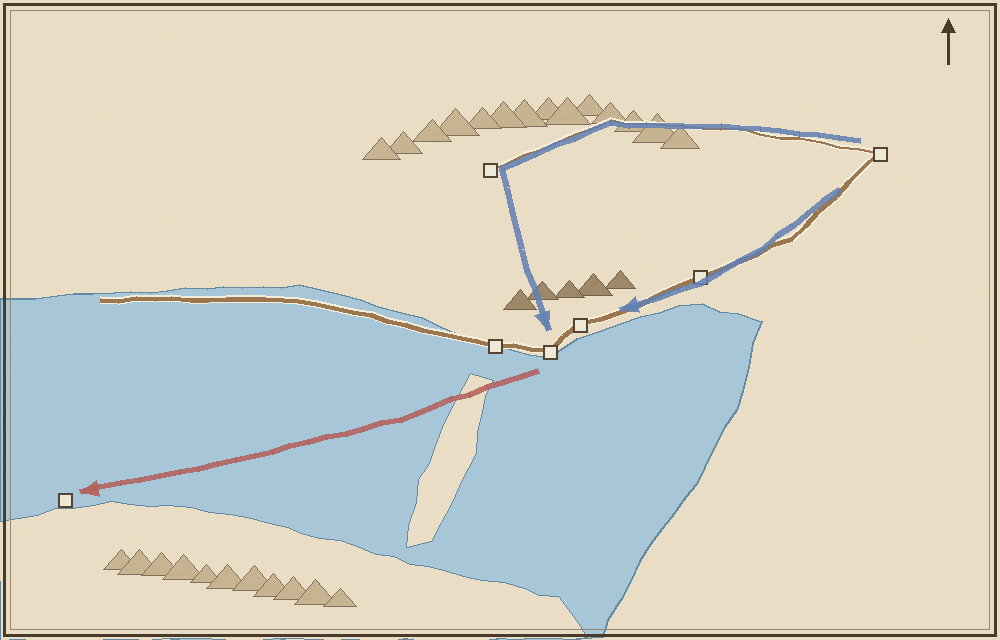 ICHINOTANI
Kyoto
Fukuhara
Koyano
Akashi
Mikusayama
Yashima
Tamba road
Awaji
Seto Inland Sea
Chinu Sea
Shikoku
Noriyori
Yoshitsune
Taira to Yashima
ICHINOTANI
Kyoto
Fukuhara
Koyano
Akashi
Mikusayama
Yashima
Tamba road
Awaji
Seto Inland Sea
Chinu Sea
Shikoku
Noriyori
Yoshitsune
Taira to Yashima
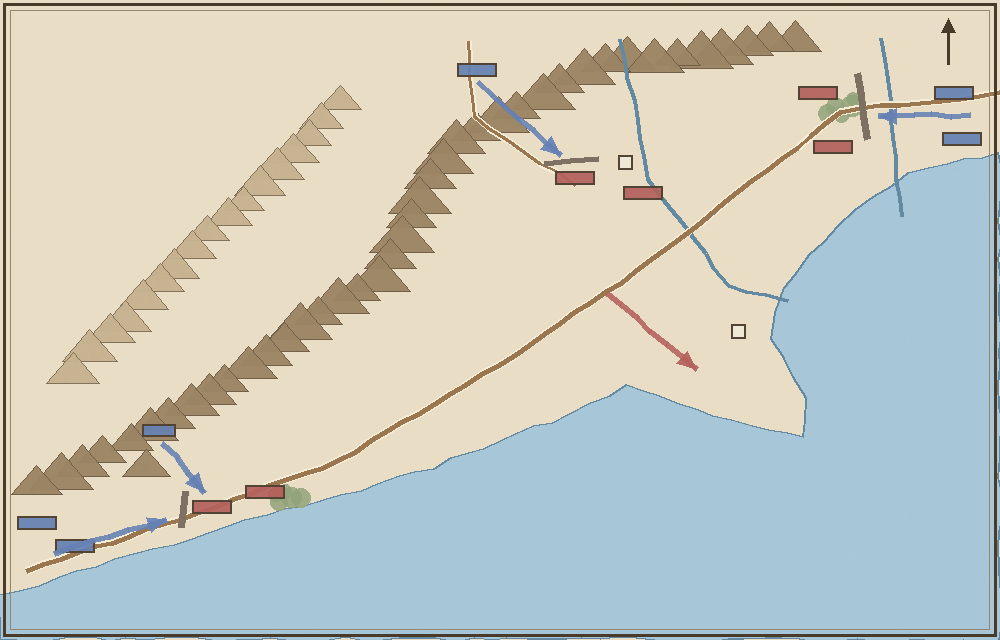 Ikuta Wood
Ichinotani
Yamanote
Fukuhara
Owada
Tekkaisan
Hiyodorigoe
Suma
Shioya
Ikuta R.
Minato R.
Noriyori
Yoshitsune
Tada
Yasuda, Doi, Kumagai
Taira ships
Ikuta Wood
Ichinotani
Yamanote
Fukuhara
Owada
Tekkaisan
Hiyodorigoe
Suma
Shioya
Ikuta R.
Minato R.
Noriyori
Yoshitsune
Tada
Yasuda, Doi, Kumagai
Taira ships