Battle of Bowang
202 · China Short
Liu Bei's Army — Cao Cao's Army · 8 turns · 42 units
Briefing
「賊無故退、疑必有伏。南道狹窄、草木深、不可追也」
"The enemy has withdrawn for no reason; there must be an ambush. The south road is narrow and the brush is deep. We must not pursue." -- Li Dian to Xiahou Dun, who meant to pursue (Records of the Three Kingdoms, Book of Wei, biography of Li Dian)
To pursue, or not to pursue: this board consists of that one question.
In the seventh year of Jian'an (AD 202) Liu Bei, then a guest of Liu Biao, marched north as far as Ye. Cao Cao sent Xiahou Dun to stop him, with Yu Jin and Li Dian. The two forces faced each other for a long time; then, one morning, Liu Bei set fire to his own camp and withdrew to the south. The board opens that morning, at six o'clock. Dun's camp lies in the north, the burnt camp south of it, and beyond that the hills close in on both sides, with a single road running down through the brush to Bowang.
In the brush on either side of that road wait eight units of Liu Bei's ambush. They are not hidden; Cao Cao's army can see them. The board asks whether you will go in all the same.
[The side that waits: Liu Bei's Army] 20 units; 8 may be moved each turn. The eight ambush units are standby troops and cannot move a single hex of their own accord. When an enemy comes adjacent to any of them, or attacks one, all eight wake together. They will not wait for ever: from Turn 3 they may also wake by chance at the start of the turn (34% on T3, 67% on T4, 100% on T5). Zhao Yun's rearguard stands just inside the mouth of the road. How far will you fall back, and where will you spring the trap?
[The side that follows: Cao Cao's Army] 22 units; 9 may be moved each turn. The Burnt Camp scores no points, but while you hold it you may move three more units each turn. That is the reason to follow, and it is also where you will come to a halt. Li Dian and the troops left in camp, eight units in all, are standby troops as well; they wake at the moment Liu Bei's ambush wakes. Unless the ambush is sprung, Li Dian does not move before Turn 6 (25% on T6, rising by 25% each turn).
[Points] The result is decided by a single margin. Margin = (points of objectives you hold - points of objectives the enemy holds) + (losses inflicted - losses suffered). The objectives are Bowang 25 and the South Road 15 (Liu Bei) and Cao Camp 20 (Cao Cao). If the margin, seen from Liu Bei's side, ends above the victory line (+14), Liu Bei wins; below it, Cao Cao wins. 6 points beyond the line is a tactical victory, 50 an operational victory, 100 an overwhelming victory. Within 6 points of the line the game is a draw.
[Names on the pieces] Liu Bei's Army: Liu Bei; Zhao Yun (rearguard); Guan Yu and Zhang Fei (the two wings of the ambush); Chen Dao; Mi Fang; Yuzhou, the men who had followed Liu Bei since Yu Province; Jingzhou, the troops added by Liu Biao. Cao Cao's Army: Xiahou Dun; Yu Jin; Li Dian; Xiahou Lan; Yanzhou, troops of Yan Province; Taishan, Yu Jin's men from Taishan; Chengshi, men of the district where Li Dian's clan and retainers lived; Yingchuan. Not on the board: Mi Zhu, Sun Qian and Jian Yong, Liu Bei's companions, of whom no record says that they led troops.
[Decisions to try] First, for Cao Cao's side: halt at the Burnt Camp, or enter the defile. If you enter, the ambush wakes, and so does Li Dian. Can Dun and Yu Jin hold in the defile for the two or three turns that Li Dian needs to arrive?
Second, for Liu Bei's side: withdraw the rearguard early and the enemy will come in deep, but the fifteen points of the South Road are then at risk. Hold it forward and the fight ends at the mouth of the road, where the ambush can reach only from the flank.
Third, for both: the ambush wakes when the enemy comes adjacent, or when its hour arrives. Which comes first decides where the pursuer is caught.
[What followed] Dun would not listen and pursued with Yu Jin. Li Dian stayed in camp. On the narrow road the ambush rose and the fight went badly. Li Dian came out to the rescue; Liu Bei, seeing the relief arrive, dispersed his men and withdrew. That day Zhao Yun took Xiahou Lan alive. They were from the same district and had known each other as boys. Yun begged for his life, recommended him as a man learned in the law, had him made a judge of the army, and thereafter kept him at a distance.
Liu Bei stayed at Xinye and Fan for six more years. He would call three times at a thatched cottage five years later. Cao Cao himself would come south in six.
"Withdrawn for no reason," said one man
"The road is narrow, the brush is deep," he said
The two who would not listen go into the defile
The one who spoke comes out to fetch them
The fire was lit by the side that withdrew
The Romance of the Three Kingdoms tells this battle as Zhuge Liang's first fire attack. In the histories it took place five years before Zhuge Liang appeared; the man who lit the fire was Liu Bei, and what he burned was his own camp. The histories do not name the officers who led the ambush: Guan Yu and Zhang Fei are placed on its wings as officers who served under Liu Bei at the time (an inference). The location of the field, the month, the day and the hour are not recorded either; the terrain and the clock of this board are estimates.
1 hex = 400 m, 1 turn = 1 hour, 1 CS = about 150 men. T1 = 06:00, Jian'an 7 (the morning the camp burned); T3 = 08:00 (the ambush may begin to wake by chance); T6 = 11:00 (Li Dian may begin to move by chance); T8 = 13:00.
Maps
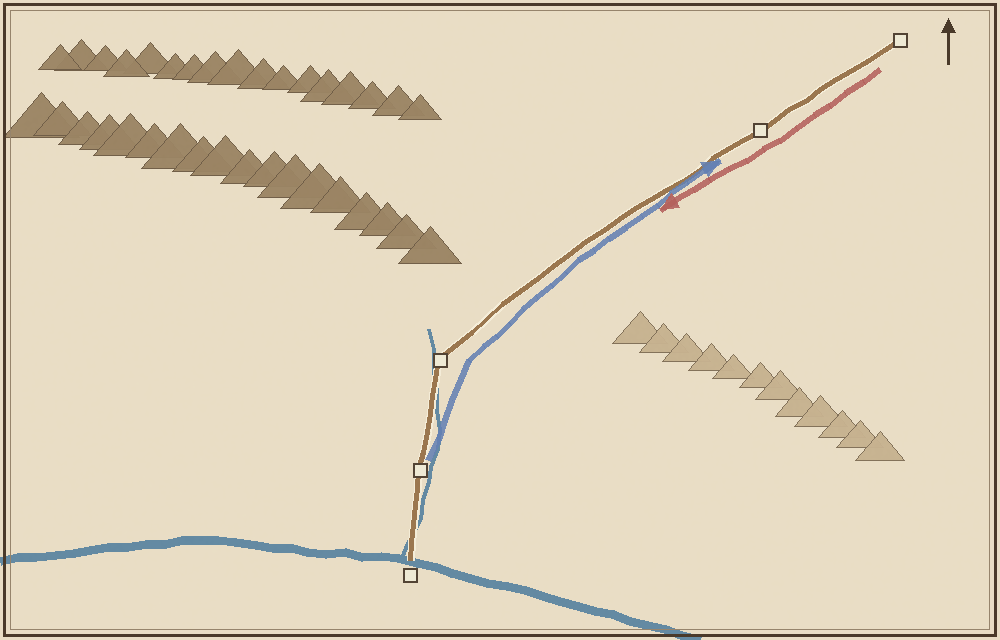 BOWANG
Xu (Cao Cao's capital)
Ye
Wan
Xinye (Liu Bei's base)
Xiangyang (Liu Biao)
Funiu Mts.
Han River
Liu Bei raids north, as far as Ye
Xiahou Dun and Yu Jin sent to stop him
BOWANG
Xu (Cao Cao's capital)
Ye
Wan
Xinye (Liu Bei's base)
Xiangyang (Liu Biao)
Funiu Mts.
Han River
Liu Bei raids north, as far as Ye
Xiahou Dun and Yu Jin sent to stop him
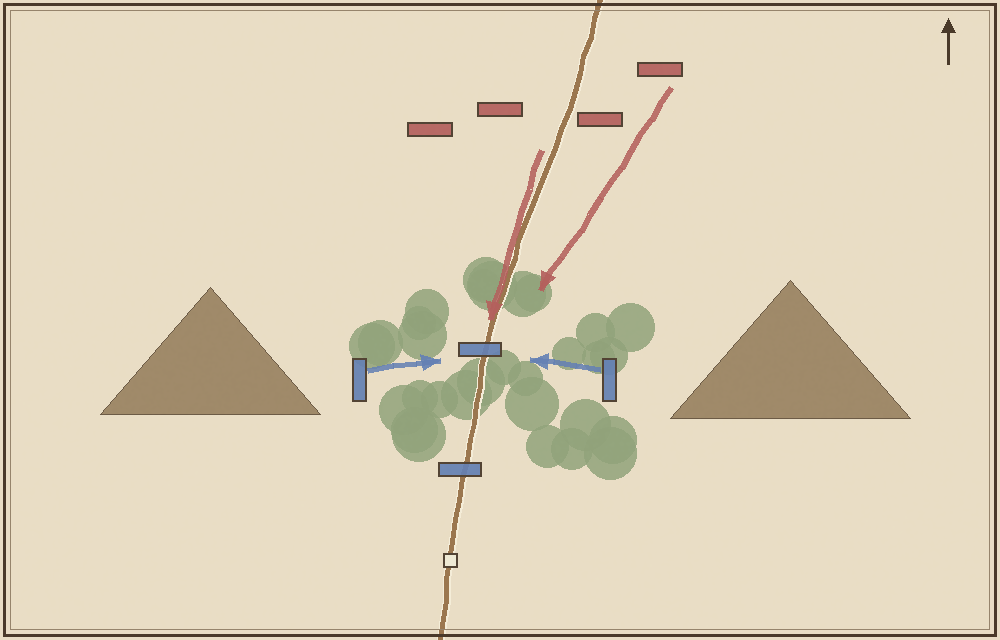 Bowang
Dun's camp (Li Dian stays behind)
Liu Bei burns his own camp
the south road: narrow, thick with brush
ambush
ambush
Dun and Yu Jin pursue
Li Dian comes to the rescue
to Wan and Xinye
to Ye and Xu
Bowang
Dun's camp (Li Dian stays behind)
Liu Bei burns his own camp
the south road: narrow, thick with brush
ambush
ambush
Dun and Yu Jin pursue
Li Dian comes to the rescue
to Wan and Xinye
to Ye and Xu