Battle of Rocroi 1643
1643 · Europe
19 May 1643 · The fields south-west of the town of Rocroi, Ardennes, French Republic
French Army (Duke of Enghien) — Spanish Army (Melo) · 12 turns · 49 units
AI personality: French Army (Duke of Enghien) Cautious / Spanish Army (Melo) Auto
See this battle in the battle list
The picture we hope to see
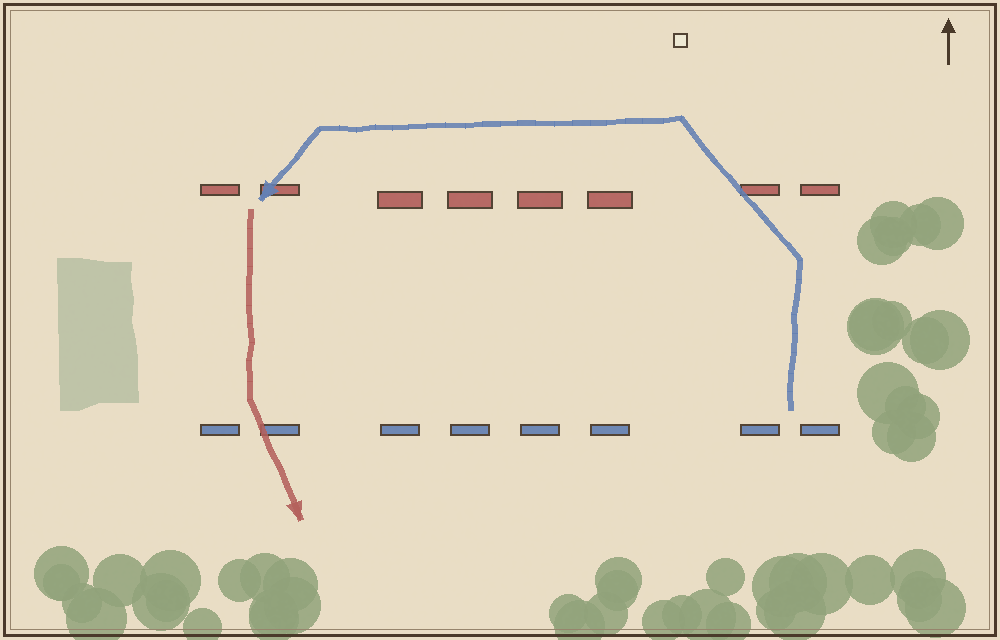
The victorious French cavalry does not pursue, but rides round behind the Spanish infantry.
Briefing
19 May 1643. The fields south-west of the town of Rocroi, Ardennes, French Republic
"That formidable infantry of the army of Spain, whose great close-packed battalions, like so many towers, but towers that could repair their own breaches, stood unshaken amid the rout of all the rest."
— Bossuet, Funeral Oration for the Prince of Condé (1687)
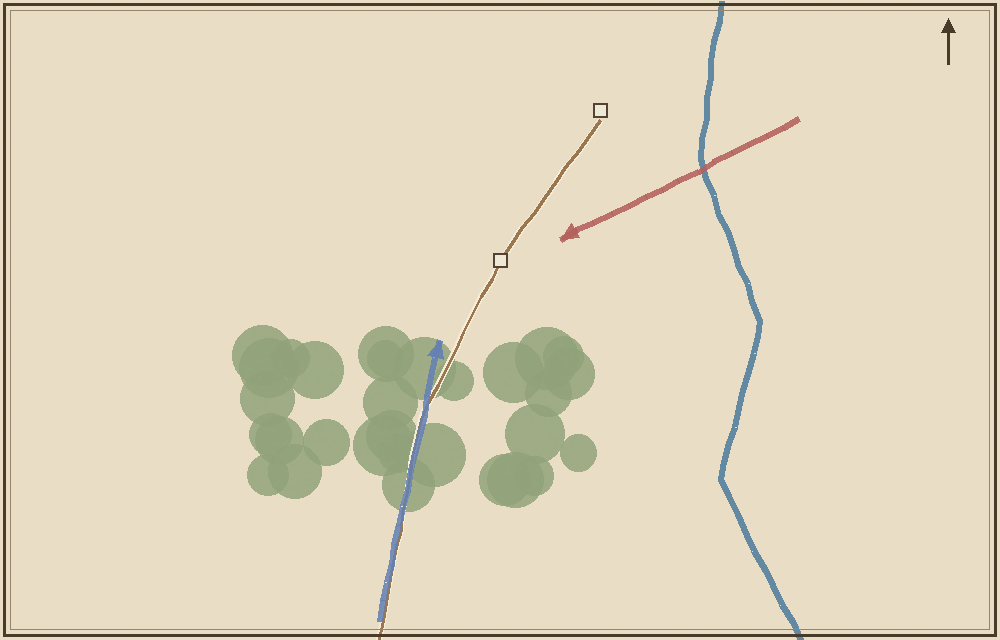
In May 1643 the army of Francisco de Melo, governor of the Spanish Netherlands, laid siege to the small Ardennes fortress of Rocroi. On 14 May King Louis XIII of France died. The relief came under the twenty-one-year-old Duke of Enghien, Louis de Bourbon, later known as the Great Condé. On the 18th the French came through a forest defile and formed on a low ridge south-west of the town; the Spaniards turned about with Rocroi at their backs. That night the two armies slept a few hundred metres apart. The last morning of the Spanish tercios, unbeaten in the field for a century, was about to break.
[How the French win] Take Rocroi (25 points) and the Spanish Camp (15 points), and hold the French Guns (15 points). The Plateau between the armies (10 points) belongs to neither side at the start. The horse of Enghien and Gassion on the right wing (Enghien, Gassion, La Moussaye, Croates) is the strongest cavalry on the board and can break Alburquerque's horse opposite. The victory line is -40: the French win if the score difference from their side is above -40. The French may activate 12 units per turn.
[How the Spanish win] Hold Rocroi and the Spanish Camp, and take the French Guns. The tercios in the centre (Villalba, Garcíez, Castelví, Velandia, Visconti, Strozzi) are the hardest infantry on the board, but slow. Isembourg's horse on the right wing (Isembourg, Alsace) is stronger than La Ferté's horse opposite. Beck's relief (Beck) arrives from the north edge on turn 11. The Spanish may activate 10 units per turn.
[Commanders] French: Louis de Bourbon, Duke of Enghien (Enghien, commander-in-chief) / Jean de Gassion (Gassion, horse of the right wing) / La Ferté-Senneterre (La Ferté, horse of the left wing) and Marshal de L'Hôpital (L'Hôpital) / d'Espenan (d'Espenan, the foot) / Baron de Sirot (Sirot, the reserve) / La Barre (La Barre, artillery) / the regiments of Picardie, La Marine, Piémont, Rambures and others, and the Swiss regiments of Molondin and Watteville.
Spanish: Francisco de Melo (Melo, governor and commander-in-chief) / the Count of Fontaine (Fontaine, the foot; old and carried in a chair) / the Duke of Alburquerque (Alburquerque, horse of the left wing) / the Count of Isembourg (Isembourg, horse of the right wing) / the Spanish tercios of Villalba, Garcíez, Castelví and Velandia, the Italian tercios of Visconti and Strozzi, the Walloon and Burgundian tercios, and the German regiments / Jean de Beck (Beck, the relief).
Not on the board: Louis XIII (who died five days before the battle) / the child Louis XIV and the regent Anne of Austria (in Paris) / most of the maestres de campo of the Spanish tercios.
[Decisions this board lets you try]
- (French) Let the victorious horse of the right wing pursue, or send it round behind the enemy foot?
- (French) How many times to throw yourself at the squares of the tercios?
- (Spanish) Use the victorious horse of the right wing to take the guns, or turn back to cover the foot?
- (Spanish) Can you hold until Beck's relief arrives?
[Outcome] Enghien's horse rode round behind the Spanish army and broke Isembourg's horse, which had reached the French guns, from the rear. Only the tercios of the centre remained. The Count of Fontaine was killed in his chair. Still in square, the tercios threw back three charges of French horse and foot, then asked for terms. As Enghien rode forward to accept, a volley rang out in the confusion, and the enraged French burst into the squares. Most of the Spanish foot were killed or taken. Rocroi was relieved, and the name of the twenty-one-year-old Enghien spread across Europe.
Through the forest defile, a duke of twenty-one formed on the ridge
The victorious horse did not pursue, but rode round behind the enemy
The old general was killed in his chair
The squares stood like towers and threw back three charges
At the very moment of surrender, a volley rang out
It was the last morning of an infantry unbeaten for a hundred years
Strengths: about 23,000 French and 27,000 Spanish (estimates vary). The positions of the armies and the extent of the marsh and woods are approximate. The Spanish Camp combines the siege lines and the baggage. Beck's relief in fact arrived after the battle was over. Regiment and colonel names are from memory (the author has yet to check them against sources).
1 hex = 150 m, 1 turn = 30 minutes, 1 CS = about 500 men. T1 = 04:30, T12 = 10:00.
Maps
 ROCROI
to Paris
Spanish Netherlands
Meuse
Enghien comes through the forest defile
Beck's relief (too late)
 ROCROI
the Spanish tercios (squares)
Enghien and Gassion break the left wing horse
rides round behind the enemy foot
Isembourg reaches the French guns
Sirot's reserve
marsh