The Six Days' Campaign
1814 · Europe Long
French Army — Allies (Army of Silesia) · 15 turns · 68 units
Briefing
« J'ai retrouvé mes bottes d'Italie. »
"I have found my Italian boots again." -- Napoleon is said to have spoken these words in February 1814. They recall the campaign of eighteen years before, when, as a commander of twenty-six, he had struck down an enemy advancing in separate columns, one column at a time.
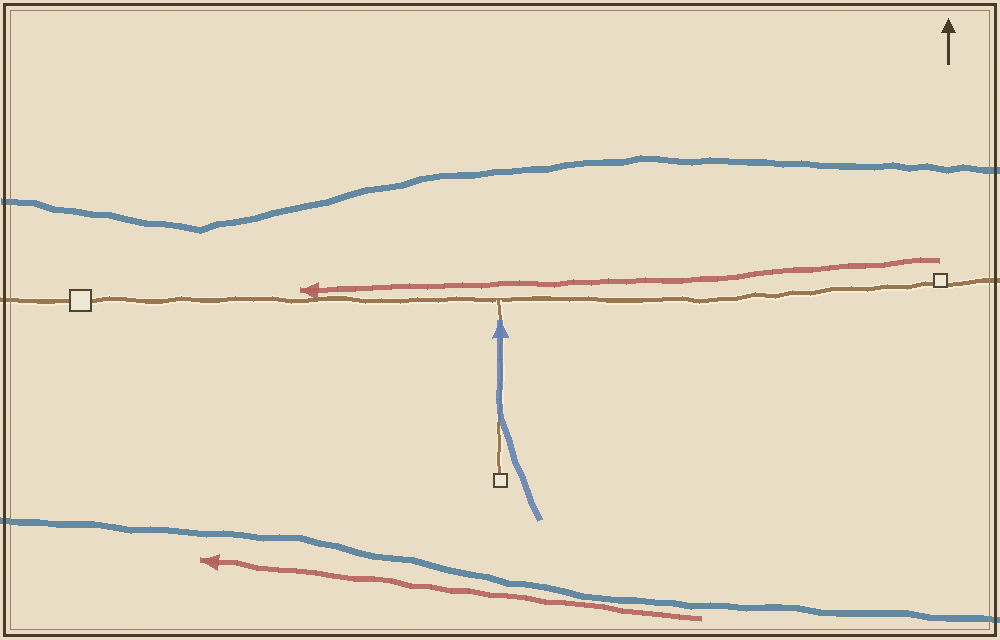
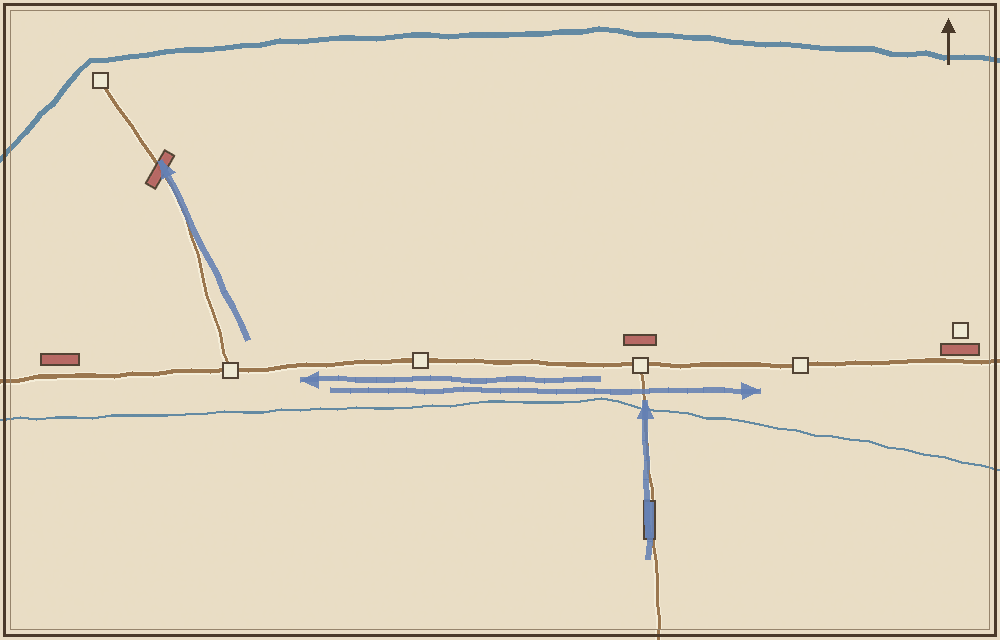
February 1814. France has been invaded from the east. In their haste to reach Paris, the fifty thousand and more of Blücher's Army of Silesia had become strung out in four parts along a single road south of the Marne. At the western head was Sacken's Russian corps; north of it, along the Marne, Yorck's Prussian corps; in the middle, at Champaubert, Olsufiev's small corps; and in the east, at Vertus, Blücher himself with Kleist and Kaptzevich. Each lay a day's march from the next.
Napoleon had only thirty thousand men. But those thirty thousand were gathered in one body on the road that runs north from Sézanne, heading through the winter mud for the middle of the Allied road.
[How to win] The result is decided by a single margin. Margin = (points of objectives you hold - points of objectives the enemy holds) + (losses inflicted - losses suffered). There are eight objectives worth 150 points: Montmirail 30, Champaubert 25, Château-Thierry 25, Étoges 20, Vauchamps 15, Vertus 15, Fromentières 10, Épernay 10. The Allies start with 95 points; Montmirail, Vauchamps and Fromentières belong to no one. If the margin seen from the French side ends above the victory line (-25 points), France wins; below it, the Allies win. Finish 12 points beyond the line for a tactical victory, 93 for an operational victory, and 187 for a strategic victory. Short of 12, it is a draw. Objectives alone will not get you there: this is a board on which you crush a divided enemy one part at a time and earn the margin in losses.
[The army that does not wake] Blücher's main body at Vertus (Kleist's Prussian II Corps and Kaptzevich's Russian X Corps) is on standby. It wakes on the morning of 13 February (turn 9), or on the spot if attacked. Whether the three bodies to the west can be dealt with before then is the whole of this board.
[Reinforcements] On the morning of 14 February (turn 12), Leval's division, brought from Spain, arrives on the southern edge by the Le Gault road.
[Counters that can move at once] France: twenty. Allies: fourteen, with six more on turn 9 (the main body wakes). A turn is four hours of daylight; the nights are skipped. In the winter mud, infantry can march only four hexes a turn.
[Commanders] France: Napoleon = Napoleon, Marmont = Marmont (VI Corps: Ricard, Lagrange), Ney = Ney (Young Guard: Meunier, Curial), Mortier = Mortier (Old Guard: Friant, Michel), Drouot = Drouot (Guard artillery), Nansouty = Nansouty (Guard cavalry: Colbert, Laferrière, Lefebvre-Desnouettes, Defrance, Guyot), Grouchy = Grouchy (cavalry: Saint-Germain, Bordesoulle), Doumerc = Doumerc, Leval = Leval.
Allies: Bluecher = Blücher, Olsufiev = Olsufiev (Russian IX Corps: Udom, Kornilov), Sacken = Osten-Sacken (Lieven, Talisin, Vasilchikov's cavalry), Yorck = Yorck (Prussian I Corps: Pirch, Horn, Prince Karl, Prince Wilhelm, Jürgass), Kleist = Kleist (Prussian II Corps: Pirch II, Zieten, Prince August, Röder), Kaptzevich = Kaptzevich (Russian X Corps: Urusov, Turchaninov).
[Decisions this board lets you test] First (France): in what order do you strike? Historically it was the middle (Champaubert), the west (Montmirail), the north (Château-Thierry) and the east (Vauchamps). Take the middle first, and the other three cannot come to one another's aid.
Second (France): how far do you pursue a beaten enemy? Pursuit earns losses, but every step of it takes you further from the next enemy.
Third (Allies): where do you gather a scattered army? The only ways out are the two ends of the one road and the Marne bridges to the north.
[Outcome] On 10 February, at Champaubert, Olsufiev's corps was destroyed and he himself taken prisoner. On the 11th Napoleon turned west and beat Sacken and Yorck at Montmirail, and on the 12th he followed them to Château-Thierry and drove them over the Marne. On the 13th Blücher, at last on the move, came west. On the 14th, at Vauchamps, Marmont and Grouchy's cavalry met him and kept cutting at the Prussians, retreating in square, until evening. Four victories in six days: the Allies lost more than 17,000 men in battle, the French 3,400.
But at the same time, to the south, Schwarzenberg's Army of Bohemia was nearing Paris along the Seine. Napoleon had to hurry back south. Six weeks later Paris fell, and on 6 April the Emperor abdicated.
Four armies strung out on one road
Thirty thousand come out into the middle
The tenth, the eleventh, the twelfth
The main body, slow to wake, on the fourteenth
The Italian boots, found again
And then, six weeks
The pursuit after 15 February and the fighting against Schwarzenberg's army (Mormant, Montereau) lie off the board. French divisions and Allied divisions and brigades are grouped into one or two counters each; cavalry is one counter per division.
1 hex = 1.2 km, 1 turn = 4 hours of daylight, 1 CS = about 1,000 men. T1 = 10 Feb 08:00 (Champaubert), T4 = 11 Feb 08:00 (Montmirail), T7 = 12 Feb 08:00 (Château-Thierry), T9 = 13 Feb 08:00 (Blücher wakes), T11 = 14 Feb 08:00 (Vauchamps), T14 = 15 Feb 08:00, T15 = 15 Feb 12:00.
Maps
 THE SIX DAYS
to Paris
Marne
Seine
Châlons
Sézanne (Napoleon turns north)
Schwarzenberg (Army of Bohemia)
THE SIX DAYS
to Paris
Marne
Seine
Châlons
Sézanne (Napoleon turns north)
Schwarzenberg (Army of Bohemia)
 Champaubert (10 Feb.)
Montmirail (11 Feb.)
Château-Thierry (12 Feb.)
Vauchamps (14 Feb.)
Étoges
Vertus (Blücher)
One road (the Allies strung out in four)
Marne
Champaubert (10 Feb.)
Montmirail (11 Feb.)
Château-Thierry (12 Feb.)
Vauchamps (14 Feb.)
Étoges
Vertus (Blücher)
One road (the Allies strung out in four)
Marne