Battle of Culloden 1746
1746 · Europe
16 April 1746 · Culloden Moor (Drummossie Moor), east of Inverness, the Highlands, Scotland, United Kingdom
Jacobite Army — Government Army · 10 turns · 50 units
AI personality: Jacobite Army Manoeuvre / Government Army Cautious
See this battle in the battle list
The picture we hope to see
Bombarded on the wet moor, the Jacobites charge without coordination and are stopped by the government's line of bayonets.
Briefing
16 April 1746. Culloden Moor (Drummossie Moor), east of Inverness, the Highlands, Scotland, United Kingdom
...strike at a swelling or bulge in the fallen tent.
(Lord George Murray, in his instructions for the night attack of the evening before; recorded)
Can men who walked all night and took nothing fight a battle by day?
On the night of 15 April the Highland army set out to attack the government camp at Nairn. Lord George Murray called it off on the way, and the men marched back, hungry and tired. On the morning of the 16th the Duke of Cumberland's army broke camp at five, and by ten it could be seen four kilometres away. The Jacobites formed their line on Drummossie Moor, the ground O'Sullivan had chosen. Lord George Murray said it favoured the government, proposed another site, and was overruled. It is open, wet ground, good for guns and cavalry and poor for an army that walks in and cuts. Against five or six thousand Jacobites stand about seven thousand of the government.
[How the Jacobites win] Break the government line. The right (Murray, Lochiel, Appin) runs through canister to reach the government left (Barrell 4th, Dejean 37th). The MacDonalds on the left (Keppoch, Clanranald, Glengarry) are slowed by the bog in front and by the guns. Put the French-style regiments of the second line (Royal Ecossais, Irish Picquets) in where the line has begun to give. The gun line (15 points), Leanach (15) and the baggage (10) are the targets. The victory line is 10: a Jacobite score margin above 10 is a win.
[How the Government wins] Hold the line, fire, and when the charge comes swing the second line in from the side. Huske's second line (Sempill, Conway, Wolfe) can reach the flank of the Jacobite right. Hold Culloden House (20) and the Inverness road (10), and cut off the fleeing with the horse (Cobham, Kerr). The guns (Belford Artillery) have range 2 and change to canister just before the charge.
[Commanders] Jacobites: Charles Edward Stuart (Prince Charles) / Lord George Murray (Murray, right wing) / Lord John Drummond (centre) / the Duke of Perth (left, nominal) / Sullivan (chief of staff) / Finlayson (guns, Finlayson) / Lochiel (Lochiel, Camerons) / Keppoch (Keppoch) / Clanranald (Clanranald) / Glengarry (Glengarry) / Lovat (Lovat, Frasers) / Lady Mackintosh's regiment (Mackintosh) / the Atholl Brigade (Murray) / Stewart of Appin (Appin) / Royal Ecossais (Royal Ecossais) / the Irish Picquets (Irish).
Government: the Duke of Cumberland (Cumberland) / Albemarle (first line, division) / Huske (second line, division) / Sempill (Sempill, Fourth Brigade) / Mordaunt (reserve) / Bland (advance guard, horse) / Belford (guns, Belford) / John Campbell (Argyll, the Highland battalion) / the 4th and 37th regiments (Barrell, Dejean, who took the charge).
Not on the board as pieces: Lord Robert Kerr (government, killed) / Murray's alternative site near Daviot Castle / Sir Robert Rich (government, badly wounded).
[Decisions this board lets you try]
- (Jacobites) Do you send the right first, or the whole line at once? Do you wait for the left to struggle through the bog, or hit with the right alone?
- (Jacobites) When do you bring the second line forward? Too early and it is a target for canister; too late and the line splits.
- (Government) Do you leave everything to the guns, or put a moment on the second line swinging in from the side?
- (Government) When do you send the horse in pursuit? Sent early, it becomes a target for the charge.
[Outcome] After the guns had traded fire, the Jacobites advanced. The government guns changed to canister. On the right the Atholl men, Lochiel's and Appin's ran into the line of the 4th and 37th, mixed with the men of Mackintosh and Lovat, and many of their leaders fell. On the left the MacDonalds were slowed by the bog and the guns, fired only from a distance and lost their leaders. Huske's second line struck the right as it began to give, and the first line broke. Cobham's dragoons met the Irish Picquets in the bog. Charles was led from the field, and Bland's horse cut off the retreat of the Highland left. Fifteen hundred to two thousand Jacobites were killed or wounded, many in the pursuit, and 376 were taken. The government lost about 50 killed and 259 wounded. The Lowland regiments fell back on Ruthven Barracks, the Highlanders towards Fort Augustus. Charles ordered the army to disperse, and by the 18th most of it had gone. He wandered among the islands all summer, sailed to France in September, and never came back to Scotland. About 3,471 prisoners were taken, about 120 were executed and about 1,200 transported. From that day the Jacobites were finished as a political force.
They walked all night and came back with nothing
They drew up a line on the wet moor
The right ran through the canister
The left was caught in the bog
In an hour the defeat was settled
Charles never came back
A government regiment is one piece, and a clan force of a few hundred is one or two. The quality of the clan regiments (the charge) is carried in CS. The sources differ on numbers (Jacobites 5,000–6,000, government 6,900–7,200). The night attack, the morning march, and the movements of the Argyll militia and the walls are not on the board.
1 hex = 80 m, 1 turn = 10 minutes, 1 CS = about 100 men. T1 = 16 April 13:30, T4 = 14:00, T10 = 15:00.
Maps
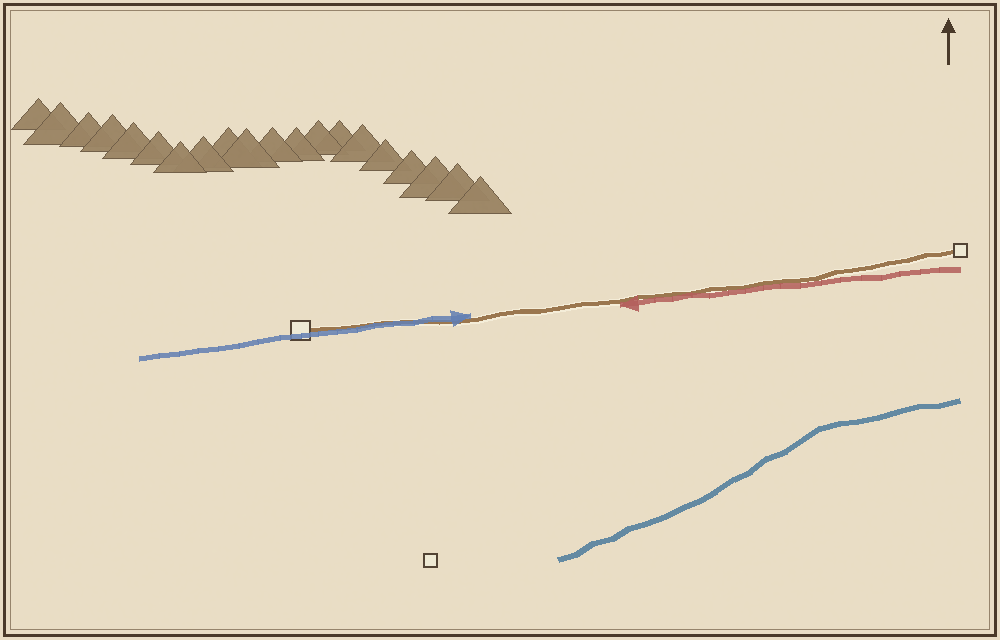 CULLODEN
Inverness
Nairn (where the government army came from)
the Highlands
Fort Augustus (where the Highlanders withdrew)
Ruthven Barracks (where the Lowlanders withdrew)
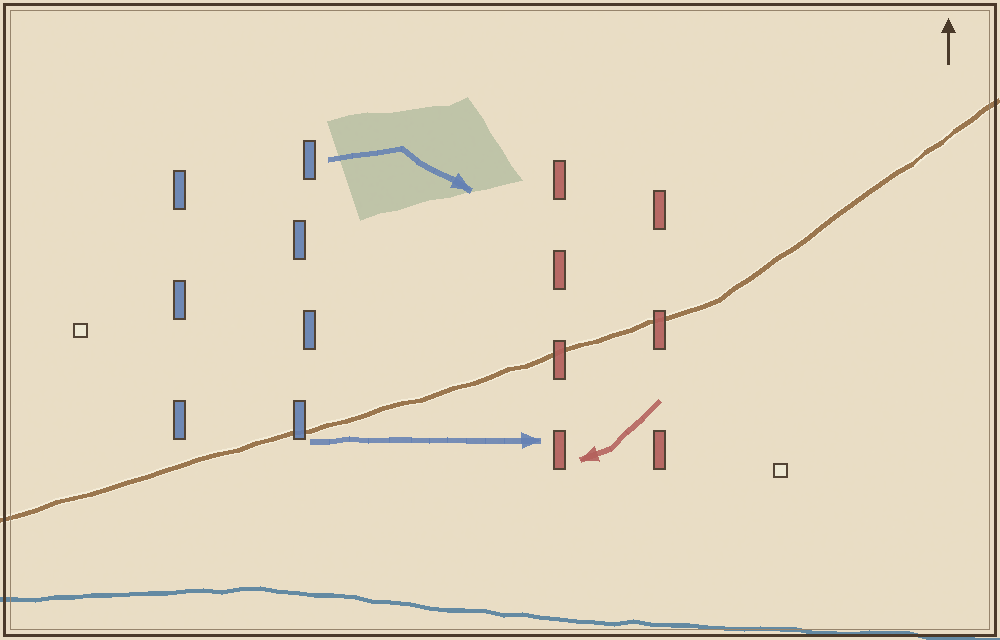 government guns (canister)
Culloden House (headquarters until the night before)
Leanach (field hospital)
bog (slows the Jacobite left)
the Highland charge (right)
Culwhiniac enclosure walls
Culloden Park wall
the second line swings in from the side (Huske)
River Nairn
Charles Edward Stuart (led from the field)
Drummossie Moor