Battle of Crécy
1346 · Europe Medium
French Army — English Army · 10 turns · 53 units
Briefing
Laissez l'enfant gagner ses éperons.
"Let the boy win his spurs." (Edward III, to the messenger who came from the Prince's division asking for help; Froissart, Chronicles, in modern French)
The slope runs two kilometres, from the village of Crécy to the village of Wadicourt. On it stand the three English divisions, on foot, their horses sent back to the wagon laager behind them.
At five in the afternoon of 26 August a short thunderstorm clears, and the evening sun shines from the valley side. At the bottom of the valley (the Vallée des Clercs) the Genoese crossbowmen form up, and behind them the knights of the Count of Alençon, the King's brother, catch up. The main French army is still on the road; when the head halts, the rear keeps coming. From T2 to T6 companies of knights arrive in column from the east and south edges. Whoever arrives has little choice but to climb.
[How the French win] You may activate 9 units per turn. From the slope band (rough, defence x2) and the pits dug in front of the dismounted men-at-arms (entrenchments), longbows with range 2 shoot down at you. Your target is the Prince (Edward Pr. of Wales). This sixteen-year-old is a sudden-death unit: destroy him and the French win at once. Taking any of the Windmill (30 points), Crécy (20), Wadicourt (20) or the Wagon Laager (10) also narrows the score. The victory line is -77: if the French score margin ends above -77, you have done better than history.
[How the English win] You may activate 10 units per turn. If you do not come down the slope, the bows and the terraces protect you. The real question is on the right. When the Prince's division is pressed, do you send the reserve at the Windmill (Edward III's division)? The historical King did not.
[Commanders] England: Edward III / Edward, Prince of Wales (Edward Pr. of Wales; later called the Black Prince) / Thomas Beauchamp, Earl of Warwick (Warwick; Marshal) / John de Vere, Earl of Oxford (Oxford) / Godfrey d'Harcourt (Harcourt Godfrey) / John Chandos (Chandos) / Reginald Cobham (Cobham) / William de Bohun, Earl of Northampton (Northampton; Constable) / Richard FitzAlan, Earl of Arundel (Arundel) / Robert Ufford, Earl of Suffolk (Suffolk) / Thomas Hatfield, Bishop of Durham (Hatfield) / Roger Mortimer (Mortimer). Present but not on the board: Walter Manny, Bartholomew Burghersh.
France: Philip VI / Charles, Count of Alençon (Alencon) / Louis de Nevers, Count of Flanders (Flanders) / Louis, Count of Blois (Blois) / John IV, Count of Harcourt (Harcourt Count; Godfrey's elder brother) / John, King of Bohemia (Bohemia; blind) / his son Charles, King of the Romans (Charles) / Raoul, Duke of Lorraine (Lorraine) / John of Hainault, Lord of Beaumont (Hainault) / James III, King of Majorca (Majorca) / Peter, Duke of Bourbon (Bourbon) / the Counts of Aumale (Aumale), Sancerre (Sancerre), Auxerre (Auxerre) and Salm (Salm) / the Genoese captains Ottone Doria (Doria) and Carlo Grimaldi (Grimaldi). The King's heir, John, Duke of Normandy, was far to the south-west at Aiguillon that day.
[Decisions this board lets you try]
- Do you send the Genoese forward? Their strings were wet from the rain and their pavises were left in the baggage (strength 1 to 2). In front, they also block the road for the knights coming up behind.
- Do you hold the arriving knights in the valley until they are assembled? You have only 9 activations, and waiting brings nightfall.
- (English) When the right is pressed, does the King commit the reserve? If he does, the Windmill stands empty.
[Outcome] The charges went on until midnight, fifteen or sixteen of them. The blind King of Bohemia had the knights on either side tie their reins to his horse and rode up the slope; the next morning they were found lying together, the horses still tied. Philip VI had two horses shot under him and was led off the field by John of Hainault, holding his bridle. That night, Froissart writes, he knocked at the gate of the castle of La Broye and called out that it was the unfortunate King of France. The King's brother Alençon, the Count of Flanders, the Duke of Lorraine, the Count of Blois and many lords and knights remained at the foot of the slope; English losses were slight. Edward marched on northward and the next month laid siege to Calais, which for more than two hundred years would be a town of the King across the sea. It is also told that the Bohemian King's ostrich feathers and his motto "Ich dien" passed to the young Prince on that day (tradition).
The rain cleared, and the crossbows lined the valley
The knights climbed the slope in the order they arrived
The blind king climbed with his reins tied
The King did not send the reserve
The boy won his spurs
For two hundred years Calais became a town across the sea
Of the French host (20,000 to 30,000), only those who reached the foot of the slope before night are on the board. The town militias, some of whom arrived and were routed the next morning, are folded into the T6 arrivals. The battlefield follows the traditional location (the slope north-east of Crécy). The pits in front of the English appear in only some chronicles, so they are placed in five men-at-arms hexes only.
1 hex = 100 m, 1 turn = 30 minutes, 1 CS = about 250 men. T1 = 26 August 17:00, T7 = 20:00 (about sunset), T10 = 21:30.
Maps
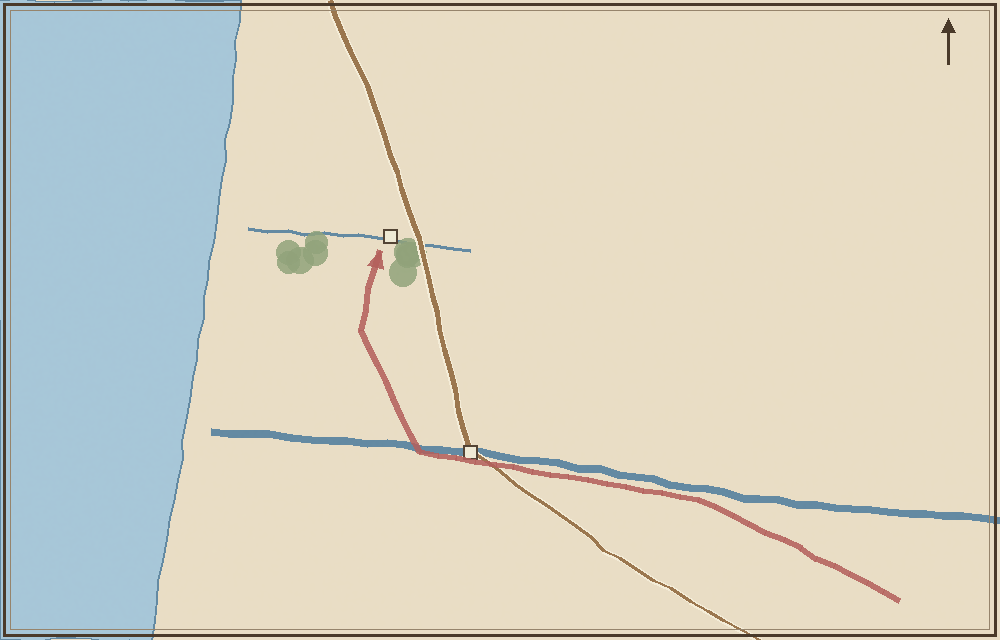 CRÉCY
Abbeville
River Somme
Blanchetaque ford
to Calais
to Paris
English Channel
English march (July-August)
County of Ponthieu
CRÉCY
Abbeville
River Somme
Blanchetaque ford
to Calais
to Paris
English Channel
English march (July-August)
County of Ponthieu
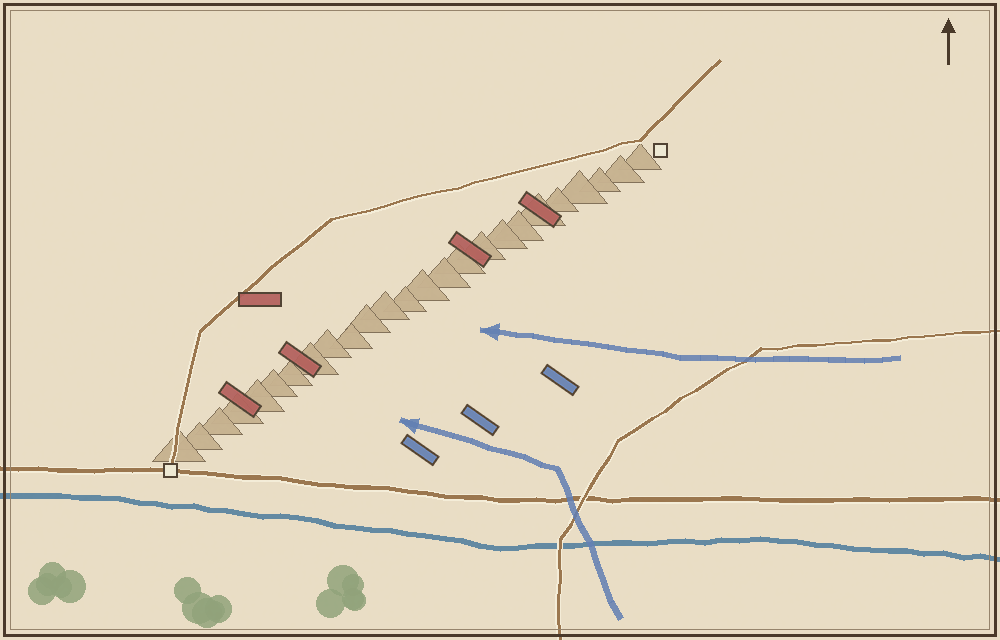 Crécy
Wadicourt
Windmill (Edward III)
Wagon laager
Vallée des Clercs
River Maye
Forest of Crécy
1st battle (the Prince)
2nd battle (Northampton)
Genoese crossbowmen
charging as they arrive
to Abbeville
Crécy
Wadicourt
Windmill (Edward III)
Wagon laager
Vallée des Clercs
River Maye
Forest of Crécy
1st battle (the Prince)
2nd battle (Northampton)
Genoese crossbowmen
charging as they arrive
to Abbeville