Battle of Mukden 1905
1905 · Japan
8–10 March 1905 · The country between the Hun and the Pu rivers, Shenyang (then Mukden), Liaoning Province, People's Republic of China
Japanese Army (Manchurian Army) — Russian Army (Manchurian Army) · 10 turns · 38 units
AI personality: Japanese Army (Manchurian Army) Auto / Russian Army (Manchurian Army) Aggressive
See this battle in the battle list
Briefing
8–10 March 1905. The country between the Hun and the Pu rivers, Shenyang (then Mukden), Liaoning Province, People's Republic of China
"For the first time in this war, I saw a rout."
— Anton Denikin, The Career of a Tsarist Officer
From the end of February some six hundred thousand men of both armies had been locked together along a front of a hundred kilometres south of Mukden. Nogi's Third Army, fresh from the fall of Port Arthur, swung wide round the western end and reached north towards the railway behind the city. Kuropatkin sent his reserves west and then east, and on the night of 7 March drew his eastern and central armies back to the line of the Hun. Mukden became the bottom of a sack, and the mouth of the sack was a single passage to the north: the railway and the Mandarin Road to Tieling. The battlefield was Chinese soil; both armies turned the mud-walled villages of a neutral country into fortresses.
[How the Japanese win] Mukden (30 points), Mukden Station (15 points), Wenguantun (15 points) and Beiling (10 points) are Russian at the start. Each one taken scores, and every Russian unit destroyed scores its combat strength. In the west stand the Third Army (Nogi's 9th, 7th and 1st Divisions) and the Second Army (Oku's 3rd, 8th, 4th and 5th Divisions, Akiyama's cavalry); in the south, beyond the Hun, the Fourth Army (Okubo, Ando); in the east, the First Army (Asada, Nishijima, Inoue, Umezawa). The Yalu Army (Samejima's 11th Division and others) arrives from the east edge on turns 2–3. The Japanese may activate 12 units per turn; worn out, they lose 4 from turn 9 (the morning of 10 March). The victory line is -44: the Japanese win if the score difference from their side is above -44.
[How the Russians win] Every unit that leaves the board by the exits on the north edge (the railway and the Mandarin Road to Tieling) scores 10 points per point of combat strength (up to 27 points in all). Objectives still held at the end also score. But if on the last turn every exit hex lies in a Japanese zone of control, the units that left count as destroyed. The Russians may activate 10 units per turn, and 4 more from turn 7 (the evening of 9 March), when the order to retreat is given. At night (turns 4 and 8) there is no combat, and units may leave enemy zones of control.
[Commanders] Japanese: Ōyama Iwao (commander-in-chief, Manchurian Army) and Kodama Gentarō (chief of staff) / Nogi Maresuke (Third Army) / Oku Yasukata (Second Army) / Nozu Michitsura (Fourth Army) / Kuroki Tamemoto (First Army) / Kawamura Kageaki (Yalu Army) / Ōshima Hisanao (Oshima H., 9th Division), Ōsako Naotoshi (Osako, 7th Division), Iida Shunsuke (Iida, 1st Division) / Akiyama Yoshifuru (Akiyama, 1st Cavalry Brigade), Ōshima Yoshimasa (Oshima Y., 3rd Division), Tatsumi Naofumi (Tatsumi, 8th Division), Tsukamoto Katsuyoshi (Tsukamoto, 4th Division), Kigoshi Yasutsuna (Kigoshi, 5th Division) / Ōkubo Haruno (Okubo, 6th Division), Andō Sadayoshi (Ando, 10th Division) / Asada Nobuoki (Asada, Guards Division), Nishijima Sukeyoshi (Nishijima, 2nd Division), Inoue Hikaru (Inoue, 12th Division), Umezawa Michiharu (Umezawa, Guards Reserve Brigade) / Samejima Shigeo (Samejima, 11th Division).
Russians: Alexei Kuropatkin (commander-in-chief) / Alexander Kaulbars (2nd Manchurian Army) / Alexander Bilderling (3rd Manchurian Army) / Nikolai Linevich (1st Manchurian Army) / Gerngross (I Siberian Corps), Mylov (VIII Corps), Tserpitsky (X Corps), Kutnevich (Composite Corps) / Topornin (XVI Corps) / Dembovsky (V Siberian Corps), Selivanov (XVII Corps), Sobolev (VI Siberian Corps) / Alekseev (the Hun detachment), Zarubaev (IV Siberian Corps).
Not on the board: Ōyama, Kodama, the five Japanese army commanders, Kuropatkin and the three Manchurian army commanders (headquarters are not made fighting units; their names live on in the colours of each army's counters and in this list) / the main body of the 1st Manchurian Army (which withdrew separately, east by way of Fushun).
[Decisions this board lets you try]
- (Japanese) Race to close the mouth in the north, or take Mukden first?
- (Japanese) Where to spend your activations in the two days before exhaustion sets in?
- (Russians) When to give up Mukden? Do you start moving before the order to retreat?
- (Russians) Whom to leave as the rearguard, and whom to send ahead to Tieling?
[Outcome] On 9 March Kuroki's First Army broke the line of the Hun at Kiuzan, and the mouth of the sack narrowed from the east as well. Under a wild sky, smoke from burning supplies hung over the field. At 18:45 Kuropatkin ordered a general retreat on Tieling. Through the night two Manchurian armies streamed north along the railway and the Mandarin Road under fire from both sides. The rearguards broke, and the retreat became a rout. At 10:00 on 10 March the Japanese entered an empty Mukden. Russian losses were about ninety thousand, more than twenty thousand of them prisoners, most taken in the last two days. Japanese losses exceeded seventy thousand, and no strength was left for pursuit. The mouth of the sack never closed. Kuropatkin was relieved of command, and the war ended in September at Portsmouth.
An army come from Port Arthur swung north round the western end
At every mud-walled village the firing flared
At the bottom of the sack a city was left behind
At dusk the order to fall back came at last
Down the railway and the road a river of men flowed north
In the morning the gates of an empty city opened
Strengths: about 250,000 Japanese and 300,000 Russians (at the start of the battle). This board takes only the last three days; for the Russians it shows the 2nd and 3rd Manchurian Armies inside the sack and the right wing of the 1st Manchurian Army on the upper Hun. Each corps is shown as two units. The Hun and the Pu were frozen and no obstacle, so they are not drawn as river lines. The positions of villages and lines, and the assignment and placing of divisions, are approximate, and some division commanders' names are from memory (the author has yet to check them against sources).
1 hex = 1.5 km, 1 turn = 6 hours, 1 CS = about 3,000 men. T1 = 8 March 06:00, T4 = 9 March 00:00 (night), T7 = 9 March 18:00, T8 = 10 March 00:00 (night), T10 = 10 March 12:00.
Maps
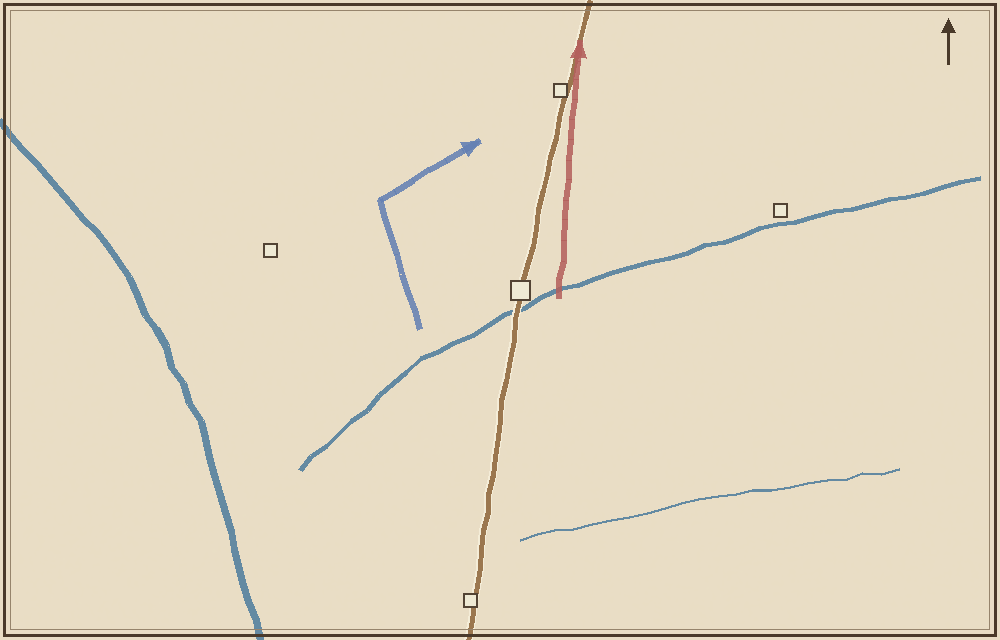 MUKDEN
Tieling (where the Russians withdrew)
Liaoyang
Fushun
Xinmintun
Shaho (the winter front)
Liao River
Third Army (Nogi)
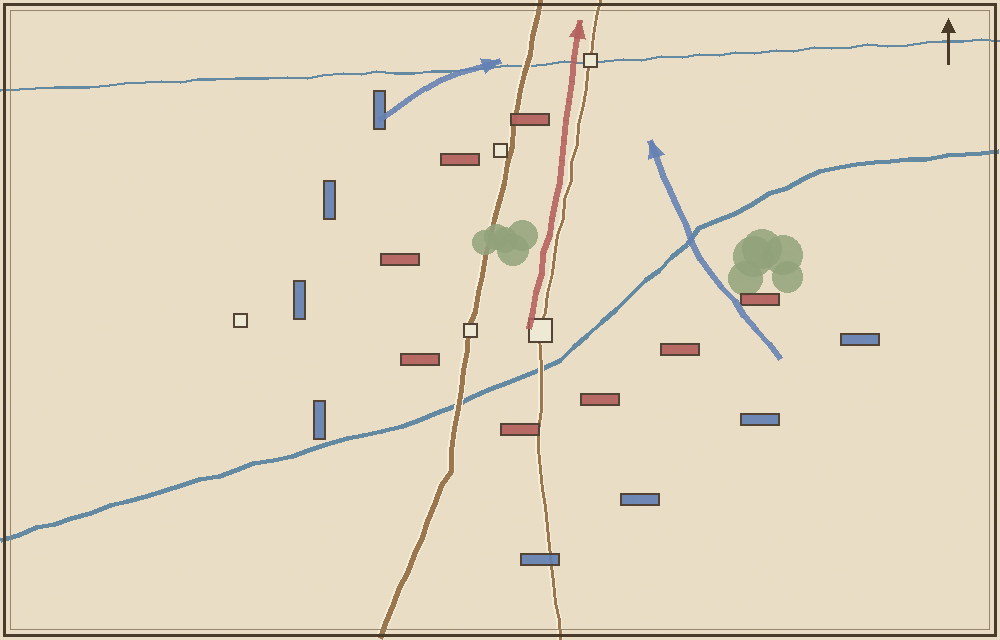 Mukden
 Station
Beiling
Dongling
Wenguantun
Tieling (where the Russians withdrew)
Hun River (frozen)
Pu River
Third Army (Nogi)
Second Army (Oku)
Fourth Army (Nozu)
First Army (Kuroki)
2nd and 3rd Manchurian Armies (in the pocket)
Kiuzan (Hun broken, 9 March)