Battle of Bannockburn 1314
1314 · Europe
23–24 June 1314 · Between the Bannock Burn and the New Park, near Stirling, Scotland, United Kingdom
Scots — English · 14 turns · 75 units
AI personality: Scots Auto / English Steady
See this battle in the battle list
Briefing
23–24 June 1314. Between the Bannock Burn and the New Park, near Stirling, Scotland, United Kingdom
"A rose of your chaplet has fallen."
— words of Robert Bruce to Moray, after English horsemen had got past him, as given in Barbour's The Bruce (paraphrase)
Of the great castles of Scotland, only Stirling was still in English hands. Its besieged keeper, Mowbray, had agreed to surrender if no relief came within three miles of the castle by midsummer day. Edward II hurried north with some fifteen thousand men and more than two thousand heavy cavalry. Robert Bruce camped in the woods of the New Park south of the castle, dug pits at the entry where the Roman road led to the castle, and waited. On the afternoon of the 23rd the English vanguard came up the road.
[How the Scots win] Hold St Ninians (the road to the castle, 25 points), the Borestone (the king's camp, 20 points) and the New Park Entry (10 points), and take Stirling Castle (20 points) and the Bannock Ford (10 points). At T12 the small folk (four units) come down from Gillies Hill in the west. The victory line is +32: the Scots win if the score difference from their side is above +32. The Scots may activate 14 units per turn.
[How the English win] Come up the Roman road, break through at St Ninians and bring relief to the castle (the castle is English at the start). On the 23rd only the vanguard and Clifford's horse are on the board. The King's main body and the rest of the army (33 units) cross the Bannock Burn during the night and arrive on the east edge, in the Carse, on T7 (04:00 on the 24th). The English have the numbers, but the low ground to the east (the Carse) is cut up by burns and bog and gives them no room to spread out. They may activate 14 units per turn. The night of the 23rd is skipped (from 19:00 at T6 to 04:00 on the 24th at T7).
[Commanders] Scots: Robert Bruce (Bruce, the king's division) / Edward Bruce (Edward Bruce, the king's brother) / Thomas Randolph (Randolph, Earl of Moray) / James Douglas (Douglas, the Black Douglas) / Walter Stewart (Stewart) / Robert Keith (Keith, light horse) / Angus Og (Angus Og, the men of the Isles) / Gilbert Hay (Hay, Constable).
English: Edward II (Edward II) / Gilbert de Clare, Earl of Gloucester (Gloucester) / Humphrey de Bohun, Earl of Hereford (Hereford) / Henry de Bohun (Bohun) / Robert Clifford (Clifford) / Henry Beaumont (Beaumont) / Aymer de Valence, Earl of Pembroke (Pembroke) / Giles d'Argentan (d'Argentan) / Hugh Despenser (Despenser) / Edmund Mauley (Mauley) / Philip Mowbray, keeper of Stirling Castle (Mowbray).
Not on the board: the son of Thomas Gray (the chronicler) / Bohun's horse.
[Decisions this board lets you try]
- (Scots) Wait in the woods, or come down onto the low ground on the morning of the 24th and push?
- (Scots) How to block the road to the castle without leaving St Ninians open?
- (English) Go straight up the road, or send the cavalry round to the east towards the castle?
- (English) On the 24th, where to spread an army packed between burn and bog?
[Outcome] On the 23rd Bruce killed Henry de Bohun with his axe when Bohun rode at him alone, and the cavalry of Clifford and Beaumont was stopped by Moray's schiltron. During the night the English crossed the Bannock Burn and spent the night on the low ground. On the morning of the 24th the Scots came down from the wood and pushed with a wall of spears. The cavalry, unable to spread out, charged and was stopped again and again; the Earl of Gloucester was killed, and the archers were scattered by Keith's light horse. Taking the small folk coming down from the hill for fresh troops, the English army broke, and many died in the burns and bogs. Edward II was refused entry to Stirling Castle and escaped by ship from Dunbar. The castle surrendered.
If no help came by midsummer, the castle would be given up
The king hurried north with two thousand knights
At the entry to the road an axe came down once
Between burn and bog the knights had no room to spread
Those who came down from the hill were not soldiers but camp followers
The king could not enter the castle, and went home south by sea
Numbers: about fifteen to twenty thousand English (more than two thousand cavalry) and six to seven thousand Scots (estimates vary). Where the fighting of the 24th took place (the Dryfield or the Carse) is still disputed; this board follows the Carse. Units are given combat strengths chosen for balance, not head counts. Whether the coming of the small folk was chance or a ruse differs between accounts. Arms that cannot be confirmed are left off: the units carry only national colours (with the banner of St George for Edward II alone). Times are approximate.
1 hex = 200 m, 1 turn = 1 hour, 1 CS = about 250 men. T1 = 23 June 14:00, T6 = 19:00, T7 = 24 June 04:00, T14 = 11:00.
Maps
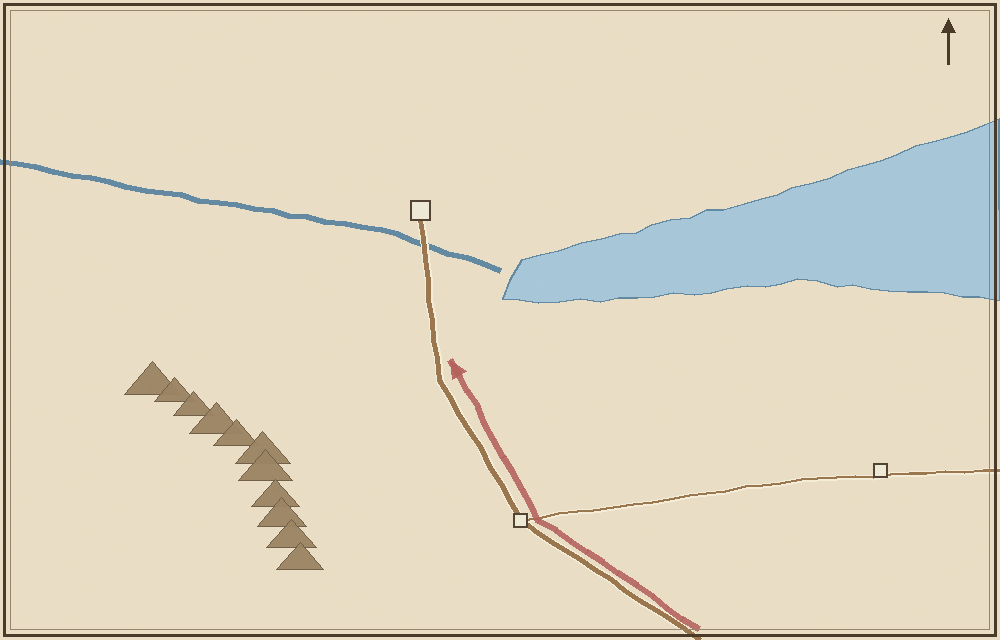 BANNOCKBURN
Stirling Castle (to surrender if not relieved by midsummer)
River Forth
Falkirk
to Edinburgh and Berwick
Edward II marches north
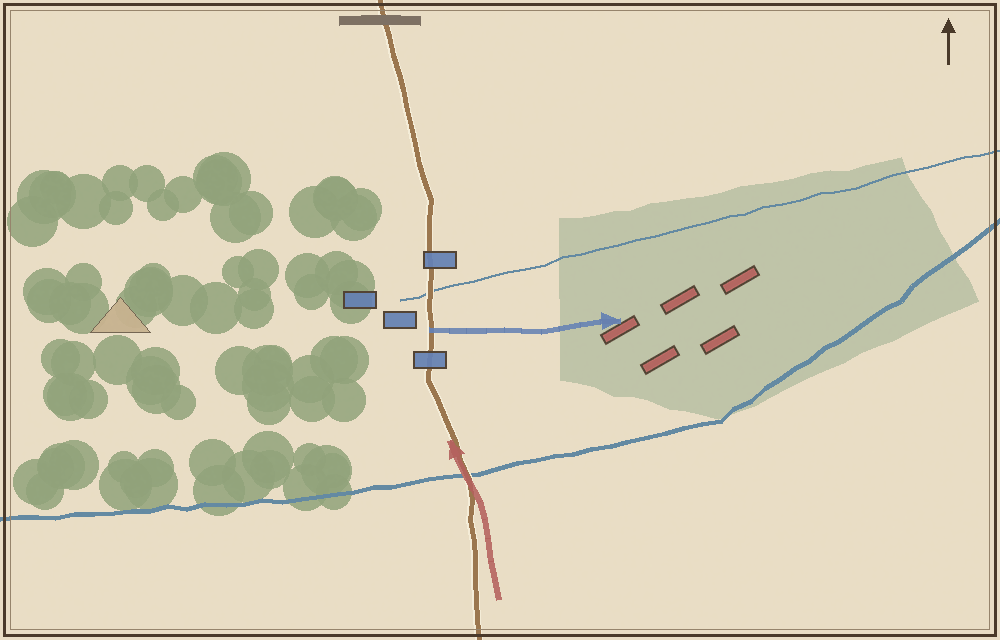 Stirling Castle (to surrender if not relieved by midsummer)
New Park (the Scots)
the Carse (low ground of burns and bog)
23rd: Bohun slain by Bruce
23rd: Clifford checked by Moray
Gillies Hill (the small folk)
24th: the schiltrons come down from the wood
Bannock Burn