Battle of Gettysburg
1863 · North America Long In the demo
Union — Confederate · 20 turns · 107 units
Briefing
"The enemy is there, and I am going to attack him there."
-- Robert E. Lee, on the evening of 1 July, to Longstreet, who urged a turning movement (from Longstreet's recollection)
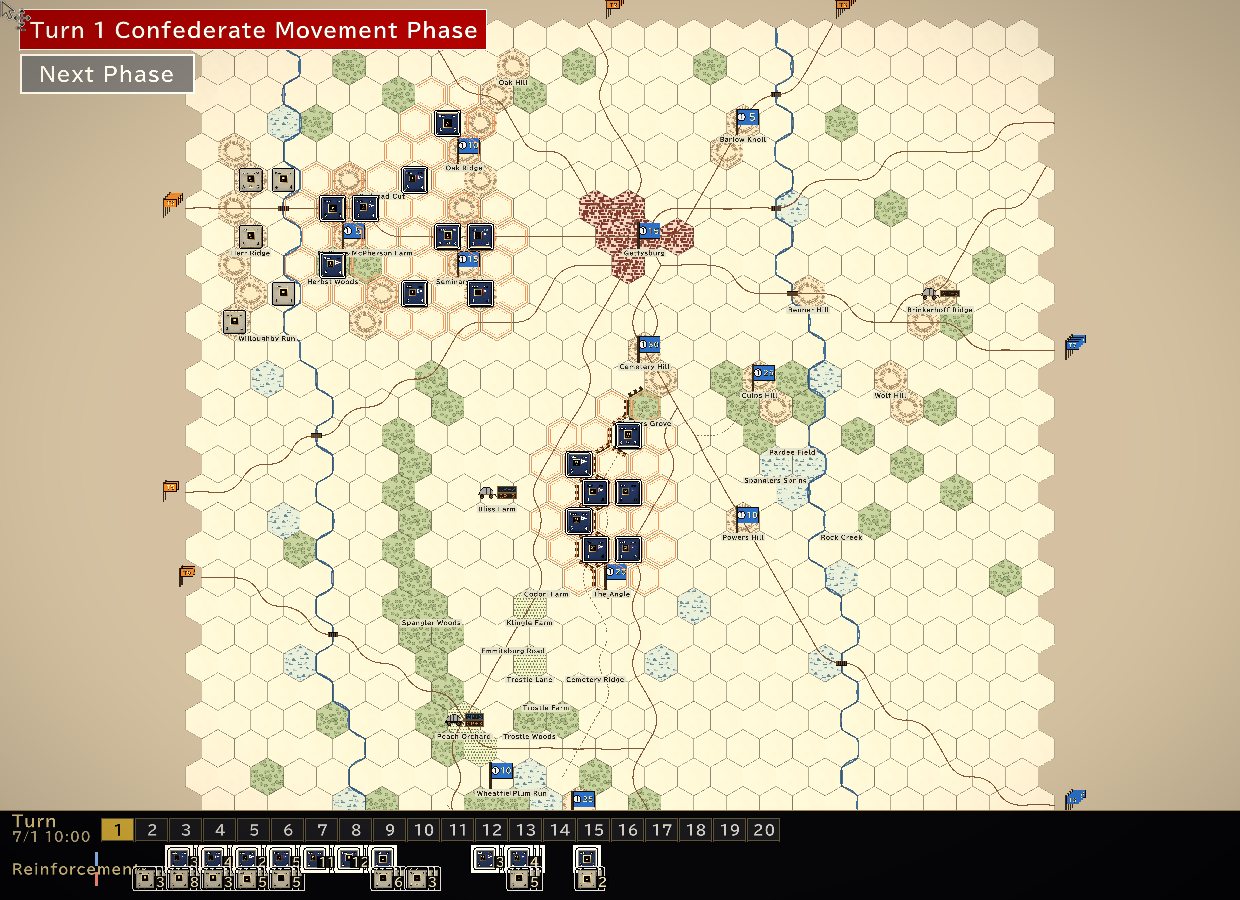
Gettysburg, 1-3 July 1863, Adams County, Pennsylvania. At a town where ten roads meet, a battle that neither army had planned took place. On 1 July, Buford's cavalry bought time west of the town, and Reynolds's I Corps hurried to the field. By evening the Union army had been driven from the town and stood on a ridge shaped like a fishhook: Culp's Hill, Cemetery Hill, Cemetery Ridge and the Round Tops. The Union held the short interior line; Lee had to work around the long exterior one. On 2 July Longstreet marched south, out of sight, to strike the Union left, and seized the Peach Orchard to which Sickles had advanced without orders. Devil's Den, the Wheatfield, and Little Round Top followed. That same night Johnson's division took the lower trenches on Culp's Hill, and the Louisiana Tigers reached the batteries on East Cemetery Hill. There was more than one moment when a single further step was all that was wanting. On 3 July, after a bombardment by 150 guns, some 12,000 men walked across 1.2 kilometres of open ground. At the centre the ground was soft, but there stood a low stone wall.
[How to win] The result is decided by a single margin. Margin = (points of objectives you hold - points of objectives the enemy holds) + (losses inflicted - losses suffered). The dividing line is Union +87. The Union wins with a lead of +104 or more; the Confederacy wins by holding the Union lead to +70 or less. Anything in between is a draw. A further 139 points beyond the line gives an operational victory, and 278 a strategic victory (for the Confederacy, -52 and -191). The objectives on the board are worth 185 points in all. The Confederacy has no choice but to keep attacking: standing on the defensive does not move the margin, and if it does not move, the board remains on the Union side.
[Commanders] Confederate, Army of Northern Virginia: Robert E. Lee. I Corps, Longstreet (Kershaw Kersh / Barksdale Barks / Law Law / the Texas Brigade Rober 1-22 / Pickett's division Garnt, Kempr, Armsd). II Corps, Ewell (Gordon Gordn / the Louisiana Tigers Hays / Steuart Stert / the Stonewall Brigade Walkr 2-31). III Corps, A. P. Hill (Pettigrew Petti / Perrin Perrn / Wilcox Wilcx). The cavalry of J. E. B. Stuart (Stuar) arrives only on the evening of 2 July, at the end of his long ride.
Union, Army of the Potomac: George Meade. Buford's cavalry (Gambl / Devin), Meredith's Iron Brigade (Mered 1-11), Howard's XI Corps (11-*), Sickles's III Corps (3-*), Hancock's II Corps (the Irish Brigade Kelly 2-12 / the Philadelphia Brigade Webb 2-22), V Corps, which came to Sickles's support (5-*), and Sedgwick's VI Corps, which marched thirty-four miles to reach the field (6-*).
[Decisions this board lets you test] Should Howard have advanced north of the town? Should Ewell have taken Cemetery Hill on the evening of 1 July? Was Sickles right to advance? Why did Lee attack the centre again on 3 July? Should VI Corps have been committed?
[Outcome] Some men laid their hands on the stone wall. They could not stay there long. Of the 12,000 or so who crossed the 1.2 kilometres, half came back. Lee rode among the broken men as they returned and said the same thing to each of them: "It is all my fault." The next day, 4 July, it rained. A train of wagons carrying the wounded, seventeen miles long, wound down toward the Potomac, and the Army of Northern Virginia never came north again. On the same day, in the West, Vicksburg surrendered. In November, Lincoln spoke for two minutes in the cemetery on this hill and redefined what the war was for: "government of the people, by the people, for the people." The war went on for two more years. Even so, the highest point reached by the wave that rolled from South to North was here, in front of this low stone wall.
Some men laid their hands on the stone wall.
They held it for only a few minutes.
Half of them came back.
Through the rain, seventeen miles of wagons wind down the road.
The wave came this far, and here it fell back.
Some unit names are abbreviated to five letters, and some pairings of commanders and units are simplified.
1 hex = 200 m, 1 turn = 120 minutes, 1 CS = about 500 men. T1 = 1 July 10:00, T7 = 2 July 06:00, T15 = 3 July 06:00, T20 = 3 July 16:00 (nights are omitted).
Maps
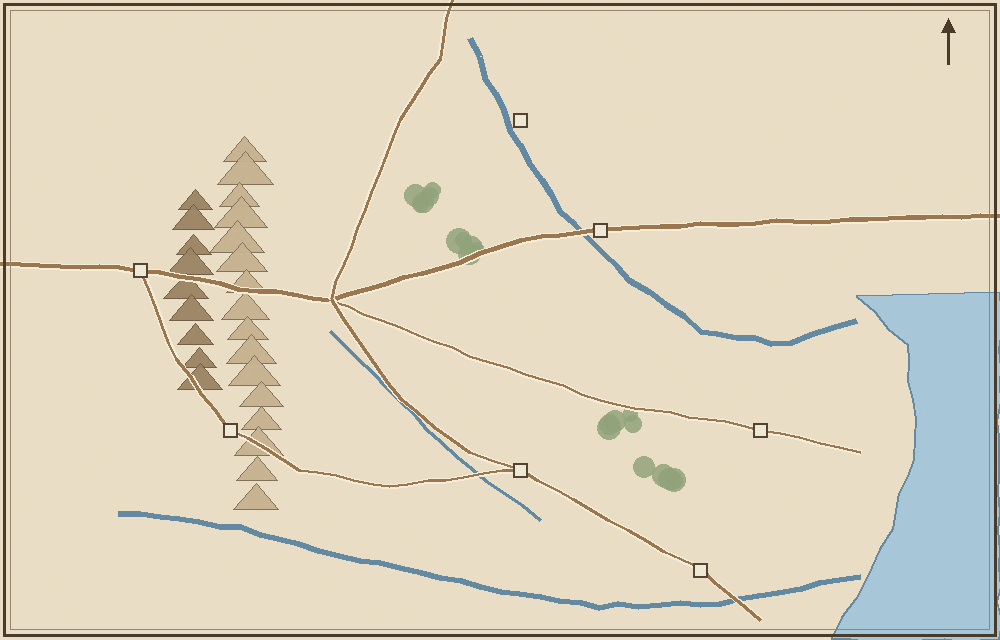 GETTYSBURG
Chambersburg
Harrisburg
York
Baltimore
Washington D.C.
Frederick
Hagerstown
Susquehanna R.
Potomac R.
South Mountain
Chesapeake Bay
GETTYSBURG
Chambersburg
Harrisburg
York
Baltimore
Washington D.C.
Frederick
Hagerstown
Susquehanna R.
Potomac R.
South Mountain
Chesapeake Bay
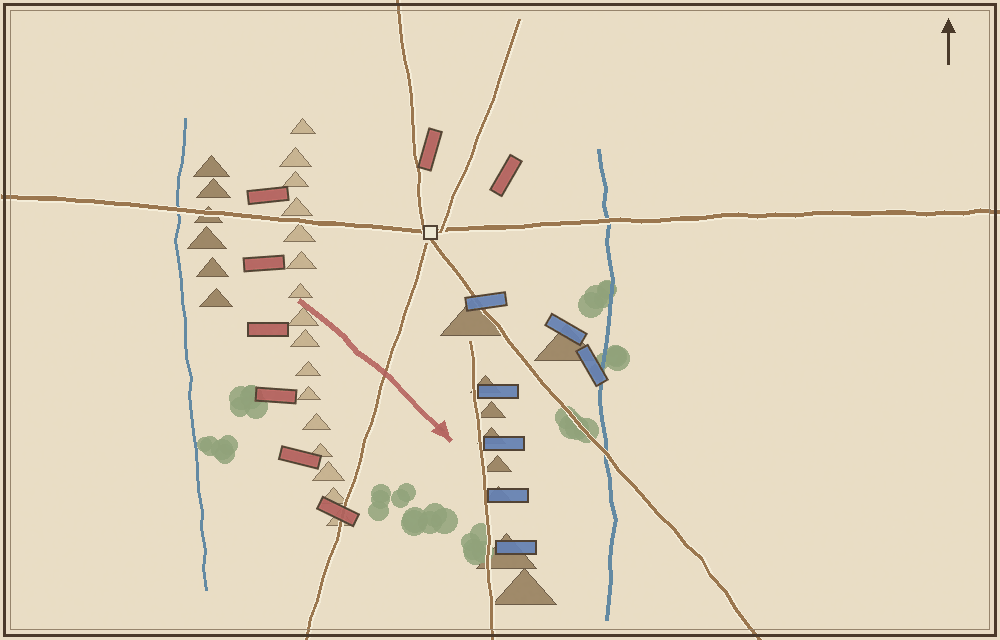 Gettysburg
Seminary Ridge
Cemetery Hill
Culp's Hill
Cemetery Ridge
Little Round Top
Round Top
Peach Orchard / Wheatfield
Willoughby Run
Rock Creek
Chambersburg Pike
Baltimore Pike
Gettysburg
Seminary Ridge
Cemetery Hill
Culp's Hill
Cemetery Ridge
Little Round Top
Round Top
Peach Orchard / Wheatfield
Willoughby Run
Rock Creek
Chambersburg Pike
Baltimore Pike