Battle of Chattanooga
1863 · North America Long
Union — Confederate · 14 turns · 76 units
Briefing
"Chickamauga! Chickamauga!"
— The cry of the Army of the Cumberland as it rushed the rifle pits (the name of its September defeat)
Chattanooga, Tennessee. Beaten at Chickamauga in September, the Union Army of the Cumberland was shut up in this town. Bragg's Confederates held Missionary Ridge to the east and Lookout Mountain to the south-west and cut off its supplies. In October Grant arrived, laid a pontoon bridge at Brown's Ferry and opened a supply line; Sherman's Army of the Tennessee came up as well.
It is 8 a.m. on 24 November 1863. In the west, Hooker is about to attack Lookout Mountain in the fog. In the north, Sherman has crossed the Tennessee on pontoons during the night and is heading for Tunnel Hill at the north end of the ridge. East of the town, on Orchard Knob, taken the day before, stand Grant and Thomas. Confederate rifle pits line the foot of Missionary Ridge, and a hundred guns stand on the slope above.
[How the Union wins] Eleven units may be activated each turn, rising to twenty-one from the afternoon of the 25th (Turn 11, 2 p.m., which includes the signal guns at 3:40), when men ordered to take only the rifle pits at the foot went up the ridge without waiting for orders. The night of the 24th (Turn 6) is a night turn with no combat. The Union begins holding Chattanooga (20 points) and Orchard Knob (10); taking Bragg's headquarters (30), Tunnel Hill (20), Lookout Mountain (20) and Rossville Gap (10) from the Confederates widens the margin. The Tennessee can be crossed only at the Union pontoons (Brown's Ferry and Sherman's crossing). The victory line is 0. If the margin from the Union side exceeds 0, they have done better than history.
[How the Confederates win] Twelve units may be activated each turn. Hold the ridge (mountain slopes, defence x2) and the rifle pits at its foot (entrenched hexsides). Can Cleburne stop Sherman at Tunnel Hill? When to give up Lookout Mountain is also a question.
[Commanders] Union: Grant; Thomas of the Army of the Cumberland, Granger of IV Corps and Palmer of XIV Corps, and the brigades of Baird's, Wood's, Sheridan's and Johnson's divisions (Willich, Hazen, Wagner, Harker and others); Sherman of the Army of the Tennessee with the divisions of Ewing, M. L. Smith and J. E. Smith (Corse, Loomis and others), Howard and Buschbeck of XI Corps, and J. C. Davis; Hooker in Lookout Valley with the divisions of Geary, Osterhaus and Cruft.
Confederate: Bragg; the corps of Hardee and Breckinridge; Cleburne at the north end of the ridge with the Texas brigade (J. A. Smith) and others; the brigades of Walker, Stevenson, Cheatham (Jackson), Anderson (Hindman's division), Bate (Breckinridge's division) and Stewart; Walthall, Moore and Pettus on Lookout Mountain; Wheeler's cavalry.
[Decisions this board poses]
- (Union) Go for Lookout Mountain on the 24th? Taking it frees Hooker to swing south to Rossville on the 25th.
- (Union) Put the main effort at Tunnel Hill or against the centre of the ridge? The activation limit rises only on the afternoon of the 25th.
- (Confederates) Bring the three brigades on Lookout Mountain back to the ridge during the night?
[Outcome] On the 24th Hooker fought his way up through the fog to the bench of Lookout Mountain at the Cravens house, and that night the Confederates abandoned the mountain for the ridge. Next morning the Stars and Stripes flew from the summit (the "Battle above the Clouds"). On the 25th Grant's main attack was Sherman's at Tunnel Hill, but Cleburne, shifting his men skilfully, threw back assault after assault and drove Sherman's troops off with a counterattack at 4 p.m. At 2:30 p.m. Grant ordered Thomas's four divisions to take the rifle pits at the foot of the ridge to help Sherman. At the signal guns at 3:40, 23,000 men rushed across the plain and took the pits, but under fire from the crest they could not stay there. Willich's skirmishers started up the slope without orders, and brigades and divisions followed. Sheridan sent his men on without waiting for an answer to his question, "the foot or the top?" The crest was broken in several places, and the Confederate centre gave way. Bragg withdrew into Georgia, with Cleburne commanding the rearguard. The next year Sherman would march from here to Atlanta.
Above the misty mountain a flag went up
On the northern hill, Cleburne would not move
The order went only as far as the rifle pits
In the pits they were fired on from above
The men climbed without waiting for anyone's order
On the crest they shouted the name of Chickamauga
Units and times follow English-language studies (Cozzens, The Shipwreck of Their Hopes, and others). The board is at brigade level, with division and corps commanders as separate units. To carry two days on one board, a turn is two hours and the night of the 24th is folded into a single turn.
1 hex = 500 m, 1 turn = 2 hours, 1 CS = about 1,200 men. Turn 1 = 8 a.m. on 24 November; Turn 6 = the night of the 24th; Turn 7 = 6 a.m. on 25 November; Turn 11 = 2 p.m.; Turn 14 = 8 p.m.
Maps
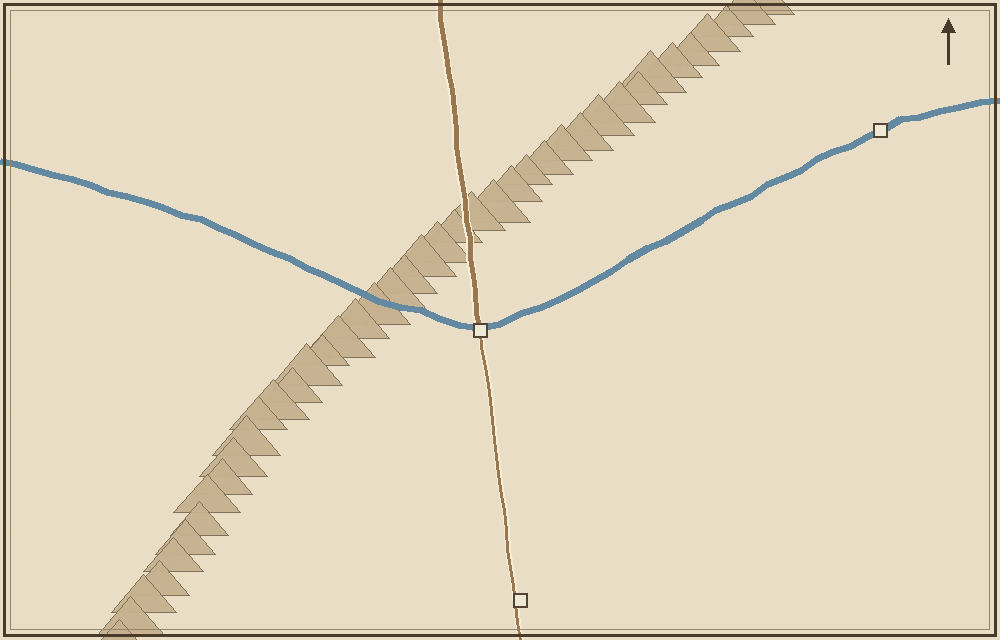 CHATTANOOGA
Chickamauga (September defeat)
to Knoxville (Longstreet)
to Nashville (supply)
to Atlanta
Tennessee River
CHATTANOOGA
Chickamauga (September defeat)
to Knoxville (Longstreet)
to Nashville (supply)
to Atlanta
Tennessee River
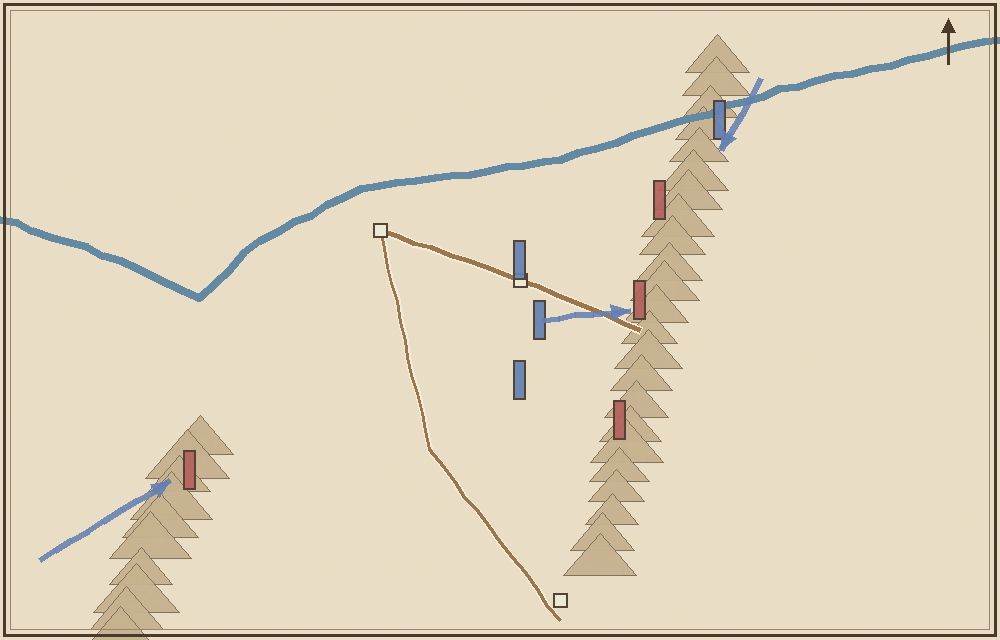 Lookout Mountain (24th, battle above the clouds)
Missionary Ridge
Tunnel Hill (Cleburne)
Sherman (main attack)
Thomas (ordered to take only the rifle pits)
Orchard Knob (Grant)
Hooker
Rossville Gap
Tennessee River
CHATTANOOGA
Lookout Mountain (24th, battle above the clouds)
Missionary Ridge
Tunnel Hill (Cleburne)
Sherman (main attack)
Thomas (ordered to take only the rifle pits)
Orchard Knob (Grant)
Hooker
Rossville Gap
Tennessee River
CHATTANOOGA