Battle of Blenheim
1704 · Europe Medium In the demo
Franco-Bavarian Army — Allied Army · 10 turns · 55 units
Briefing
"I have not time to say more, but to beg you will give my duty to the Queen, and let her know her army has had a glorious victory."
-- the Duke of Marlborough, pencilled to his wife Sarah on the back of a tavern bill on the night of the battle (13 August 1704)
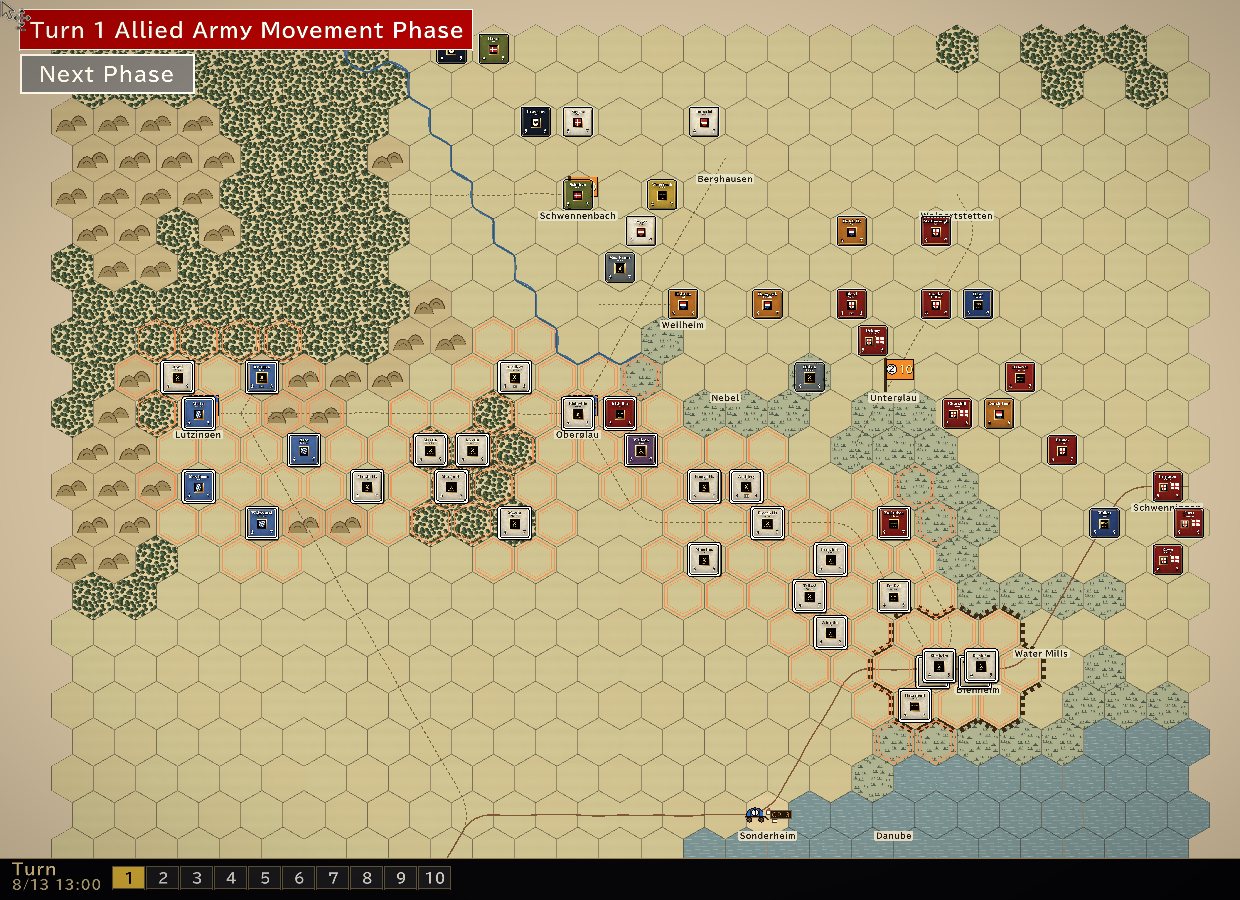
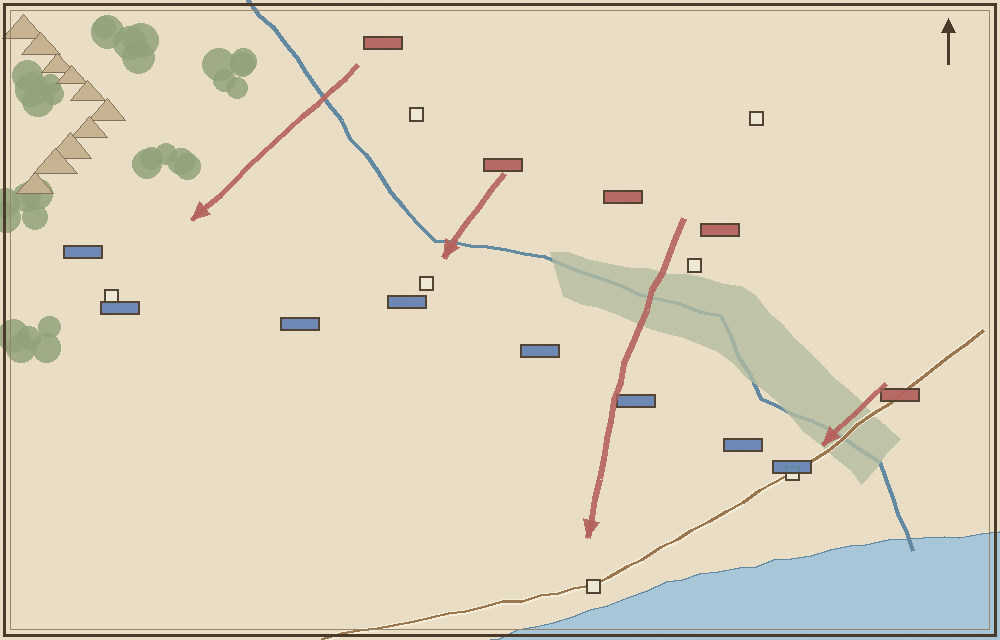
The Danube flows along the south of the board, and the little Nebel comes down slantwise from the north. South-west of it three villages stand in a row: Blenheim on the bank of the Danube, Oberglau in the centre, and Lutzingen at the edge of the woods on the western hills. The Franco-Bavarian army put its infantry into the three villages and drew up its cavalry in the stubble fields between them. The villages were strong with hedges and barricades of carts; the fields lay open as far as the eye could see. Marshal Tallard knew as well as anyone that the fields were the only place to attack. So he did not defend the bank of the Nebel, but drew back a kilometre and waited. He meant to strike the enemy as they crossed, before they could form their ranks, and throw them back into the stream.
The board begins at one in the afternoon, when Marlborough ordered the whole line forward. Prince Eugene on the right is in the scrub before Lutzingen, Lieutenant General Cutts on the left is at the water mills by the mouth of the stream, taken that morning, and Churchill's infantry and cavalry in the centre are on the marshy bank at Unterglau. There are no reinforcements. For both armies, what is on the board is everything.
[The Nebel] Downstream from Oberglau the banks are marshy meadow, and the stream itself is no defensive line; crossing it only slows you down. Upstream from Oberglau, in front of Eugene, it remains a river edge, and attacking across it doubles the defence. Units cannot enter the Danube to the south, nor retreat into it.
[Reading the victory line] The "margin" on screen is a single number seen from the Franco-Bavarian side. Take the points of the objectives the Franco-Bavarians hold, subtract the allied points, add the losses inflicted and subtract the losses suffered. This number is read at the end of the final turn. The "victory line" is the even point of that number, and it is not zero. Above the line the Franco-Bavarians win; below it the allies win; the further from the line, the higher the grade of victory.
[How Tallard defends / how Marlborough attacks] The margin opens at +75. The Franco-Bavarians hold Blenheim (40), Oberglau (30) and Lutzingen (25); the allies hold Unterglau and Schwennenbach at 10 each. The victory line is +7. When a village changes hands, the margin moves by twice its value. If the allies take Blenheim the margin is -5, and with losses even, that alone puts it below the line. Oberglau alone gives +15, still above the line. The Franco-Bavarians need only hold the villages and inflict more losses on the enemy who crosses than they suffer. The allies must take one village, wear down the French cavalry in the fields, and keep their own losses no greater than the enemy's.
[Counters that can move at once] The Franco-Bavarians: twelve of twenty-nine. Tallard's army and the army of Marsin and the Elector, though drawn up on the same field, each counted on the other for help, and neither sent troops. The allies: thirteen of twenty-six. If the allies take the Sonderheim hex, deep in the pointless fields on the bank of the Danube, the Franco-Bavarians fall from twelve to nine. Tallard was captured near that village, and from then on no orders reached the Blenheim garrison from anyone.
[Commanders] Franco-Bavarian: Tallard = Marshal Camille d'Hostun de Tallard (captured that day) / Marsin = Marshal Ferdinand de Marsin / Max Eman Elector = Maximilian II Emanuel, Elector of Bavaria / Clerambault = the Marquis de Clérambault (commander in Blenheim; drowned in the Danube that evening) / Navarre = the Navarre Regiment (burned its colours before surrendering) / Hautefeuil = the Comte d'Hautefeuille (dismounted dragoons) / Du Roi = the Régiment du Roi / Zurlauben Gendarmes = the Gendarmerie under Zurlauben (a Swiss) / Blainville = the Marquis de Blainville (Oberglau; killed that day) / Irish Bde Clare = the Irish Brigade in French service (Clare, Lee, Dorrington) / Maffei = the Bavarian infantry of Count Maffei / Rozel = the Marquis de Rozel (the woods north of Lutzingen) / Arco and Wolframsd = the Bavarian cavalry of Count Arco and Wolframsdorf / Nine Bns = the nine battalions in the centre (recruits).
Allies: Marlborough = John Churchill, Duke of Marlborough / Eugene Savoy = Prince Eugene of Savoy / Cutts Salamander = Lieutenant General John Cutts (called "the Salamander" because he stood unconcerned in the smoke of the guns) / Rowe = Brigadier Archibald Rowe (ordered that no one fire until he had struck his sword into the palisade, and fell before it) / Ferguson = Brigadier James Ferguson / Wilkes = Wilkes's Hessian brigade / Palmes = Colonel Francis Palmes (the English cavalry who threw back the Gendarmerie) / Churchill Charles = Charles Churchill (the Duke's brother; the infantry of the centre) / Orkney = George Hamilton, Earl of Orkney / Hulsen = Hulsen's Hessian and Hanoverian brigade / Holstein Beck = the Prince of Holstein-Beck (mortally wounded before Oberglau) / Blood = Colonel Holcroft Blood's guns / Lumley = Lieutenant General Henry Lumley (English cavalry) / Hompesch = Count Hompesch (Dutch cavalry) / Hesse Kassel = Prince Frederick of Hesse-Kassel / Hanover Dragoons = the Hanoverian dragoons (who captured Tallard) / Fugger = Fugger's Imperial cuirassiers (lent by Eugene to strike the flank of the Irish Brigade) / Anhalt = Prince Leopold of Anhalt-Dessau (Prussian infantry) / Scholten = Count Scholten (Danish infantry) / Max Hanov = Prince Maximilian of Hanover / Wurttemb = the Duke of Württemberg. Not a counter: William Cadogan (Marlborough's quartermaster general, who brought word at noon that Eugene had arrived).
[Decisions this board lets you test]
1. Villages or fields? The villages carry heavy points and are strong behind their hedges. The fields have no points, but Sonderheim lies beyond them. How do the allies divide the troops attacking the villages from those crossing the fields? For the Franco-Bavarians, the more troops go into the villages, the thinner the fields become. Every time he was attacked, Clérambault called reserves into the village, and by evening twenty-seven battalions were packed into five hundred metres square.
2. Go forward to the marshy bank, or stay back and wait? Bring the cavalry up to the bank and you can strike the enemy as they cross, where their feet are stuck. But cavalry that goes forward leaves the guns and infantry of the villages behind.
3. The flank of Oberglau. The northern end of the centre is exposed to flanking fire from the infantry in the village. Marlborough borrowed cuirassiers from Eugene to close it.
4. Eugene's wing. Cross the upper stream and the scrub to take Lutzingen, or is it enough to pin the Elector there?
[Outcome] At half past five in the afternoon, Marlborough sent forward eighty squadrons of cavalry and twenty-three battalions of infantry at once. Tallard's cavalry broke, and the nine battalions left behind in the centre were cut down where they stood, still in square. Much of the broken cavalry was driven off the bank into the Danube between Sonderheim and Höchstädt. Tallard gave up his sword to the Hanoverian dragoons near Sonderheim. At nine at night, the twenty-seven battalions in Blenheim laid down their arms. Clérambault rode into the Danube, fell from his horse and drowned. There were fourteen thousand prisoners. Bavaria was knocked out of the war, and the French army withdrew beyond the Rhine. Queen Anne granted Marlborough the royal manor of Woodstock, and the house built there is called by the English name of this village. One hundred and seventy years later, in a room of that house, the Duke's descendant Winston Churchill was born.
Twenty-seven battalions in five hundred metres square.
In the fields, nine battalions still standing.
The marshal became one line on the back of a bill.
To the Queen, a glorious victory.
The village's name is still the name of a house.
The morning's march and the artillery duel (from the start at two in the morning until noon) are not on the board. The surrender of Blenheim at nine at night also comes after the board. The fascine crossings the allies laid in the centre have been replaced by making the lower Nebel marshy, so it can be crossed anywhere, slowly. The Danube was straightened in the nineteenth century, so the bank on the board is an estimate of its course in 1704. The field tracks between the villages follow the lines of today's village roads.
1 hex = 300 m, 1 turn = 45 minutes, 1 CS = about 500 men. T1 = 8/13 13:00 (general assault), T3 = 14:30 (Holstein-Beck is thrown back before Oberglau), T5 = 16:00 (the allied centre is across), T7 = 17:30 (Marlborough's general charge), T9 = 19:00 (Tallard is captured), T10 = 19:45.
Maps
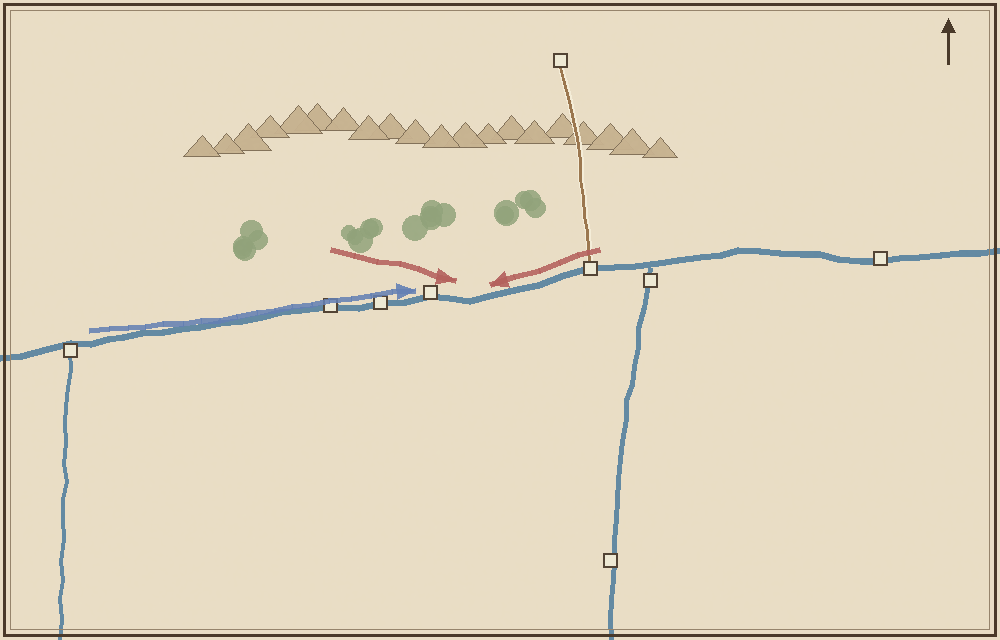 BLENHEIM
Ulm
Lauingen
Dillingen
Hochstadt
Donauworth
Rain
Augsburg
Ingolstadt
Nordlingen
Danube
Lech R.
Swabian Jura
Tallard's march
Marlborough
Eugene
BLENHEIM
Ulm
Lauingen
Dillingen
Hochstadt
Donauworth
Rain
Augsburg
Ingolstadt
Nordlingen
Danube
Lech R.
Swabian Jura
Tallard's march
Marlborough
Eugene
 Blenheim
Oberglau
Lutzingen
Unterglau
Sonderheim
Schwennenbach
Wolpertstetten
Nebel
Danube
to Hochstadt
Cutts
Marlborough
Eugene
Tallard's horse
Jura hills
Blenheim
Oberglau
Lutzingen
Unterglau
Sonderheim
Schwennenbach
Wolpertstetten
Nebel
Danube
to Hochstadt
Cutts
Marlborough
Eugene
Tallard's horse
Jura hills