Battle of Bi
597 BC · China Medium
Chu Army — Jin Army · 10 turns · 44 units
Briefing
夫文、止戈為武。
"In the very writing of the word, 'martial' is made of 'stop' and 'spear'." (King Zhuang of Chu, after the battle, when he was urged to heap up the Jin dead into a victory mound; Zuo Zhuan, Duke Xuan 12)
Xian Hu crossed the river without waiting for orders.
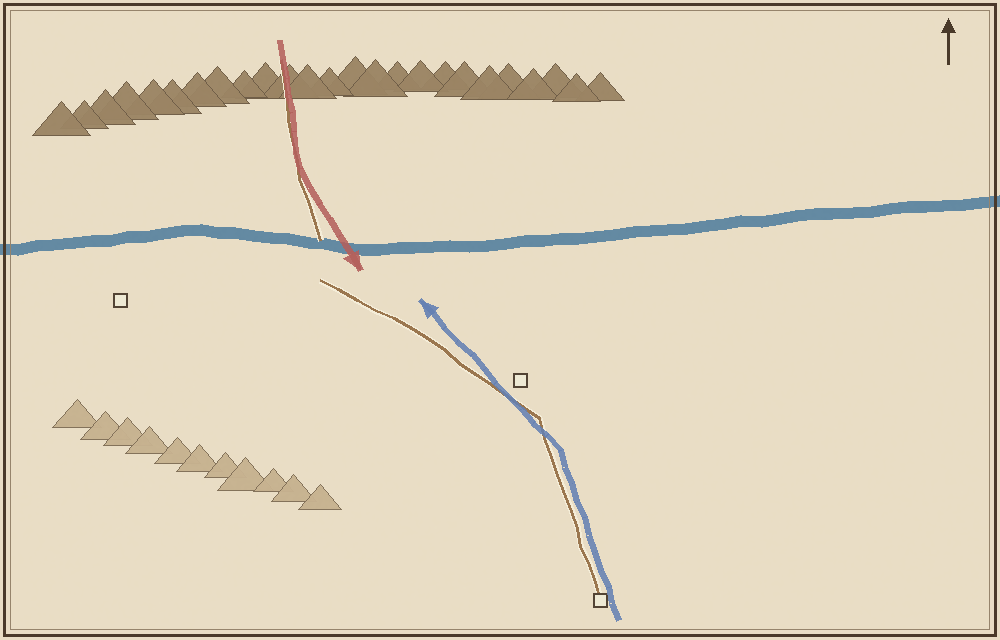
When the Jin relief army reached the Yellow River, Zheng had already submitted to Chu. Xun Linfu, commander of the Centre Army, wanted to turn back, and Shi Hui of the Upper Army agreed. But Xian Hu, deputy of the Centre Army, declared that it was no conduct for a man to retreat on hearing of the enemy, and crossed with his own troops alone. The marshal Han Jue told Xun Linfu: to lose a detachment is a grave fault; better to cross with the whole army, and the blame will be shared among six. So the three armies of Jin made camp between Ao and Hao, with the Yellow River at their backs.
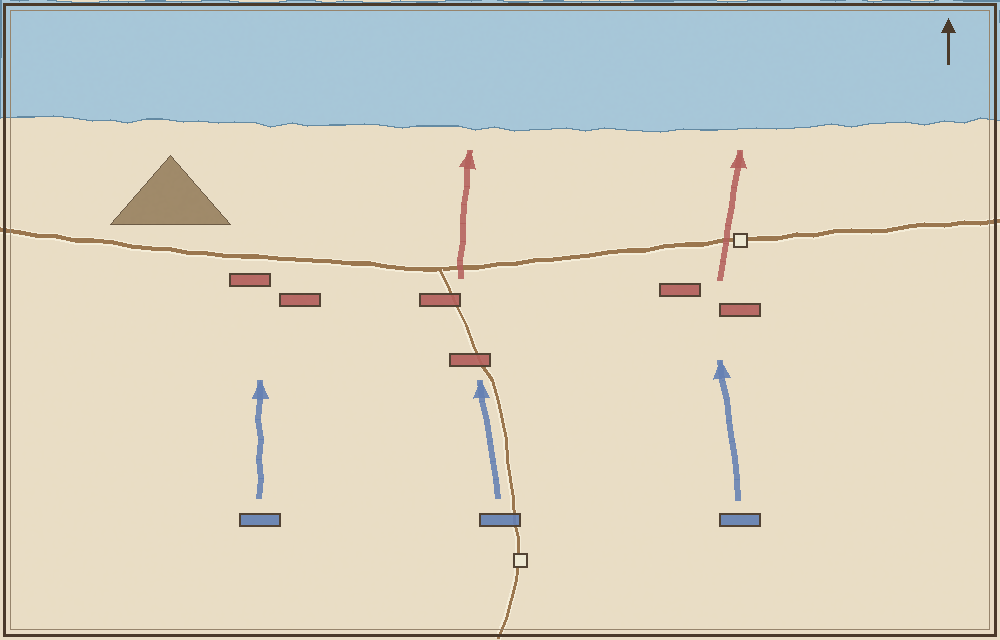
King Zhuang of Chu had also thought of going home, but his favourite Wu Can argued for battle. This afternoon three men of Chu in one chariot (Yue Bo, Xu Bo, She Shu) ride up to challenge the Jin camp, and Wei Qi and Zhao Zhan of Jin ride out to challenge the Chu camp in return. The chief minister Sunshu Ao cries out: "Better we press them than they press us."
[How Chu wins] You may activate 10 units per turn; Jin only 7. Chariots (movement 5) first, foot behind them, push north all at once. Take the Jin Camp (20 points), Ao Shan (15) and Hao (10), pin the Jin troops against the Yellow River and destroy them. The victory line is +17: a Chu score margin above +17 is a win.
[How Jin wins] Not by holding the camp. Troops that escape by boat from the four ferry landings on the bank (off-board exit hexes) score 2 points per combat strength. Your commanders are divided, and orders reach only 7 units. Who crosses first, and who holds the rear? Can the Upper Army on Ao Shan (Shi Hui) withdraw without breaking?
[Commanders] Jin: Xun Linfu, commander of the Centre Army (Huanzi; the general's banner) / his deputy Xian Hu (Zhizi) / Centre Army officers Zhao Kuo and Zhao Yingqi / Shi Hui, commander of the Upper Army (Sui Wuzi) / his deputy Xi Ke / Xi Qi (Ju Bo) / Upper Army officers Gong Shuo and Han Chuan / Zhao Shuo, commander of the Lower Army / his deputy Luan Shu / Lower Army officers Xun Shou (Zhi Zhuangzi) and Zhao Tong / Xun Shou's son Zhi Ying / the marshal Han Jue / Wei Qi and Zhao Zhan, who challenged Chu.
Chu: King Zhuang (the general's banner) / Qu Dang, the King's chariot guard / the chief minister Sunshu Ao / Shen Yin, commander of the Centre / Zizhong, commander of the Left / Zifan, commander of the Right / Wu Can / Pan Dang / the three men in one chariot who challenged Jin: Yue Bo, Xu Bo and She Shu / Gongyin Qi, who led the foot of the right wing / Lord Hui of Tang, who formed the left wing / Lianyin Xianglao / Prince Guchen / Xiong Fuji, who captured Zhi Ying.
Note: the banners of the four directional animals and the general's banner are decorations drawn from later convention, not copies of the flags of this battle.
[Decisions this board lets you try]
- (Chu) Do you drive into the Jin camp with the chariots that arrive first, or wait for the foot? Sunshu Ao's answer was: do not wait.
- (Jin) Do you go out to save Xian Hu's troops (standing forward), or abandon them and make for the ferries?
- (Jin) How many units can you put in the boats before the Chu chariots swing round to the landings?
[Outcome] Xun Linfu did not know what to do. He beat the drum in the camp and proclaimed: "A reward for those who cross first." The Centre and Lower Armies fought for the boats; those already aboard cut at the hands clinging to the gunwales, and the fingers in the boats, it is said, could be scooped up in both hands. Only the Upper Army did not move: Shi Hui took the rear himself, gathered his troops and withdrew without breaking. Xun Shou turned back to recover his captured son Zhi Ying; he shot Lianyin Xianglao and carried off the body, and took Prince Guchen prisoner. At dusk Chu encamped at Bi; the Jin remnants could not form a camp and crossed the river all night, their voices heard until morning. When Pan Dang urged a victory mound of Jin dead, King Zhuang refused with the words "stop the spear", sacrificed to his ancestors by the river and went home. He became the hegemon of the age. Eight years later Xi Ke, deputy of the Upper Army that day, defeated Qi at An.
It was one man's decision that crossed the river
Press them, do not be pressed
The Centre and the Lower fought for the boats
Only the Upper withdrew, still in line
The victorious king did not heap up the dead
Stop the spear, and it reads as "martial"
The sources give no numbers for the three armies of Jin; the counts on the board are inferred from chariot strength. The Jin remnants' night crossing lies off the board, after T10. The sites of Bi, Ao and Hao are placed north-west of modern Zhengzhou on the south bank of the Yellow River, but they are not certain.
1 hex = 300 m, 1 turn = 30 minutes, 1 CS = about 250 men (chariots and foot together). T1 = sixth month, 13:00; T10 = 17:30 (dusk).
Maps
 BI
Yellow River
Zheng (submitted to Chu)
Jin
Chu
Luoyi (Zhou)
Jin relief army (crosses the river)
Chu marches north
BI
Yellow River
Zheng (submitted to Chu)
Jin
Chu
Luoyi (Zhou)
Jin relief army (crosses the river)
Chu marches north
 Yellow River
Mount Ao
Hao
Jin camp (between Ao and Hao)
BI
Upper Army (Shi Hui) withdraws in order
Centre and Lower Armies fight for the boats
"Better we press them than they press us"
Xian Hu (crossed on his own)
to Guan
Yellow River
Mount Ao
Hao
Jin camp (between Ao and Hao)
BI
Upper Army (Shi Hui) withdraws in order
Centre and Lower Armies fight for the boats
"Better we press them than they press us"
Xian Hu (crossed on his own)
to Guan