Fall of Constantinople
1453 · Europe Medium
Byzantine and Latin Garrison — Ottoman Army · 9 turns · 73 units
Briefing
Το δε την πόλιν σοι δούναι ούτ' εμόν εστιν ούτ' άλλου των κατοικούντων εν ταύτη.
"To surrender the city to you is not in my power, nor in the power of anyone who lives in it." -- Constantine XI, replying to Mehmed II's demand for surrender (Chronicon Maius, a later expansion of Sphrantzes's chronicle; attributed)
Seven thousand defenders. Five and a half kilometres of wall. Eight hundred millimetres per man.
29 May 1453, half past one in the morning: the night of the fifty-third day. Since the siege had closed on 6 April, the great gun cast by Urban had slowly worn away the outer wall day after day. It fired seven times a day. Each time a ball struck, the wall was chipped, and at night the defenders went down and filled the breach again with barrels, earth and rubble. The filled breach was then struck again. That went on for fifty-three days. On 22 April the fleet had crossed the hill into the Golden Horn, and as many defenders as that required had been drawn off to the sea walls. They would not come back.
That night Mehmed II prepared three waves. First he would send in the irregulars to tire the defenders, then throw the Anatolian regulars against the old wall of Blachernae, and finally send in the Janissaries. Fresh troops would come every two hours. The defenders had no relief.
The board covers the five kilometres of the Theodosian Walls from the Golden Horn to the Golden Gate. The wall is not the same everywhere. The southern half is the true Theodosian Wall, with the moat, the outer wall and the great inner wall in three layers; on the board these are folded into two, the palisade of the outer wall and the great wall. Either way, it cannot be broken through here. There are only two places where it can. One is the Mesoteichion in the Lycus valley: at the bottom of the valley the wall is at its lowest, and the moat, which could not be maintained on the slope, ended at the Gate of St Romanus. This is where the great gun kept aiming, and the outer wall is already a heap of rubble. All that remains is the makeshift palisade that Giustiniani rebuilt every night. The other is the Kerkoporta at Blachernae: a small postern in the corner of the wall, whose bar had not been lowered that night.
[How to win] The result is decided by a single margin: the difference in points for gates and objectives, plus the difference between losses inflicted and losses suffered. At the start the defenders lead by 172 points, because every point lies inside the walls. Nothing that can be taken has been placed outside them. To win, the Ottoman army must break through at the Mesoteichion, the Charisius Gate and Blachernae, and swing the margin twenty points over to its own side. The defenders need only still be standing on the walls when dawn comes.
[Commanders] Defenders: Constantine = Constantine XI Palaiologos (the last Roman emperor) / Giustiniani = Giovanni Giustiniani Longo (came from Genoa at his own expense with seven hundred men, and was entrusted with overall command) / Dalmata = John Dalmata / Toledo = Don Francisco de Toledo / Minotto = Girolamo Minotto (the Venetian bailo) / Bocchiardi = the three Bocchiardi brothers / Caristo = Teodoro di Caristo (an old master of the bow) / Notaras = Loukas Notaras (Grand Duke; the mobile reserve) / Grant = Johannes Grant (the engineer who countermined the tunnels) / Sphrantzes = George Sphrantzes (governor of the city, who wrote down this night) / Orhan = Orhan, the exiled Ottoman prince. Attackers: Mehmed = Mehmed II (twenty-one years old) / Halil = Çandarlı Halil Pasha (the Grand Vizier, who opposed this siege to the end) / Zaganos = Zaganos Pasha (who built the pontoon bridge) / Karaca = Karaca Pasha / Ishak = Ishak Pasha / Urban = Urban's great gun / Hasan = Hasan of Ulubat (said to have been the first to climb the wall).
[Decisions this board lets you test] First, do you go out to retake the Golden Horn? While the Ottomans hold the shore of the Horn, the defenders can move two fewer counters at a time. The only way to retake it is to go outside the walls, and troops outside the walls are no longer defending them. Second, how many units do you spare for the Kerkoporta? That little gate is worth no points to the Ottomans if they take it; it only gives them more moves. But moves are exactly what this night is decided by, and for the defenders it lies at the far end of the wall. Third, do you take Giustiniani down from the palisade? He is the strongest counter on the board, and he stands in the most dangerous hex. Historically, the defence broke at the single moment when he fell and was carried away.
[Outcome] Before dawn, some fifty men came in through the Kerkoporta and raised a flag on a tower. At almost the same moment, Giustiniani fell with his breastplate pierced. His stretcher was carried into the city, and the Genoese who saw it followed. A section of the palisade stood empty. When the Emperor was last seen, it is said, he had cast off his purple buskins and was running into the breach. His body was never found. Notaras was executed five days later, and Minotto was killed as well. Giustiniani was carried by ship to Chios and died there. Isidore changed his clothes and escaped; Sphrantzes lost his family and wrote his chronicle in a monastery. That afternoon Mehmed II entered by the Charisius Gate and rode on to Hagia Sophia. From that day the twenty-one-year-old was called "the Conqueror". In the West, when the news arrived, the words "Roman Empire" at last passed into the past tense. People carrying Greek manuscripts crossed to Italy, and within fifty years they had begun something that would be called by another name.
In the wall that no one had crossed for a thousand years,
fifty-three days had made a hole.
One bar had not been lowered.
The purple buskins were left just short of the breach.
To surrender the city to you is not in my power.
He did not surrender it. It only fell.
The bombardment and mine warfare from 6 April to 28 May, the fleet carried over the hill, and the sea battle of 20 April are not on the board. Only the last night is. The sea walls, the Marmara front, and the one kilometre south of the Golden Gate to the Marble Tower have also been cut. The defenders' combat strength does not follow their numbers: placed on the same scale, seven thousand men would not make the board a question worth setting, so it has been deliberately raised. Estimates of the Ottoman strength range from fifty to eighty thousand, and the lower figure has been used. The moat and the palisade faced the same way and their effects cancelled out, so both have been folded into a single palisade on the outer wall; where there was no moat (the Lycus valley and Blachernae), no palisade has been placed at all.
1 hex = 200 m, 1 turn = 30 minutes, 1 CS = about 300 men (the Ottoman conversion; for the defenders see the note above). T1 = 5/29 01:30, the first wave goes down into the moat / T6 = 04:00, the Janissaries go in / T9 = 05:30, the wall is broken.
Maps
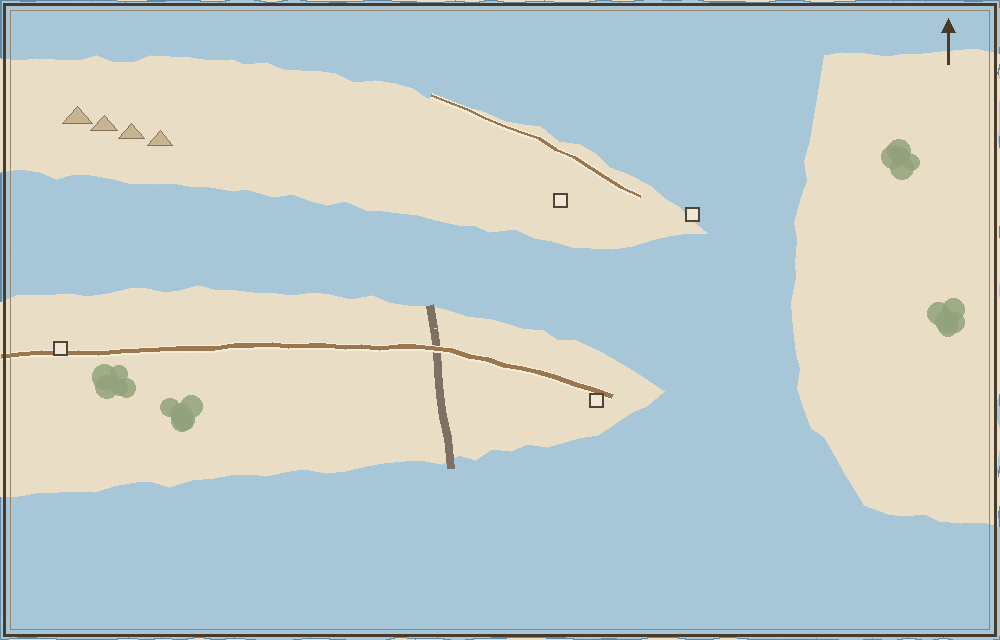 CONSTANTINOPLE
Galata
Rumeli Hisari
to Edirne
Theodosian Walls
Golden Horn
Bosphorus
to the Black Sea
Sea of Marmara
Anatolia
CONSTANTINOPLE
Galata
Rumeli Hisari
to Edirne
Theodosian Walls
Golden Horn
Bosphorus
to the Black Sea
Sea of Marmara
Anatolia
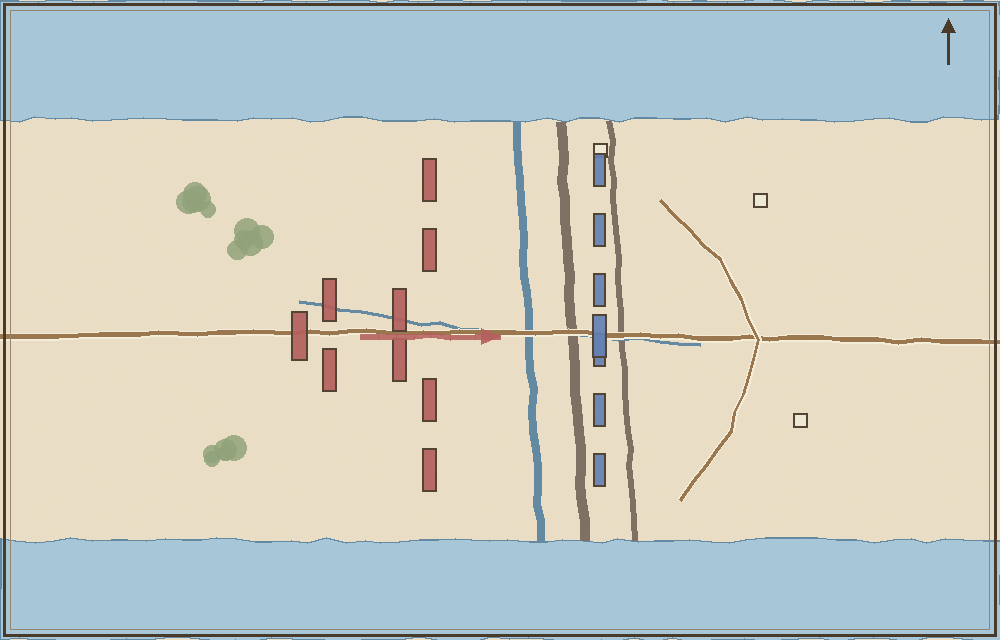 Blachernae
St Romanus Gate
the great cannon
Ottoman army
Lycus valley
Golden Horn / the boom
Sea of Marmara
the city
Blachernae
St Romanus Gate
the great cannon
Ottoman army
Lycus valley
Golden Horn / the boom
Sea of Marmara
the city