Battle of Hitokotozaka 1572
1572 · Japan
19 November 1572 (the 14th day of the 10th month of Genki 3) · Hitokotozaka, Iwata, Shizuoka Prefecture, Japan
Tokugawa — Takeda · 8 turns · 40 units
AI personality: Tokugawa Steady / Takeda Manoeuvre
See this battle in the battle list
Briefing
19 November 1572 (the 14th day of the 10th month of Genki 3). Hitokotozaka, Iwata, Shizuoka Prefecture, Japan
"Ieyasu has two things too fine for him: a Chinese-yak helmet crest, and Honda Heihachi."
– a lampoon said to have been written at Hitokotozaka by Kosugi Sakon of the Takeda
In the autumn of Genki 3, Takeda Shingen entered Tōtōmi with a great army. Tokugawa Ieyasu crossed the Tenryū River from Hamamatsu with some three thousand men to scout, and beyond Mitsuke he was discovered by the Takeda vanguard. Shingen's main body followed behind it. Ieyasu decided to withdraw, leaving Honda Tadakatsu and Naitō Nobunari as the rearguard. The ferry over the Tenryū lay a little more than a league away, and on the way the road descended from the Iwatahara plateau by the slope of Hitokotozaka.
[How the Tokugawa win] Every unit that leaves the board by the Tenryū ferry on the west edge scores 10 points per CS (up to 60 in all). If Ieyasu (Tokugawa Ieyasu) gets away, he scores 20 points. Hitokotozaka (10 points) and Mitsuke (10) begin in Tokugawa hands, and their points are lost if the Takeda take them. The victory line is +52: the Tokugawa win if the margin from their side exceeds it. The Tokugawa move first. Up to 9 units may move at once.
[How the Takeda win] Take Hitokotozaka and Mitsuke and destroy Tokugawa units; the Takeda win if the margin falls below the line. Up to 10 units may move at once. From turn 1 to turn 5 the following columns enter from the east edge. A Tokugawa force that stays will in time be crushed by numbers.
[Commanders] Tokugawa: Tokugawa Ieyasu, Honda Tadakatsu, known as Heihachirō, aged twenty-four, Naitō Nobunari, Ōkubo Tadayo and Ōkubo Tadasuke.
Takeda: Baba Nobuharu, Naitō Masatoyo, Yamagata Masakage and Kosugi Sakon.
[Decisions this board poses]
- (Tokugawa) How far east to leave the rearguard: hold at the town of Mitsuke, or fall back and hold at Hitokotozaka.
- (Tokugawa) Whether to send the main body ahead to the ferry, or to fall back together with the rearguard.
- (Takeda) Whether to crush the rearguard with the vanguard, or to work around it and close the road to the ferry.
[Outcome] The Tokugawa set fire to the town of Mitsuke to slow the pursuit, and at Hitokotozaka Honda Tadakatsu stood his ground at the foot of the slope, a poor position. Meanwhile Ieyasu's main body crossed the Tenryū and returned to Hamamatsu. Two months later Ieyasu was heavily defeated by Shingen at Mikatagahara.
Some accounts place the fight on the 13th day of the month. The numbers, positions and details of the rearguard action rest largely on later Tokugawa records such as the Mikawa Monogatari, and include estimates. The lampoon is a tradition. The burning of Mitsuke is not a special rule; it is expressed through the strength of the rearguard units. Combat strengths are not head counts but values worked back from the paths to victory.
1 hex = 250 m, 1 turn = 20 minutes, 1 CS ≈ 100 men. T1 = 10:00, T8 = 12:20 (times estimated).
Maps
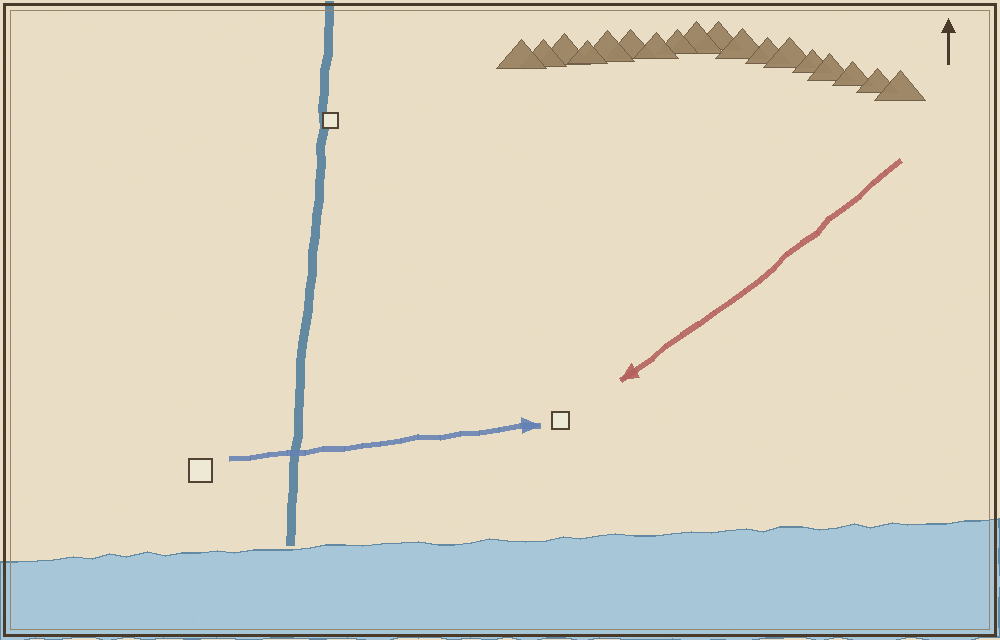 HITOKOTOZAKA
Hamamatsu Castle
Tenryu River
Futamata Castle
Takeda Shingen enters Totomi
Ieyasu rides out to scout
Mitsuke
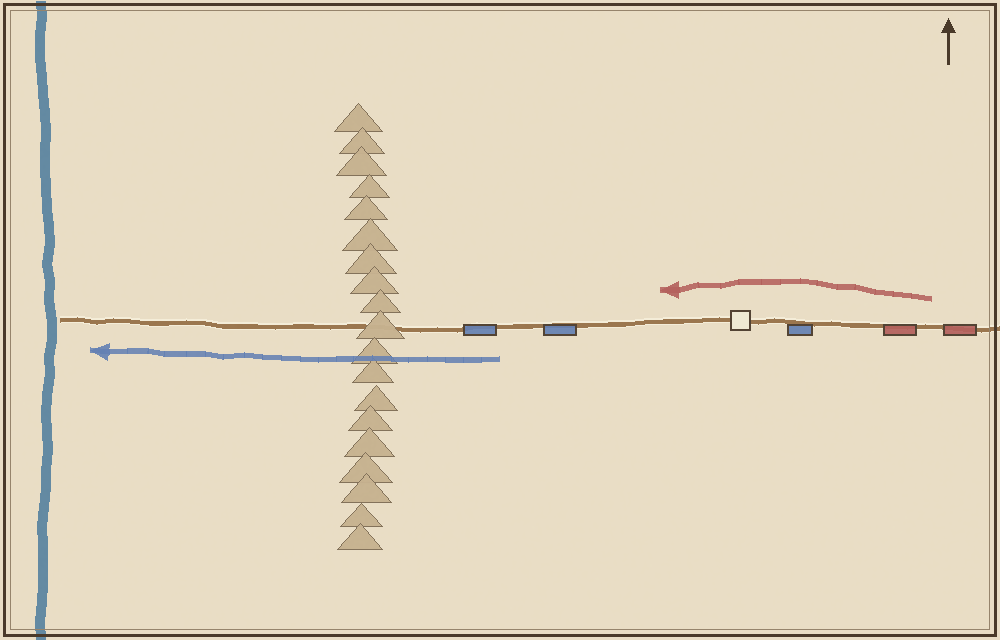 HITOKOTOZAKA
Mitsuke set on fire
Honda Tadakatsu holds the rear
Baba Nobuharu pursues
Tenryu River