Second Battle of Bull Run
1862 · North America Long
Union (Army of Virginia) — Confederate (Army of N. Virginia) · 12 turns · 302 units
Briefing
"We fought a terrific battle here yesterday with the combined forces of the enemy, which lasted with continuous fury from daylight until after dark, by which time the enemy was driven from the field, which we now occupy." -- John Pope, telegram to Halleck, early on 30 August. By that evening it was Pope who had been driven from the field.
On the morning of 29 August, on the fields west of Bull Run, Jackson's wing lies behind a single embankment. From Sudley Church to beyond the Brawner farm, the fills and cuttings of a railroad begun and then abandoned run for three kilometres, and they serve as a ready-made breastwork. Pope read this army as one trying to escape. So all day long he sent divisions and brigades against the embankment in the order in which they reached the field.
To the west, south of the turnpike, Longstreet's wing arrived before noon and drew up silently in line with the prolongation of the Union left. Pope either did not know or did not believe it. Porter, on the Manassas-Gainesville road, reported enemy in his front and did not move.
On the afternoon of the second day, Porter's V Corps struck the Deep Cut head-on and broke. At that moment Longstreet's twenty-five thousand went forward together.
[How to win] The result is decided by a single margin. Margin = (points of objectives you hold - points of objectives the enemy holds) + (losses inflicted - losses suffered). There are eight objectives worth 155 points: Henry Hill 40, Stone Bridge 25, Chinn Ridge 20, Deep Cut 20, Groveton 15, Sudley Church 15, Stone House 10, Brawner Farm 10. The Union starts with 95 points, the Confederates with 45, and Groveton belongs to no one. If the margin seen from the Union side ends above the victory line (+48 points), the Union wins; below it, the Confederates win. Finish 23 points beyond the line for a tactical victory, 185 for an operational victory, and 369 for a strategic victory. Short of 23, it is a draw.
[The way back] The Union alone can leave the board by its eastern edge, south of the turnpike to Centreville. Each unit that gets away scores one point per point of combat strength. On the night of 30 August, Pope's army retreated over this Stone Bridge.
[The army that does not wake] Longstreet's wing (Hood, Kemper, D.R. Jones, Wilcox, Evans, and R.H. Anderson, who arrives later) is on standby. It begins to wake at 14:00 on 30 August (turn 10), and by 16:00 (turn 11) all of it moves. If attacked, it wakes on the spot. Porter's V Corps and Piatt's brigade are also on standby and wake on the morning of 30 August (turn 7).
[Counters that can move at once] Union: twenty-eight. Fourteen more on turn 2 (Heintzelman and Reno cross the Stone Bridge), eight on turn 6 (King and Ricketts arrive by the Sudley road from the south), and ten on turn 7 (Porter wakes). Confederates: forty, with twenty-five more on turn 10 (Longstreet wakes).
[Commanders] Union: Pope = John Pope (Army of Virginia), Sigel = Franz Sigel (I Corps: Schurz, Schenck, Milroy), McDowell = Irvin McDowell (III Corps: King, Ricketts, and Reynolds's Pennsylvania Reserves), Heintzelman = Samuel Heintzelman (III Corps, Army of the Potomac: Kearny and Hooker), Porter = Fitz John Porter (V Corps; later court-martialled), Reno = Jesse Reno (IX Corps). Gibbon = John Gibbon (the Iron Brigade), Buchanan and Chapman = Sykes's Regulars, Warren = Gouverneur K. Warren.
Confederates: Lee = Robert E. Lee, Jackson = Thomas J. Jackson (left wing), Longstreet = James Longstreet (right wing), Hood = John Bell Hood (the Texas Brigade), Gregg, Branch, Pender, Archer, Field and E.L. Thomas = A.P. Hill's Light Division, Lawton, Trimble, Early and Forno = Ewell's division (Ewell lost a leg on 28 August), Starke, Baylor, B.T. Johnson and A.G. Taliaferro = Jackson's division, S.D. Lee = Stephen D. Lee's artillery battalion, Stuart and Fitz Lee = the cavalry. On each counter, the upper name is the brigade commander and the lower is the regiment.
[Decisions this board lets you test] First (Union): where do you push against the embankment? Put everything on the front, and the left, south of the turnpike, lies open. An army no one has yet seen is drawn up there.
Second (Union): where do you send Porter when he wakes on the second morning? Historically he was sent straight at the Deep Cut and broke under the flanking fire of S.D. Lee's guns on the ridge to the south-west.
Third (Confederates): does Jackson leave the embankment? He may gain something, but the moment he leaves it he shows his flank.
Fourth (Confederates): when Longstreet wakes, does he make for Henry Hill or for the Stone Bridge behind the Union army? The hill is worth 40 points; the bridge is worth 25 and is the Union line of retreat.
[Outcome] At 16:00 on 30 August, Longstreet's wing came out from south of the turnpike all at once and rolled up the Union left for four kilometres. The 5th New York lost nearly three hundred men in about ten minutes. Several Union brigades on Chinn Ridge bought an hour, and in that time Sykes's Regulars and Reynolds's Reserves formed on Henry Hill. The hill did not fall before dark, and that night the Union army retreated over the Stone Bridge to Centreville. Over the three days the Union lost about 14,000 men and the Confederates about 7,300.
Pope was relieved and sent to Minnesota. Porter was cashiered by court-martial for disobeying orders (a board of review cleared his name in 1879). Early in September Lee crossed the Potomac into Maryland, and two weeks later he faced McClellan beside Antietam Creek.
Behind the embankment, three kilometres of an army lie hidden
It is trying to escape, he read
All day he sent them in as they arrived
Beyond the left, an army no one has seen
At four o'clock, four kilometres roll up
The hill did not fall before dark
The encounter at the Brawner farm on the evening of 28 August and the battle of Chantilly on 1 September (where Kearny and Stevens fell) are left out. Historically Longstreet's wing arrived and deployed before noon on 29 August; on the board it is placed south of the turnpike from the start, asleep. Brigades are divided into their regiments; the artillery of each division is grouped into one counter.
1 hex = 180 m, 1 turn = 2 hours, 1 CS = about 250 men. T1 = 29 Aug 08:00, T6 = 18:00, T7 = 30 Aug 08:00, T10 = 14:00 (Longstreet begins to wake), T11 = 16:00 (when Longstreet historically went forward), T12 = 18:00.
Maps
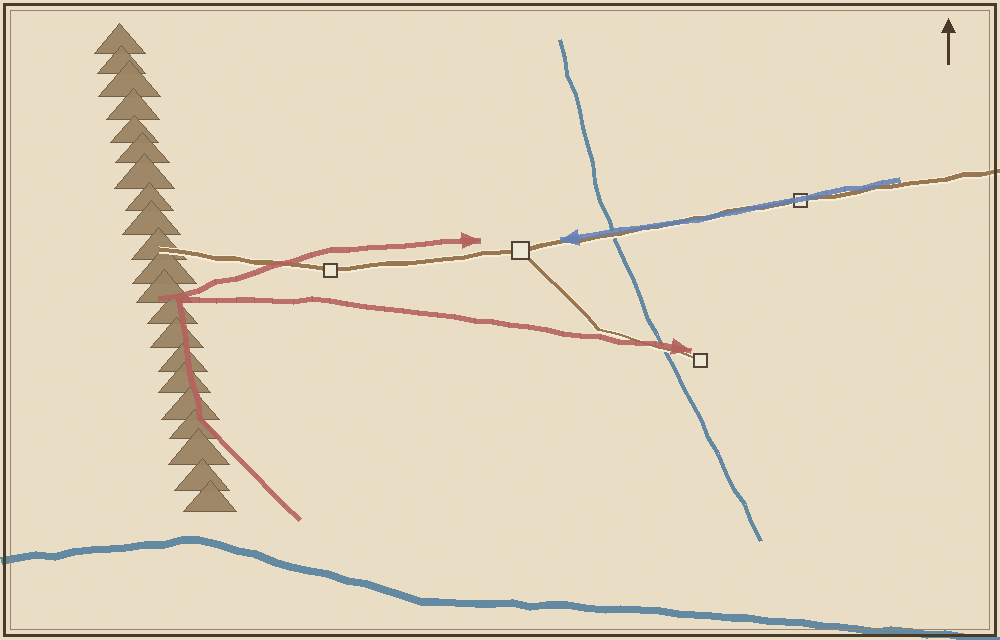 SECOND BULL RUN
Manassas Junction (burned 27 Aug.)
Centreville
to Washington
Thoroughfare Gap (28 Aug.)
Gainesville
Rappahannock River
Jackson's march (25-27 Aug.)
Bull Run
Virginia
SECOND BULL RUN
Manassas Junction (burned 27 Aug.)
Centreville
to Washington
Thoroughfare Gap (28 Aug.)
Gainesville
Rappahannock River
Jackson's march (25-27 Aug.)
Bull Run
Virginia
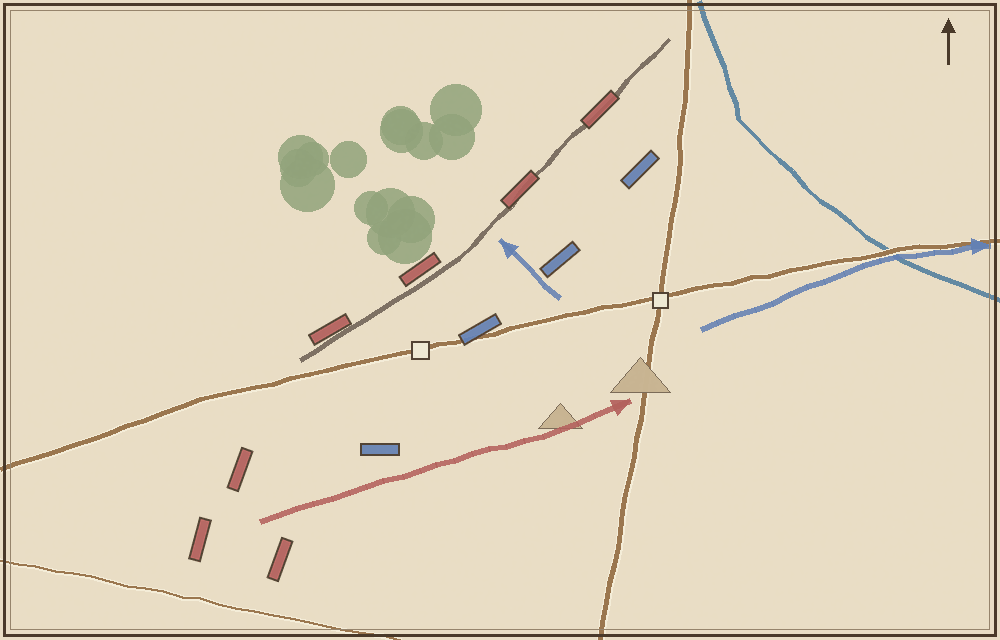 Unfinished railroad (Jackson's line)
Deep Cut (30 Aug., afternoon)
Henry Hill (held until dark)
Chinn Ridge
Groveton
Stone Bridge (Union retreat, night)
Porter (idle, 29 Aug.)
Longstreet (30 Aug., 4 p.m.)
Bull Run
Unfinished railroad (Jackson's line)
Deep Cut (30 Aug., afternoon)
Henry Hill (held until dark)
Chinn Ridge
Groveton
Stone Bridge (Union retreat, night)
Porter (idle, 29 Aug.)
Longstreet (30 Aug., 4 p.m.)
Bull Run