Battle of Friedland 1807
1807 · Europe
14 June 1807 · The bend of the Alle (today the Lava), Pravdinsk (formerly Friedland), Kaliningrad Oblast, Russian Federation
French Army (Napoleon) — Russian Army (Bennigsen) · 13 turns · 80 units
AI personality: French Army (Napoleon) Steady / Russian Army (Bennigsen) Manoeuvre
See this battle in the battle list
Briefing
14 June 1807. The bend of the Alle (today the Lava), Pravdinsk (formerly Friedland), Kaliningrad Oblast, Russian Federation
"It is not every day that one catches the enemy in such a mistake."
— words attributed to Napoleon on reaching the field of Friedland (tradition; paraphrase)
Four months after the battle in the snow at Eylau, Napoleon was driving on Königsberg in the spring campaign, and Bennigsen's Russian army was falling back along the Alle. On 13 June Bennigsen learned that only Lannes's corps stood at Friedland, and to crush it he crossed the river by the town's bridges during the night. The Russian army that came out onto the plain west of the bend had the Alle at its back and was split north and south through its middle by the mill stream and the mill pond. From dawn, Lannes held off a far larger enemy on a long line from the Sortlack wood to Heinrichsdorf.
[How the French win] Take the town and bridges of Friedland (25 points) and Sortlack (10 points), and hold Posthenen (20 points), Heinrichsdorf (15 points) and the Domnau road (10 points). The victory line is -2: the French win if the score difference from their side is above -2. In the morning the French may activate 8 units per turn; from turn 6, when Napoleon arrives, 14; and from turn 8, when the main body is up, 18.
[How the Russians win] Take Posthenen and Heinrichsdorf to break Lannes, and hold the town and bridges. To withdraw, cross the Alle by the town's bridges or the Kloschenen ford in the north: each unit that leaves the board by the east edge scores 10 points per CS (up to 40 points in all). The Russians may activate 13 units per turn.
[Reinforcements and times] French: Mortier's VIII Corps (T2–T3, north of the west edge), Ney's VI Corps and Latour-Maubourg's dragoons (T6, south edge, south of the Sortlack wood), Victor's I Corps, Sénarmont's guns and the Guard (T7–T8, middle of the west edge, behind Posthenen). The Russians receive no reinforcements.
[Commanders] French: Napoleon (Emperor) / Lannes (Reserve Corps; Lannes): Oudinot's grenadiers (Oudinot), Verdier (Verdier), and the cavalry of Grouchy (Grouchy) and Nansouty (Nansouty) / Mortier (VIII Corps; Mortier): Dupas (Dupas) and Dąbrowski's Poles (Dąbrowski) / Ney (VI Corps; Ney): Marchand (Marchand) and Bisson (Bisson) / Victor (I Corps; Victor): Dupont (Dupont), Lapisse (Lapisse), Villatte (Villatte), and Sénarmont of the artillery (Sénarmont) / Latour-Maubourg's dragoons (Latour-Maubourg) / the Guard (Guard).
Russians: Bennigsen (army commander; Bennigsen) / left wing (south): Bagration (Bagration), Raevsky's jägers (Raevsky), the Guard (Guard), and the cavalry of Golitsyn (Golitsyn) and Kollogrivov (Kollogrivov) / right wing (north): Gorchakov (Gorchakov), Dokhturov (Dokhturov), Kamensky (Kamensky), Uvarov's cavalry (Uvarov) and Cossacks.
Not on the board: Napoleon (headquarters are not units), Berthier (chief of staff) and Platov (with most of the Cossacks east of the river).
[Decisions this board lets you try]
- (French) In the morning, stretch Lannes's line thin and long, or draw it in around Posthenen?
- (French) When to bring Ney out of the wood, and where to push: into the town, or into the mill pond to split the Russians?
- (Russians) Can you break Lannes in the morning while you have the numbers?
- (Russians) If you withdraw, when, and with which units first? There are bridges in one place only.
[Outcome] Napoleon arrived at noon and waited for his main body. At 17:30, on a signal of three guns, Ney's VI Corps came out of the Sortlack wood, and Bagration's left wing, crowded into the south of the bend, was driven back on the town. When Ney's men, thrown back by the Guard cavalry, fell into disorder, Dupont's division held, and Sénarmont took thirty guns forward to four hundred paces, two hundred, one hundred and fifty, and at last sixty, firing all the while. The town burned, and the Russians set fire to the bridges themselves. The southern wing swam the river or searched for fords, and many drowned. Gorchakov's northern wing could not retake the town and crossed by the Kloschenen ford after dark. Russian losses were close to twenty thousand, French eight to ten thousand. Some ten days later the two emperors met on a raft on the Niemen at Tilsit.
To crush a lone corps, they crossed the river by night
At their backs the river, in their middle the mill pond
From morning one corps held on along a long line
The Emperor came, waited for his army, and at evening three guns spoke
The guns went forward to sixty paces, and the town and the bridges burned
Over the men who swam the river, the long June day came to its end
Numbers: by evening about eighty thousand French and about sixty thousand Russians (estimates vary). Combat strengths are not head counts but values worked back from the ways to win. The positions and commanders of divisions are approximate, and the names of the Russian divisions still have to be checked against sources. Sénarmont's guns are placed as range-2 units that can move (the historical closing of the distance is written as a combination of movement and range). The burning of the bridges is not written into the board; only the scarcity of crossings is put into the terrain.
1 hex = 300 m, 1 turn = 90 minutes, 1 CS = about 600 men. T1 = 14 June 05:00, T6 = 12:30, T9 = 17:00, T13 = 23:00.
Maps
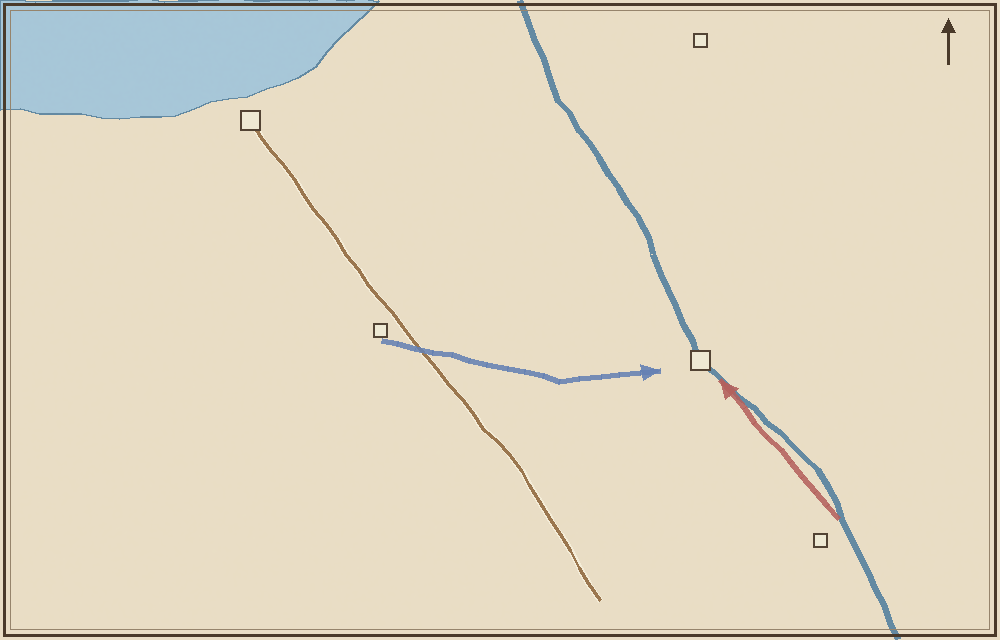 FRIEDLAND
Königsberg
Eylau (February's battlefield)
Heilsberg (10 June)
Alle
Tilsit (peace in July)
Napoleon's main body (from noon)
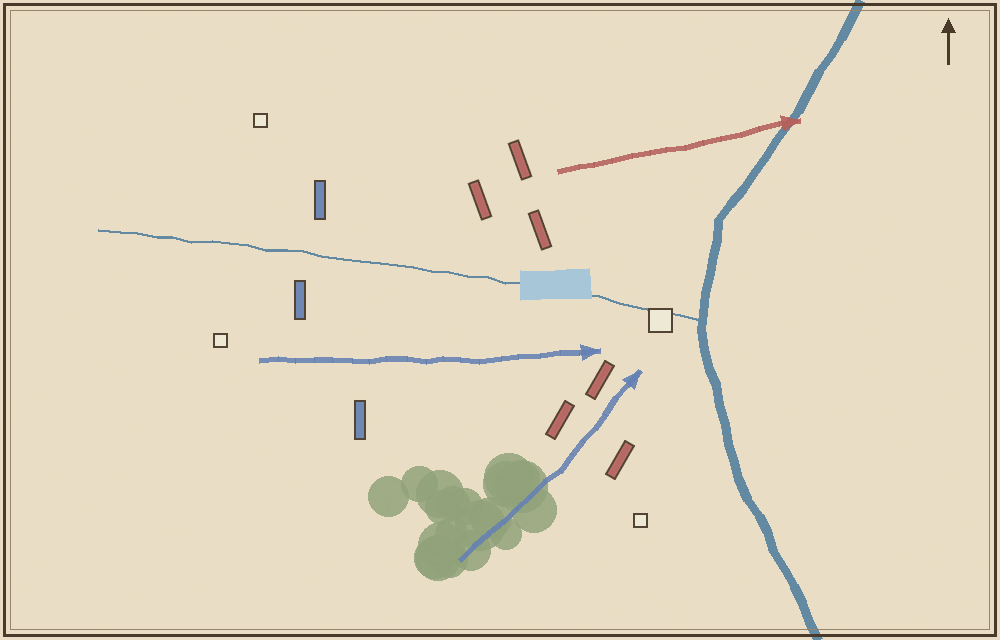 FRIEDLAND
Ney from the Sortlack wood
Sénarmont's guns, to sixty paces
the mill stream and pond (splitting the Russians)
Lannes holds from dawn
the town and bridges burn
Gorchakov escapes by the ford
Alle