Battle of Stones River
1862 · North America Long
Union (Army of the Cumberland) — Confederate (Army of Tennessee) · 12 turns · 219 units
Briefing
"You gave us a hard-earned victory, which, had there been a defeat instead, the nation could scarcely have lived over." -- Abraham Lincoln, letter to Rosecrans, August 1863. It was a victory at the turn of the year, three weeks after the disaster at Fredericksburg.
New Year's Eve 1862, north-west of Murfreesboro. Rosecrans's Army of the Cumberland and Bragg's Army of Tennessee had camped since the night before only five hundred metres apart across the West Fork of the Stones River. The bands of both armies played the same songs in turn, and at the end, it is said, both camps sang "Home, Sweet Home" together.
And the two commanders had made exactly the same plan: to strike the enemy's right with their own left. For the Union, Crittenden's left wing would cross McFadden's Ford towards Murfreesboro; for the Confederates, Hardee's left wing would swing round the Union right towards the Nashville Pike.
The Confederates moved an hour earlier. Shortly after six in the morning, the divisions of McCown and Cleburne fell upon Johnson's division on the Union right, still gathered around its breakfast fires.
[How to win] The result is decided by a single margin. Margin = (points of objectives you hold - points of objectives the enemy holds) + (losses inflicted - losses suffered). There are eight objectives worth 155 points: Murfreesboro 40, Round Forest 30, Nashville Pike 25, Wayne's Hill 15, Overall Creek 15, Slaughter Pen 10, Gresham Lane 10, McFadden's Ford 10. The Union starts with 100 points, the Confederates with 55. If the margin seen from the Union side ends above the victory line (+25 points), the Union wins; below it, the Confederates win. Finish 19 points beyond the line for a tactical victory, 150 for an operational victory, and 300 for a strategic victory. Short of 19, it is a draw. If the Union plan works, Murfreesboro (40 points) falls; if the Confederate plan works, the Nashville Pike and the Overall Creek bridge (40 points together) fall.
[Who moves first] On this board alone, the Confederates move first. The same plan, an hour earlier.
[The armies that do not wake] Johnson's division on the Union right (the brigades of Kirk, Willich and Baldwin) is at breakfast and on standby. It begins to wake little by little from turn 2 (7:00), and wakes on the spot if attacked. Breckinridge's Confederate division is east of the river on Wayne's Hill and does not move, convinced that the Union is about to cross the ford. It begins to wake from turn 7 (noon), and wakes on the spot if attacked.
[Counters that can move at once] Union: forty. Confederates: forty, with ten more on turn 7 (Breckinridge begins to wake).
[Commanders] Union: Rosecrans = William Rosecrans, McCook = Alexander McCook (right wing: Johnson, Davis, Sheridan), Thomas = George Thomas (centre: Rousseau, Negley), Crittenden = Thomas Crittenden (left wing: Wood, Palmer, Van Cleve). Hazen = William Hazen (the brigade that held the Round Forest), Sill, Roberts and Schaefer = Sheridan's brigade commanders (all three were killed that day), Shepherd = the Regular Brigade, Mendenhall = John Mendenhall (chief of artillery), Morton = the Pioneer Brigade.
Confederates: Bragg = Braxton Bragg, Hardee = William Hardee (left: McCown, Cleburne), Polk = Leonidas Polk (centre: Withers, Cheatham), Breckinridge = John C. Breckinridge (east of the river). Hanson = Roger Hanson (the Orphan Brigade), Chalmers and Donelson = the brigades that struck the Round Forest, Wharton = the cavalry that rides round behind the Union army. On each counter, the upper name is the brigade commander and the lower is the regiment.
[Decisions this board lets you test] First (Union): Van Cleve is halfway across the ford. Do you push him on east of the river, or call him back to hold the right? The historical Rosecrans called him back.
Second (Union): as the right wing folds back, where do you make a new line? Falling back to the pike and the railroad shortens it, but if that line breaks there is no way out.
Third (Confederates): do you send the wheeling left wing all the way to the pike, or turn it against the Union line short of it? The wider it swings, the more time the Union has to form a new line.
Fourth (Confederates): when Breckinridge wakes, do you send him to the Round Forest or to the ford?
[Outcome] By midday the Union right had been driven back to the line of the Nashville Pike; in the cedars, Sheridan's division bought time while losing all three of its brigade commanders. Rosecrans rode up and down himself to form a new line and gun line along the pike, and at its corner, beside the railroad embankment in the Round Forest, Hazen's brigade did not give a step. In the afternoon, Breckinridge's brigades, called over from east of the river, struck twice and were shattered.
That night Bragg telegraphed Richmond: "God has granted us a happy New Year." But the Union army did not retreat. On 2 January Breckinridge was ordered once more against the hill east of the ford and lost 1,800 men in an hour in front of the fifty-eight guns Mendenhall had massed. On the night of 3 January Bragg withdrew towards Tullahoma. Over the three days the Union lost 12,900 men and the Confederates 11,700: on both sides, about one man in three.
The night both camps sang the same song
The same plan, an hour earlier
The right wing folded back like a knife
In the cedars, three brigade commanders fall
By the embankment, a single wood will not break
Three days after the telegram of a happy New Year
The quiet day of 1 January and the fight at McFadden's Ford on 2 January are told in the outcome. Wheeler's wide cavalry ride behind the Union army, and the Union brigades of Spears and Starkweather (escorting trains off the field on 31 December), are left out. Brigades are divided into their regiments; the artillery of each division is grouped into one counter.
1 hex = 150 m, 1 turn = 1 hour, 1 CS = about 200 men. T1 = 31 Dec 06:00 (McCown's attack), T2 = 07:00, T7 = 12:00 (Breckinridge begins to wake), T9 = 14:00, T12 = 17:00 (sunset).
Maps
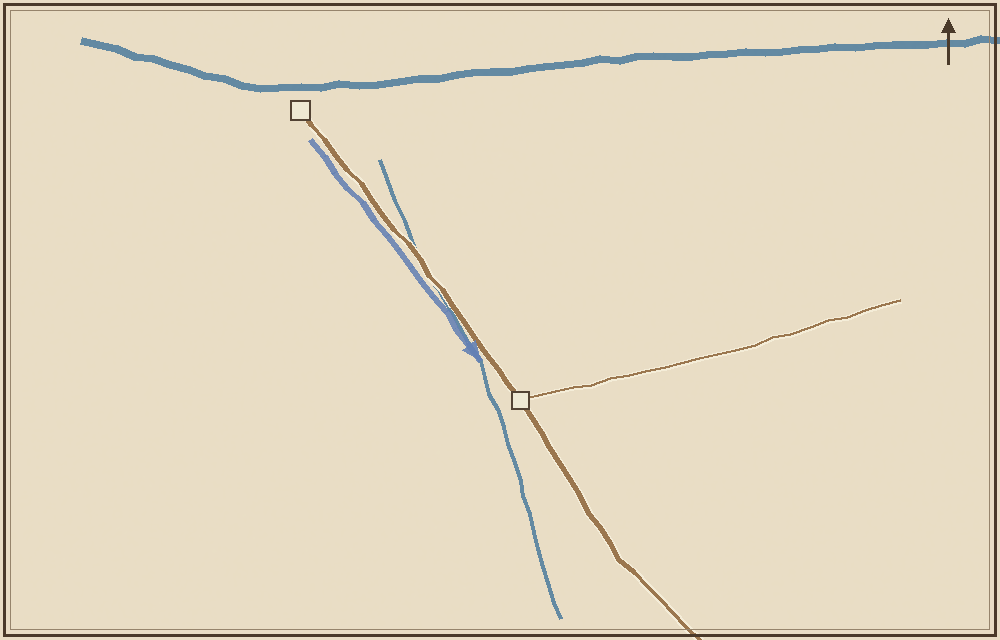 STONES RIVER
Murfreesboro
Nashville
to Chattanooga
Cumberland River
Tennessee
Rosecrans's advance (26-30 Dec.)
STONES RIVER
Murfreesboro
Nashville
to Chattanooga
Cumberland River
Tennessee
Rosecrans's advance (26-30 Dec.)
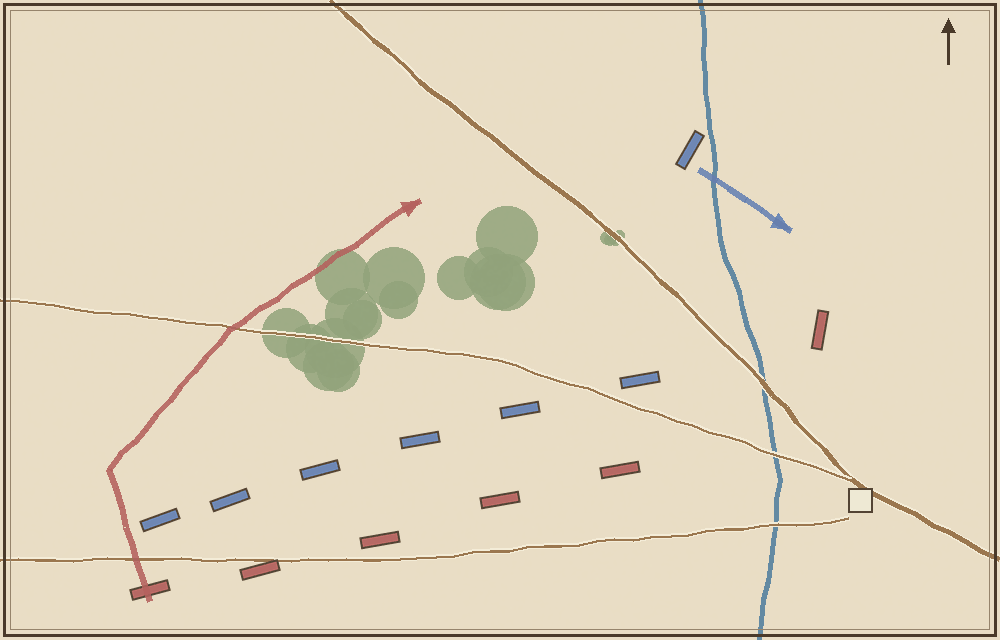 Round Forest (Hazen)
The cedars (Sheridan)
Dawn attack (after 6 a.m.)
McFadden's Ford (the Union plan)
Breckinridge (east of the river)
Murfreesboro
The Union line folds back
Nashville Pike and railroad
Stones River (West Fork)
Round Forest (Hazen)
The cedars (Sheridan)
Dawn attack (after 6 a.m.)
McFadden's Ford (the Union plan)
Breckinridge (east of the river)
Murfreesboro
The Union line folds back
Nashville Pike and railroad
Stones River (West Fork)