Battle of Eylau
1807 · Europe Long
French Army — Russian and Prussian Army · 14 turns · 78 units
Briefing
"Quel massacre ! Et sans résultat !"
"What a massacre! And without result!" — Marshal Ney, riding over the field the next morning
Eylau, in East Prussia. In February 1807 Napoleon pursued the Russian army in the depth of winter, and the two sides fought for the town of Eylau from the evening of the 7th into the night. On the morning of 8 February they face each other across two low ridges east of the town. The Russians have 67,000 men and 400 guns; the French 49,000 and 300 guns. Davout's III Corps is approaching the French from the south-east and Ney's VI Corps from the north-west; L'Estocq's Prussian corps is approaching the Russians from the north.
At 8 a.m. the Russian guns open fire. The snow keeps falling.
[How the French win] Fourteen units may be activated each turn. Davout (seven units) enters on Turns 3 to 5 at the south edge, and Ney (five units) on Turn 12 at the west edge. The French begin holding Eylau church (30 points, Napoleon's command post) and Windmill Knoll (10); taking the Russian positions at Serpallen (10), Anklappen (10), Schmoditten (10) and Kutschitten (20, on the road to Königsberg) widens the margin. The victory line is +50. If the margin from the French side exceeds +50, they have done better than history.
[How the Russians and Prussians win] Thirteen units may be activated each turn. Draw the French in front of the grand battery in the centre (three artillery units with range 2). L'Estocq's Prussians (six units) enter on Turn 9 at the north edge. Can you break the centre before Davout, coming from the south-east, folds back your left?
[Commanders] French: Napoleon; the Guard; Marshal Augereau of VII Corps with the divisions of Desjardins and Heudelet and the 14th of the Line; Marshal Soult of IV Corps with the divisions of Saint-Hilaire, Leval and Legrand; Marshal Murat of the cavalry reserve with d'Hautpoul's cuirassiers, the dragoons of Grouchy, Klein and Milhaud, and Lasalle and Bruyère; Marshal Davout of III Corps with the divisions of Friant, Gudin and Morand; Marshal Ney of VI Corps.
Russians and Prussians: General Bennigsen; Tuchkov on the right, Sacken and Doctorov in the centre, Osterman-Tolstoy on the left; Prince Bagration; Kamensky with the reserve; Yermolov with the artillery; Golitsyn with the cavalry and Platov with the Cossacks; General L'Estocq of Prussia with his chief of staff Scharnhorst.
[Decisions this board poses]
- (French) Hold the Russians in the centre until Davout arrives? Going forward puts you in front of the grand battery.
- (French) When the centre is about to break, throw in the whole cavalry reserve at once? Keep the Guard back?
- (Russians) Send the reserve to the left wing being pressed by Davout, or push on in the centre?
[Outcome] Sent forward to pin the centre, Augereau's VII Corps lost its way in a blizzard, veered left and blundered into the front of the 70-gun Russian battery in the centre, where it was shattered. The 14th of the Line, unable to retreat, fought to the last man. Russian infantry pressed into the town, and Napoleon, in the church tower, came close to being taken. With his centre about to break, Napoleon sent in Murat's cavalry reserve of 11,000 at once. D'Hautpoul's cuirassiers rode through both Russian lines, turned and rode through them again. In the afternoon Davout bent the Russian left back to a right angle, but at 4 p.m. L'Estocq's Prussians, having marched round behind the Russian position, arrived and drove Davout back towards Kutschitten. At 7 p.m. Ney arrived from the north, and the fighting went on until 10 p.m. That night Bennigsen withdrew, but the French did not notice and had no strength left to pursue. The two armies' killed and wounded together ran to several tens of thousands.
In the snow a corps lost its way
Seventy guns stood before it
The Emperor poured in all his cavalry
The cuirassiers rode twice through the enemy lines
At evening Prussians came round behind
In the morning only the dead lay on the snow
Strengths and times follow English-language studies (Petre and others). Estimates of losses vary widely between books (French 10,000 to 30,000, Russian 15,000 to 20,000). The villages are placed from contemporary battle maps. The blizzard is not represented by reducing ranges, since that would remove the grand battery itself.
1 hex = 400 m, 1 turn = 60 minutes, 1 CS = about 1,000 men. Turn 1 = 8 a.m. on 8 February; Turn 9 = 4 p.m.; Turn 12 = 7 p.m.; Turn 14 = 9 p.m.
Maps
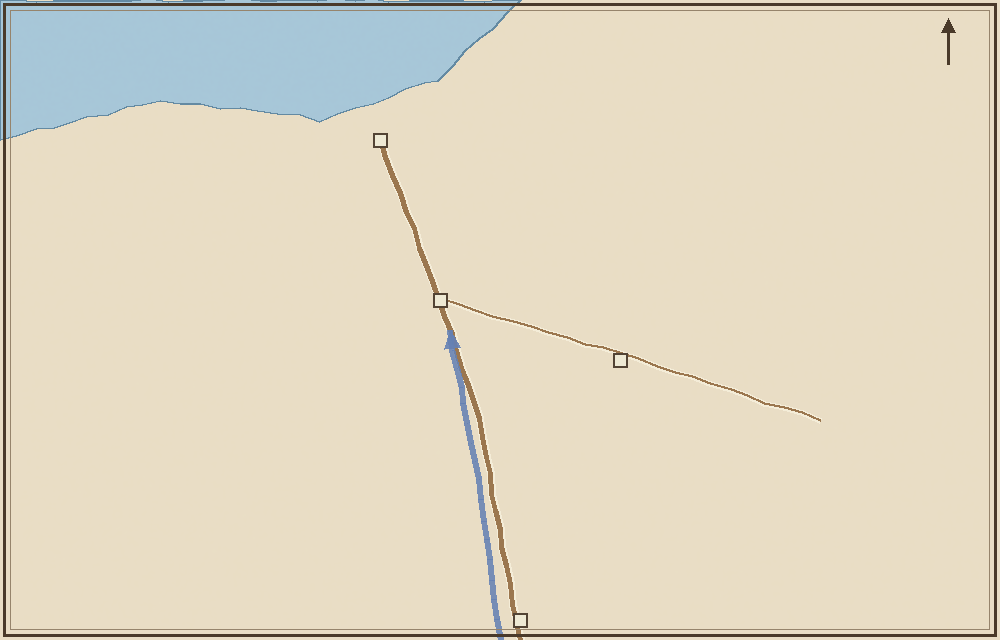 EYLAU
Königsberg
to Warsaw
Baltic Sea
Bartenstein
East Prussia
French winter advance (from late January)
EYLAU
Königsberg
to Warsaw
Baltic Sea
Bartenstein
East Prussia
French winter advance (from late January)
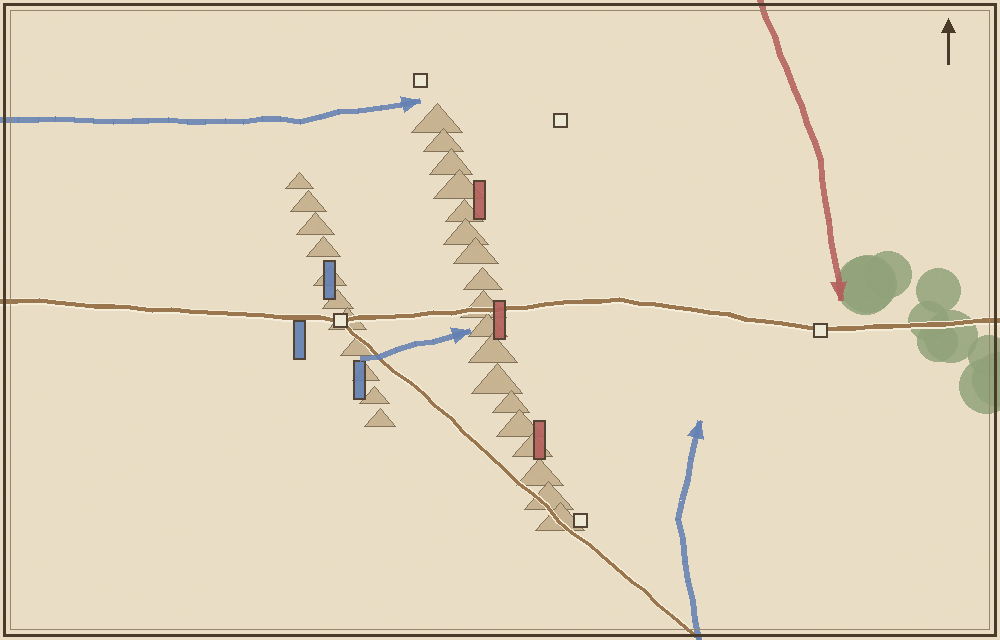 Eylau church (Napoleon)
Russian grand battery (70 guns)
Augereau (lost in the blizzard)
Murat's cavalry charge
Davout (from the south-east, morning)
Lestocq (4 p.m.)
Ney (7 p.m.)
Kutschitten
Serpallen
Eylau church (Napoleon)
Russian grand battery (70 guns)
Augereau (lost in the blizzard)
Murat's cavalry charge
Davout (from the south-east, morning)
Lestocq (4 p.m.)
Ney (7 p.m.)
Kutschitten
Serpallen