Battle of Yangren
191 · China Medium
Sun Jian's Army — Dong Zhuo's Army · 10 turns · 50 units
Briefing
「惟孫堅小戇、頗能用人、當語諸將、使知忌之」
"Only Sun Jian, blunt and stubborn as he is, knows how to use his men. Tell the generals to be wary of him." -- Dong Zhuo to his chief clerk Liu Ai (Shanyang Gong Zaiji, quoted in the commentary to the biography of Sun Jian, Records of the Three Kingdoms)
28 against 22. Dong Zhuo's army has more pieces. Yet at the start it may move only 5 of them in a turn.
In the second year of Chuping (AD 191) Dong Zhuo sent Hu Zhen, Grand Protector, with Lü Bu as commander of horse and five thousand foot and cavalry, against Sun Jian at Yangren. Hu Zhen was short-tempered; he let it be known that "once I cut off one head that wears the blue ribbon, this army will be in order", and the officers hated him. The army was to rest at Guangcheng. Lü Bu and others gave out that "the rebels in Yangren have already fled" and marched it on through the night. The town was well guarded. When the men had unbuckled their armour to rest, someone cried that "the rebels are coming out of the town", and the whole force ran for a dozen li, throwing away armour and losing saddles and horses. At daybreak they found there was no enemy. They picked up their weapons and came back. The board opens that morning, at six o'clock.
[The side in the town: Sun Jian's Army] 22 units; 8 may be moved each turn. North and west of Yangren runs a ditch deepened overnight: a defender attacked across those hexsides is doubled. The south and east are open. Dong Zhuo's army is strung out along the road to the north-west in the order in which it returns, with Hua Xiong, its commandant, at the head. Receive it behind the ditch, or sally against the head of the column?
[The side on the road: Dong Zhuo's Army] 28 units. The activation limit begins at 5; two are added on Turn 4 and two on Turn 7, making nine. The main body threw away its armour, and its combat strengths are set one step lower. Lü Bu and the horse of Bing Province, five units, are standby troops and stay in the wood north of the road. They wake if attacked or if an enemy comes adjacent, but will not begin to move of their own accord before Turn 7 (15% on T7, rising by 15% each turn). The larger army spends the morning unable to use its hands.
[Points] The result is decided by a single margin. Margin = (points of objectives you hold - points of objectives the enemy holds) + (losses inflicted - losses suffered). The objectives are Yangren 30, the Liang Road 10 and the Ru Ford 10 (Sun Jian), and the Guangcheng Road 20 (Dong Zhuo). If the margin, seen from Sun Jian's side, ends above the victory line (+28), Sun Jian wins; below it, Dong Zhuo wins. 7 points beyond the line is a tactical victory, 53 an operational victory, 106 an overwhelming victory. Within 7 points of the line the game is a draw.
[Names on the pieces] Sun Jian's Army: Sun Jian; Cheng Pu; Zhu Zhi; Huang Gai; Han Dang; Zu Mao, who at Liangdong wore Jian's red headcloth as a decoy; Sun Ben; Wu Jing. Changsha, Lingling and Guiyang are the troops of the three southern commanderies where Jian raised his army; Yuzhou, troops of Yu Province; Nanyang, the men guarding the supply road from Luyang. Dong Zhuo's Army: Hu Zhen (Grand Protector); Hua Xiong (commandant); Lu Bu (commander of horse); Bing Horse, the cavalry of Bing Province; Liangzhou, foot and horse of Liang Province; Qiang-Hu; Sili, troops absorbed at Luoyang. Not on the board: Xu Rong and Li Meng, whose separate force had beaten Jian east of Liang; Li Jue, later the envoy sent to offer peace; Yuan Shu, at Luyang, who held the grain.
[Decisions to try] First, for Sun Jian: your limit is 8. Send everyone out and the town stands empty; send no one and you wait for the enemy's limit to recover on Turns 4 and 7. How much will you strike in the morning?
Second, for Sun Jian: go near Lü Bu's wood and five units wake. Can you strike Hua Xiong's column and leave the wood untouched?
Third, for Dong Zhuo: you have 5 moves. Use them to support Hua Xiong at the front, or to close up the column behind? Lü Bu will not come when called.
[What followed] Sun Jian sallied, routed the enemy and took the head of the commandant Hua Xiong. Soon afterwards someone told Yuan Shu that "if Jian takes Luoyang he can no longer be controlled; it is to be rid of a wolf and gain a tiger", and the grain stopped. Jian rode more than a hundred li to Luyang by night, drew his plan on the ground and argued, and the grain was sent. Dong Zhuo sent Li Jue to propose peace, offering to make Jian's kinsmen inspectors and governors. Jian refused and advanced to Dagu, ninety li from Luoyang. Dong Zhuo left for Chang'an; Jian entered the burnt capital and closed the opened tombs.
Not long afterwards Jian was shot dead at Mount Xian, near Xiangyang. He was thirty-seven.
"Cut off one blue ribbon," said the general
"The rebels have already fled," someone said
"They are coming out of the town," someone cried
A dozen li of running, and then the day broke
The man they were told to be wary of
opens the gate in the morning
In the Romance of the Three Kingdoms it is Guan Yu who kills Hua Xiong. In the histories it was Sun Jian's army. The histories record Hu Zhen's night of confusion (Yingxiong Ji) and Jian's great victory at Yangren (the main biography) separately, and their order is uncertain; this board follows the account of the Zizhi Tongjian and sets them in a single morning. The position of Yangren, the month, the day and the hour are estimates.
1 hex = 500 m, 1 turn = 1 hour, 1 CS = about 70 men. T1 = 06:00, Chuping 2 (daybreak; Dong Zhuo's army returns); T4 = 09:00 (its limit begins to recover); T7 = 12:00 (Lü Bu may begin to move by chance); T10 = 15:00.
Maps
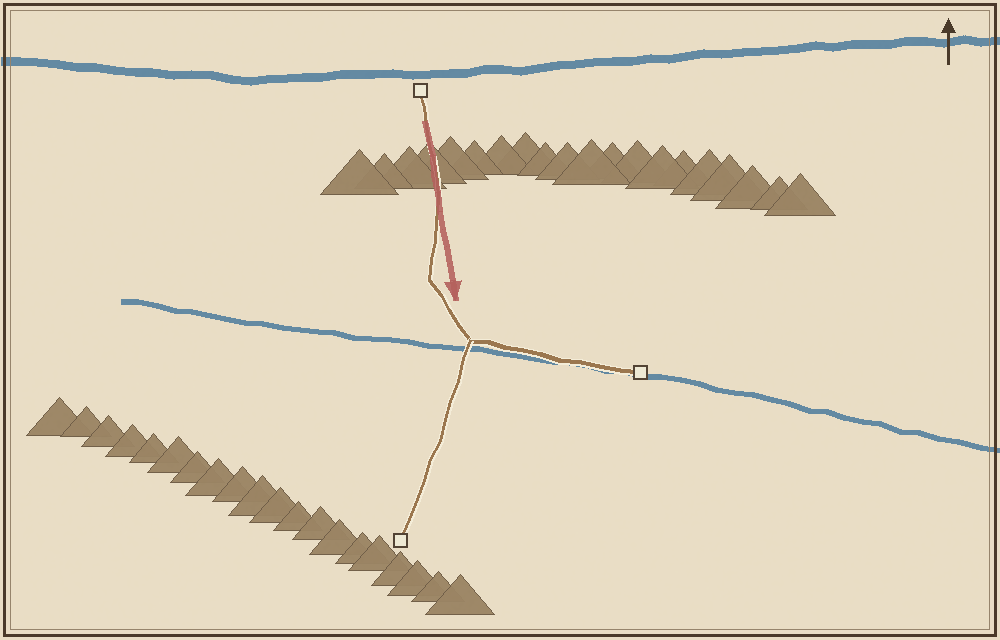 YANGREN
Luoyang (Dong Zhuo)
Luyang (Yuan Shu; Sun Jian's base)
Liang
Guangcheng
Dagu Pass
Ru River
Mount Song
Funiu Mts.
Hu Zhen: five thousand foot and horse
YANGREN
Luoyang (Dong Zhuo)
Luyang (Yuan Shu; Sun Jian's base)
Liang
Guangcheng
Dagu Pass
Ru River
Mount Song
Funiu Mts.
Hu Zhen: five thousand foot and horse
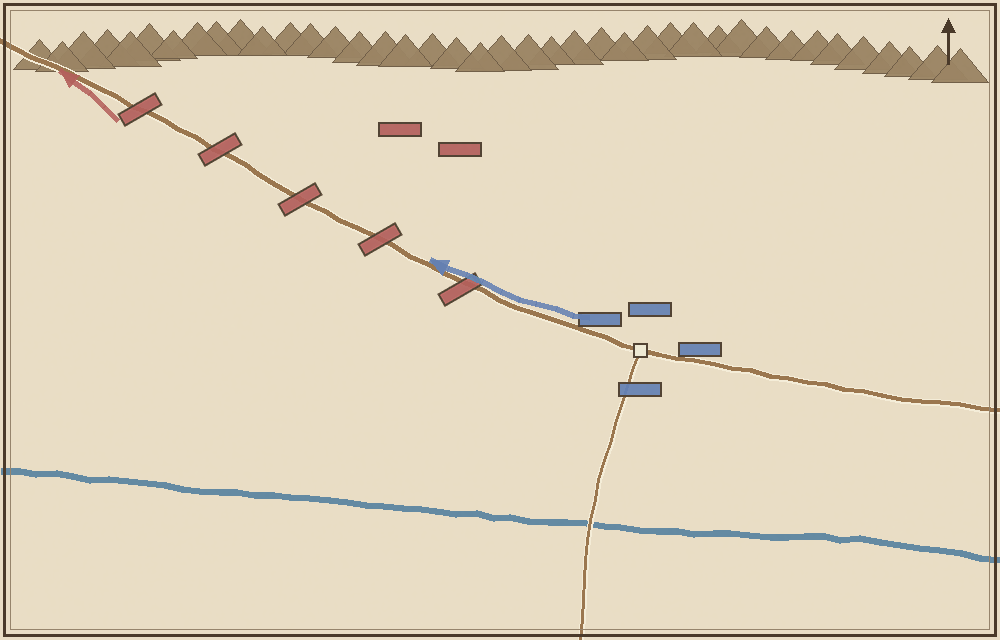 Yangren (Sun Jian)
marched all night; no camp, no ditch
"The rebels are coming out of the town!"
Lü Bu's horse (stands aside)
Sun Jian sallies
Hua Xiong, the commandant
to Guangcheng and Luoyang
to Luyang (the supply road)
to Liang
Ru River
Yangren (Sun Jian)
marched all night; no camp, no ditch
"The rebels are coming out of the town!"
Lü Bu's horse (stands aside)
Sun Jian sallies
Hua Xiong, the commandant
to Guangcheng and Luoyang
to Luyang (the supply road)
to Liang
Ru River