Battle of Agincourt 1415
1415 · Europe
25 October 1415 · Between the woods of Azincourt and Tramecourt, near Azincourt, close to Hesdin, Pas-de-Calais, Hauts-de-France, France
French Army — English Army · 9 turns · 49 units
AI personality: French Army Auto / English Army Auto
See this battle in the battle list
The picture we hope to see
On a narrow, muddy field between woods, the advancing French jam together under their own numbers and are broken by the smaller English army.
Briefing
25 October 1415. Between the woods of Azincourt and Tramecourt, near Azincourt, close to Hesdin, Pas-de-Calais, Hauts-de-France, France
Nestrocque!
(perhaps 'Now strike!') — Sir Thomas Erpingham, throwing his baton into the air (Monstrelet, Chronicle)
Between one wood and the other there are fewer than nine hundred paces.
After taking Harfleur, the English army, wasted by dysentery, marched seventeen days towards Calais, and on 24 October found the French barring the road between two villages. It rained all night on fields freshly ploughed. In the morning the French formed in three lines: vanguard, main battle and rearguard. The Constable, the Marshal and nearly all the great lords crowded into the vanguard. For three hours neither side moved. Then the king had the archers pull up their stakes, advance to within bowshot, and drive them in again. The English numbered about eight thousand, most of them archers; the French nearly twice as many.
[How the French win] Break the English line. Between the two woods the front is only nine hexes wide. The vanguard (Albret, Boucicaut, Orleans, Bourbon) must walk across the muddy field (3 MP) to reach it; the cavalry on the wings (Clignet, Bosredon) can be sent at the archers behind the stakes. The king (Henry V) is a sudden-death unit: kill him and you win at once. On turn 3 the lord of Azincourt (Azincourt Ysembart) enters from the west edge and can fall upon the English camp at Maisoncelle (20 points). On turn 5 the Duke of Brabant (Brabant) arrives from the north edge. The rearguard (Marle, Fauquembergue and the mounted servants) is a standby group: from turn 6 it may move by chance (20% on turn 6, +20% each turn), or as soon as an enemy comes next to it or attacks it. You may move up to 10 units per turn. The victory line is 12: the French win if their margin exceeds 12.
[How the English win] Hold the line and shoot. The archers (Archers, Erpingham) have a range of 2, and the archers' hexes on both wings have stakes (entrenchments) facing north. Lose the king and you lose. Guard the camp with the single baggage guard (Baggage), or take men from the line? The French hold the road to Calais (20 points) and the villages of Azincourt and Tramecourt (10 each). You may move up to 12 units per turn.
[Commanders] French: Charles d'Albret, Constable (Albret) / Marshal Boucicaut (Boucicaut) / Charles, Duke of Orléans (Orleans) / John, Duke of Bourbon (Bourbon) / the Count of Eu (Eu) / the Count of Vendôme (Vendome, left wing) / Arthur, Count of Richemont (Richemont, right wing) / Admiral Dampierre (Dampierre) / Guichard Dauphin (Dauphin) / the Count of Nevers (Nevers) / Clignet de Bréban (Clignet, cavalry) / Louis de Bosredon (Bosredon, cavalry) / David de Rambures, Master of the Crossbowmen (Rambures) / John, Duke of Alençon (Alencon, main battle) / Edward, Duke of Bar (Bar, main battle) / the Count of Vaudémont (Vaudemont) / the Count of Marle (Marle) / the Count of Fauquembergue (Fauquembergue) / Antoine, Duke of Brabant (Brabant) / Ysembart d'Azincourt (Azincourt).
English: Henry V (Henry V) / Humphrey, Duke of Gloucester (Gloucester) / Edward, Duke of York (York, right wing) / Lord Camoys (Camoys, left wing) / the Earl of Huntingdon (Huntingdon) / the Earl of Oxford (Oxford) / the Earl of Suffolk (Suffolk) / Sir Thomas Erpingham (Erpingham, archers) / Sir John Cornwall (Cornwaille) / Dafydd Gam (Gam).
Not on the board: King Charles VI and the Dauphin (not present) / Robinet de Bournonville (the baggage raid) / Montjoie, the French chief herald.
[Decisions this board lets you try]
- (French) Send the cavalry at the staked archers first, or with the vanguard?
- (French) Close the main battle up behind the vanguard, or leave a gap? Close it up, and men fall on top of the fallen.
- (English) Keep the archers behind their stakes, or send them into the melee?
- (English) Leave the baggage guard, or thicken the line?
[Outcome] The French cavalry was stopped by stakes and arrows, and its horses, fleeing back, threw the vanguard into disorder. The vanguard waded through the mud and, pressed by the woods into a mass that could not move, struck the English line; men fell on top of the fallen. The archers came in from the flanks with axes and mallets. The Duke of Alençon struck at the king and was killed, and the crown on the king's helmet was broken. When the baggage was attacked and the French rearguard seemed to be gathering, the king ordered the prisoners killed, and withdrew the order when the threat passed. The French dead are put at about six thousand, among them the Constable, the Admiral, the Master of the Crossbowmen and three dukes. The Duke of Orléans spent twenty-five years in England. The English lost a little over a hundred, the Duke of York and the Earl of Suffolk among them. The English reached Calais and crossed the sea in November. Five years later, by the Treaty of Troyes, Henry became heir to the throne of France.
Rain fell on nine hundred paces of field
Three lines of knights struck as one dense mass
From behind the stakes, the archers came out with axes
The Duke of Orléans did not come home for twenty-five years
Nestrocque
The road from that one cry led to Troyes
The three French lines (vanguard about 5,000, main battle about 3,000, rearguard) are folded into 30 units, and the English (dismounted men-at-arms and archers) into 19. The sources disagree widely on numbers (English 6,000–9,000, French 12,000–25,000), and on who led the main battle and the rearguard. The English camp at Maisoncelle actually lay about a kilometre to the south. The three hours before the fighting and the English advance are not on the board.
1 hex = 80 m, 1 turn = 20 minutes, 1 CS ≈ 200 men. Turn 1 = 25 October 11:00, turn 9 = 13:40.
Maps
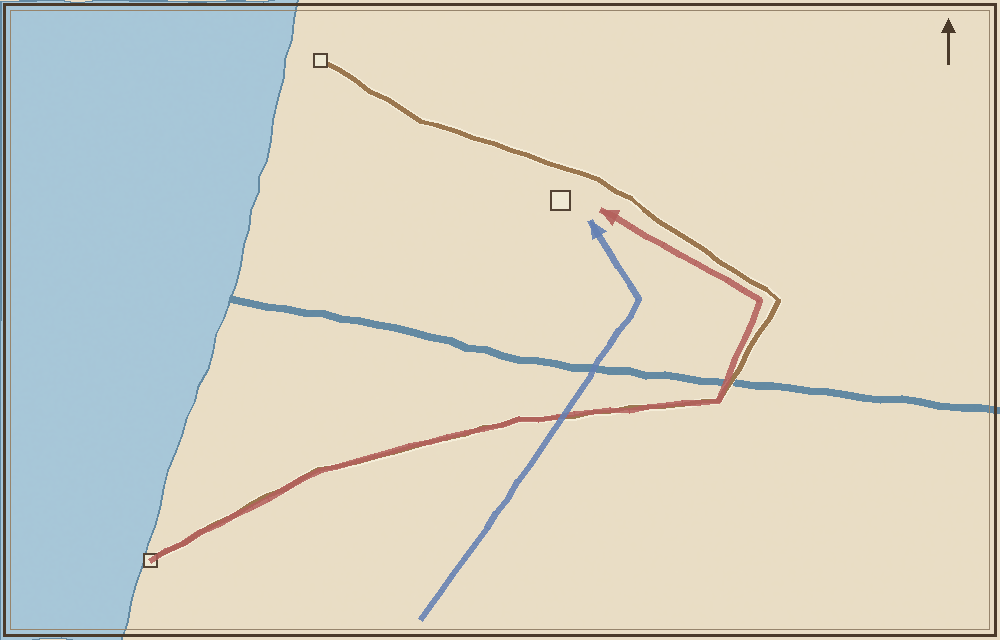 AGINCOURT
Calais
Harfleur (taken in September)
River Somme
English Channel
English march (17 days)
French army (from Rouen, getting ahead)
to Paris
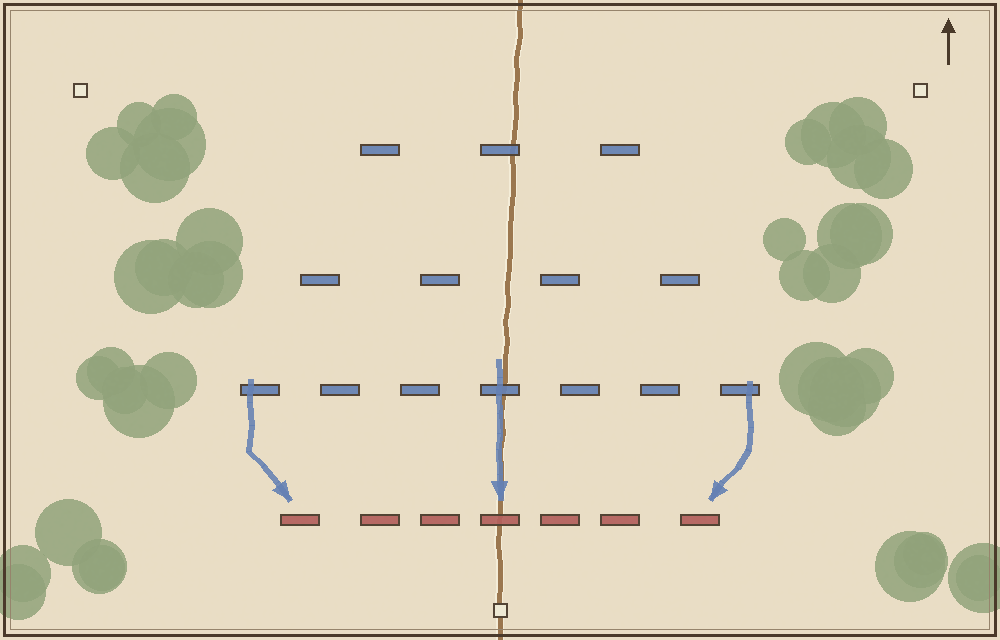 freshly ploughed field (mud)
Maisoncelle (English camp and baggage)
Azincourt
Tramecourt
Azincourt wood
Tramecourt wood
archers and stakes (both wings)
French vanguard (dismounted knights)
main battle (Alençon, Bar)
rearguard (mounted servants, no commander)
cavalry charge (both wings)
Ysembart's raid on the baggage
to Calais (the English goal)