Battle of Marathon 490 BC
490 BC · Europe
Late summer (August or September), 490 BC · The plain of Marathon and the Great Marsh, Marathonas, East Attica, Greece
Athenians and Plataeans — Persian Army (Datis) · 8 turns · 33 units
AI personality: Athenians and Plataeans Cautious / Persian Army (Datis) Delay
See this battle in the battle list
Briefing
Late summer (August or September), 490 BC. The plain of Marathon and the Great Marsh, Marathonas, East Attica, Greece
"They were the first Greeks we know of to charge their enemy at a run, and the first to endure the sight of Median dress and the men who wore it."
— Herodotus, Histories 6.112 (paraphrase)
The army that King Darius sent under Datis and Artaphernes crossed the Aegean, burned Eretria, and beached its ships at Marathon, north-east of Athens. Its guide was Hippias, the tyrant whom Athens had once driven out. Athens sent ten thousand hoplites, and Plataea sent its whole levy of one thousand. For several days the two armies faced each other between the sanctuary of Herakles at the mouth of the valley and the beach. The ten generals were divided, but at the urging of Miltiades the polemarch Callimachus decided to fight.
[How the Athenians win] Take the Persian ships on the beach (20 points) and the Persian camp (10 points), and hold the sanctuary of Herakles (15 points) and the road to Athens (15 points). The victory line is -14: the Athenians win if the score difference from their side is above -14. The Athenians may activate 12 units per turn on turns 1 and 2, and 8 from turn 3 (after the run their legs are heavy).
[How the Persians win] Take the road to Athens and the sanctuary of Herakles. If the line breaks, they may run for the ships: each unit that leaves the board by the beach on the north edge (Schinias) scores 10 points per CS (up to 22 points in all), for the men who got aboard and put out to sea. The Persians may activate 10 units per turn.
[Commanders] Athenians: Callimachus (polemarch, right wing; Callimachus), Miltiades (general; Miltiades), Stesilaus (general; Stesilaus), Themistocles (tribe Leontis; Leontis Themistocles), Aristides (tribe Antiochis; Antiochis Aristides) and Cynegeirus (Cynegeirus). Tribal units carry the tribe's name (Aiantis, Erechtheis and the rest); the left wing is the Plataeans (Plataea).
Persians: Datis (Datis) and Artaphernes (Artaphernes). The centre is Persians (Persians) and Saka (Saka), and the wings are levies of the subject peoples (Medes, Levy).
Not on the board: Hippias (guide to the Persian army) and Arimnestus (commander of the Plataeans).
[Decisions this board lets you try]
- (Athenians) How far to let the thin centre give ground? Can the wings win before the centre is broken through?
- (Athenians) With the victorious wings, pursue the fleeing enemy, or turn inward and close on the enemy centre?
- (Persians) Push through with the strong centre, or make for the ships before the army breaks?
- (Persians) How many units to leave guarding the ships?
[Outcome] In the centre the Persians and the Saka won and drove the Athenians back inland. On both wings, however, the Athenians and Plataeans won; instead of pursuing they turned inward and closed on the victorious enemy centre from both sides. The Persians fled to their ships on the beach, and many were lost in the Great Marsh. The Athenians clung to the ships and took seven of them. Herodotus gives six thousand four hundred Persian dead and one hundred and ninety-two Athenian. Callimachus and Stesilaus fell, and Cynegeirus, who had seized the stern of a ship, had his hand cut off with an axe. The Persian fleet sailed round Cape Sounion to strike at Athens, but the Athenian army had marched back to the city the same day.
Match the enemy's length, and only one rank is left for the centre
Eight stades at a run, carrying the heavy shield
The centre was broken, and the wings won
The wings did not pursue; they turned inward
A hand that clung to a ship on the beach was cut off with an axe
The dead were buried under a mound on the plain, and the mound is there still
Numbers: about ten thousand Athenians and one thousand Plataeans; most estimates put the Persian army at twenty to thirty thousand (estimates vary). Combat strengths are not head counts but values worked back from the ways to win (the tribes of the centre are one rank of CS 2, the wings two ranks of CS 4). Of the order of the tribes, only Callimachus and the tribe Aiantis on the right, the tribes Leontis and Antiochis in the centre and the Plataeans on the left are recorded; the rest were placed by the author. Where the Persian cavalry was that day is not known, so it is not on the board. The day and the hours are estimates.
1 hex = 150 m, 1 turn = 30 minutes, 1 CS = about 250 men. T1 = 06:00, T8 = 09:30.
Maps
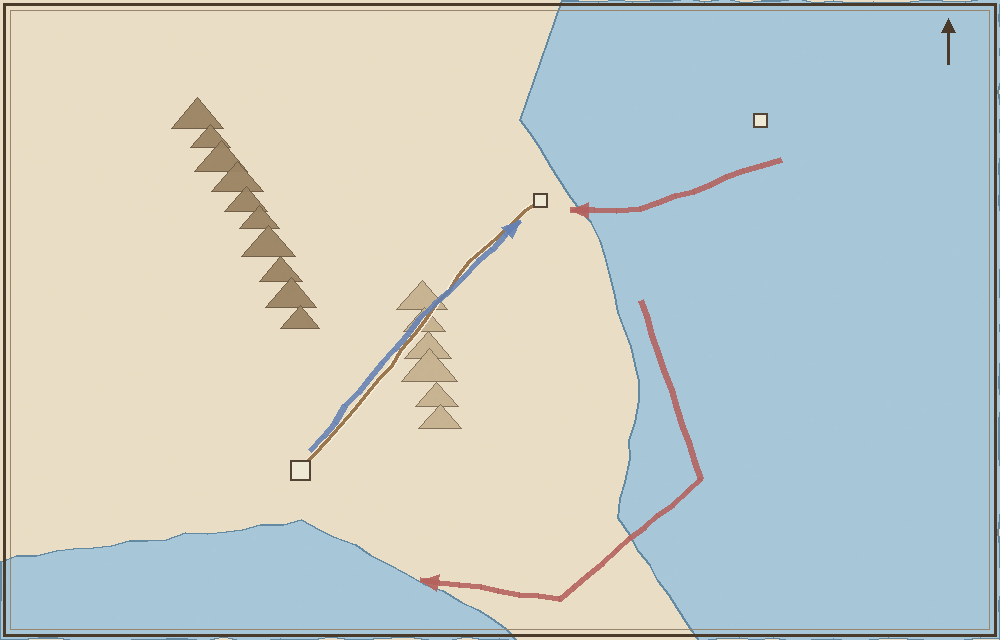 MARATHON
Athens
Eretria (burned)
Euboea
Plataea (sends a thousand)
the fleet of Datis
Phaleron (the fleet sails round)
Mt Parnes
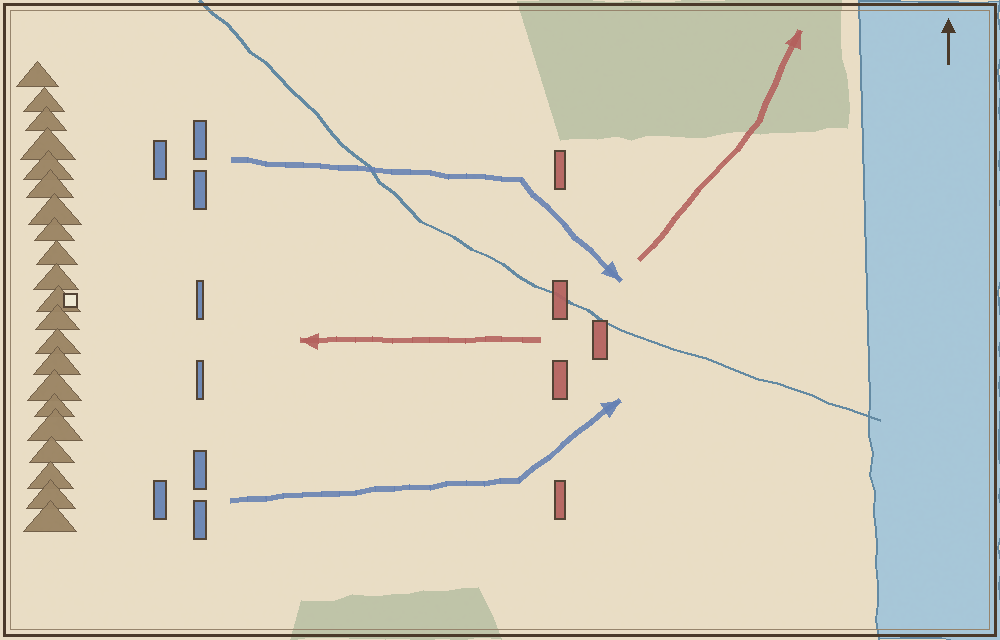 MARATHON
thin centre (one rank)
strong wings
running eight stades
the victorious wings turn inward
to the ships (seven taken)
Great Marsh
Persians and Saka