Kato Ichiran (War of Kato)
1545 · Japan Medium
Imagawa & Takeda — Hojo · 9 turns · 47 units
Briefing
"On the sixteenth, the day hinoe-ne, at the hour of the Dragon, Yoshiwara fell of itself."
-- Komai Kohakusai, Kohakusai-ki, entry for the 9th month of Tenbun 14 (the campaign diary of a retainer of Takeda Harunobu)
Hold on to Nagakubo Castle, or send the troops back beyond Hakone? Hojo Ujiyasu had two enemies. From the west came Imagawa Yoshimoto and Takeda Harunobu; and beyond Hakone, the two Uesugi houses and the Koga kubo were besieging the Hojo castle of Kawagoe. On the sixteenth day of the 9th month, the Hojo abandoned Yoshiwara castle without a fight, passed through the marshes of Ukishimagahara, and fell back behind the Kise River. The board begins four days later, on the twentieth, when the Kohakusai-ki writes "Yoshimoto is at Nagakubo". The Imagawa main body is camped at the foot of Ashitaka west of Nagakubo Castle, and Harunobu's men of Kai at Okanomiya. The Hojo are in the castle, on the east bank of the Kise, and at Mishima. There are no reinforcements.
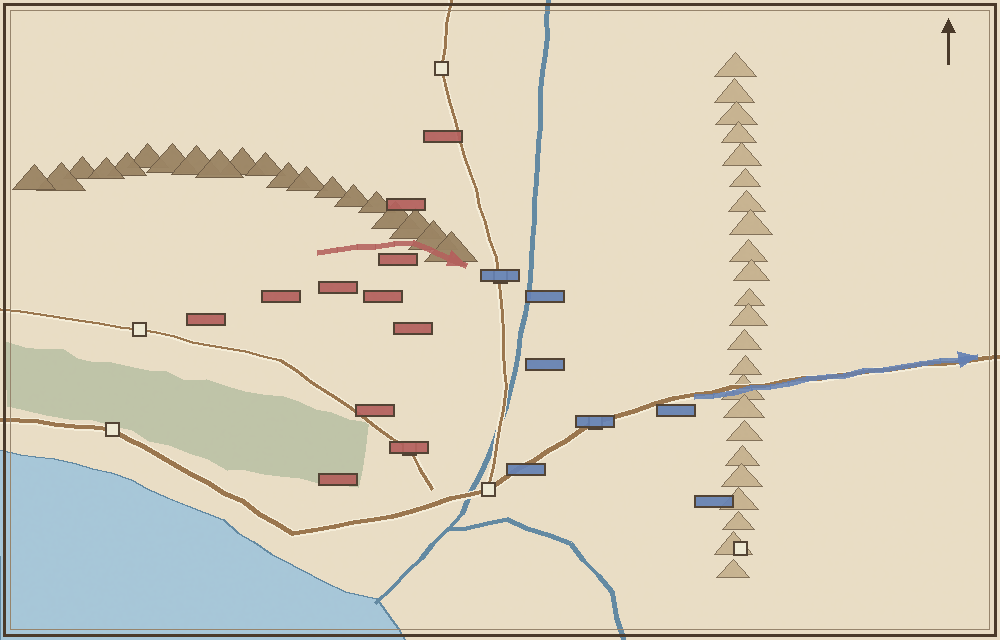
[Nagakubo Castle] The castle hex is a fortress. A unit inside need not attack even when enemies are adjacent, and it stays where it is, ignoring retreat results. The only way to take it is to surround it and wear it down. The Kise River divides the board from north to south, and attacking across it doubles the defence.
[The Hojo who do not move] Of the nineteen Hojo units, thirteen are standby forces: six in the castle and on the bank to its east, and seven along the Kise line. Neither group can move of its own accord until an enemy comes adjacent or attacks it, and when a group wakes, it wakes all together. Only the six units of the Odawara and Sagami contingents at the rear can move freely.
[The reluctant Takeda] The nine units of Harunobu's Kai contingent (Takeda Harunobu, Itagaki Nobukata, the Kurihara Band, the Mukoyama Band and five Kai-shu units) are also standby forces. Harunobu came into Suruga at Yoshimoto's request, but he had little wish to cross swords with the Hojo in earnest, and in the end he joined Sessai in mediating between the two armies. The Takeda group wakes all together when an enemy comes adjacent or attacks it, or when the seven Hojo units on the Kise line wake. Conversely, when the Takeda group wakes, the Hojo on the Kise line wake at the same moment: the two groups are linked to each other. The Takeda do not wake when the six units of the castle group wake.
[The Hakone road] Hojo units can leave the board by the exit of the Tokaido climbing east from Mishima (three hexes on the eastern edge of the board). Each unit that leaves scores 2 points per point of combat strength: it means troops from Suruga were sent back to Kawagoe.
[Margin and victory line] The "margin" on screen is a single number seen from the Imagawa-Takeda side: the difference in points of the places held, plus losses inflicted minus losses suffered. Points the Hojo earn by the Hakone road go to the Hojo side. The margin opens at -70 (Nagakubo Castle, 40, and Mishima, 30, are Hojo). The victory line is -80. If the margin on the final turn is -80 or higher, the Imagawa-Takeda side wins; below it, the Hojo win; the further from the line, the higher the grade of victory.
In other words, if nothing happens, the Imagawa-Takeda side wins. Holding the castle is not enough for the Hojo. They must push the margin down by at least eleven more points, either by inflicting more losses than they suffer or by sending troops back to the Kanto. For the Imagawa-Takeda side, taking either the castle or Mishima makes things much easier, but every loss run up in a forced attack hands points to the Hojo.
[Counters that can move at once] The Imagawa-Takeda side can move six of twenty-eight. To surround and wear down the castle in nine turns, you must choose which six to bring up and in what order. While the nine Takeda units are asleep, however, only the nineteen Imagawa units can actually be brought up. The Hojo can move twelve of nineteen, but while thirteen are asleep there is use for only six.
[Commanders] Imagawa-Takeda: Imagawa Yoshimoto / Taigen Sessai (a monk of Rinzai-ji and Yoshimoto's strategist, who also sat at the peace talks) / Asahina Yasuyoshi (lord of Kakegawa Castle) / Okabe Chikatsuna / Matsui Sadamune (lord of Futamata Castle) / Fuji Nobutada (chief priest of the Fuji shrine) / Kazurayama Ujimoto (who had left the Hojo for the Imagawa the year before) / Takeda Harunobu (the later Shingen) / Itagaki Nobukata / Kurihara Band and Mukoyama Band (only their surnames appear in the Kohakusai-ki).
Hojo: Hojo Ujiyasu / Hojo Genan (the youngest son of Soun; by one account the commander at Nagakubo) / Hojo Tsunataka / Matsuda Morihide (senior retainer) / Daidoji Morimasa / Tame Mototada / Kasahara Tsunanobu (district governor of Izu) / Shimizu Tsunayoshi.
The ten men Asahina, Okabe, Matsui, Fuji, Tsunataka, Matsuda, Daidoji, Tame, Kasahara and Shimizu have been placed as senior retainers of their houses at the time. The author has not been able to confirm a source placing them in the field in this campaign. Not counters: Hojo Tsunashige (shut up in Kawagoe Castle) / Komai Kohakusai (who kept the diary of this campaign and, on the fifteenth of the 10th month, went with Itagaki and Mukoyama as envoys to Ujiyasu's camp).
[Decisions this board lets you test]
1. When, and how many, do you send back to the Kanto? Send the six at the rear early and you earn points, but the ground behind Mishima is left empty. Send them late and the Imagawa may close the exit of the Hakone road.
2. Do you hurry the siege of the castle? The closer you come to the castle, the more you wake the Hojo sleeping east of the river.
3. Do you cross the Kise? Cross and you meet doubled defence at the river edge. Do not cross, and the seventy points of the castle and Mishima stay with the Hojo.
4. Once woken, do the Hojo cross the river to relieve the castle? The historical Ujiyasu did not.
5. Do you wake the Kise line? Wake the Hojo on the river line and the Takeda at Okanomiya wake too and join in. Surround only the castle without waking them, and the Takeda may never move before the board ends. The historical Harunobu chose mediation over battle.
[Outcome] On the twenty-seventh of the 9th month, Harunobu had a bridge built over the Kise. But Nagakubo Castle did not fall. On the fifteenth of the 10th month, Itagaki, Mukoyama and Kohakusai went to Ujiyasu's camp at Kuwabara, and on the twenty-second both armies ceased shooting. On the twenty-fourth, through the mediation of Harunobu and Sessai, the Imagawa and the Hojo made peace, and on the sixth of the 11th month the Hojo handed over Nagakubo Castle and returned the lands east of the Fuji River to the Imagawa. Ujiyasu turned his troops towards the Kanto. In the 4th month of the following year, Tenbun 15, a night attack by a handful of men broke the siege by the Uesugi and the Koga kubo, who claimed eighty thousand. This was the night battle of Kawagoe. Uesugi Tomosada of the Ogigayatsu line was killed that night, and his house came to an end. Nine years later, Kai, Sagami and Suruga exchanged daughters in marriage, and the three houses entrusted their backs to one another.
The castle did not fall; it was handed over.
The arrows stopped on the twenty-second.
The troops who crossed Hakone were in time for the night at Kawagoe.
The promise to guard one another's backs began with this winter's peace.
The positions at Yoshiwara, Imai and Senbon Matsubara from the sixteenth to the nineteenth of the 9th month are treated as having been settled before the board. The coming and going of envoys and the ceasefire in the 10th month are not events on the board. No source gives the numbers of troops, so the men per CS are the author's own setting. The coastline is an estimate that undoes the construction of the ports of Tago-no-ura and Numazu.
1 hex = 900 m, 1 turn = 4 days, 1 CS = about 200 men. T1 = 9/20 (Yoshimoto at Nagakubo), T2 = 9/24 (the bridge over the Kise on the 27th), T7 = 10/14 (envoys to Kuwabara on the 15th), T8 = 10/18 (Nagakubo Castle inspected on the 20th), T9 = 10/22 (both sides cease shooting).
Maps
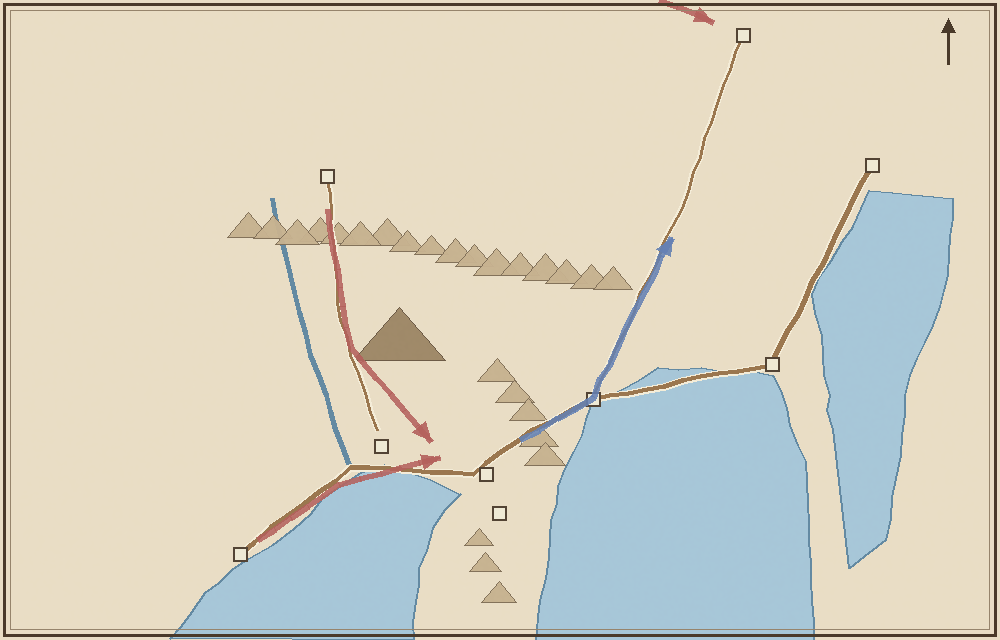 KATO ICHIRAN (NAGAKUBO)
Sunpu
Kofu
Zentokuji
Odawara
Kamakura
Edo
Kawagoe
Nirayama
Mt. Fuji
Hakone
Suruga Bay
Sagami Bay
Izu
Imagawa Yoshimoto
Takeda Harunobu
Hojo Ujiyasu
Uesugi & Koga Kubo
KATO ICHIRAN (NAGAKUBO)
Sunpu
Kofu
Zentokuji
Odawara
Kamakura
Edo
Kawagoe
Nirayama
Mt. Fuji
Hakone
Suruga Bay
Sagami Bay
Izu
Imagawa Yoshimoto
Takeda Harunobu
Hojo Ujiyasu
Uesugi & Koga Kubo
 Nagakubo Castle
Mishima
Kisegawa
Okanomiya
Kuwabara
Kazurayama
Kokokuji
Hara
Ashitakayama
Ukishima-ga-hara
Kise R.
Kano R.
Hakone
Imagawa
Takeda
Hojo
to Kanto
Nagakubo Castle
Mishima
Kisegawa
Okanomiya
Kuwabara
Kazurayama
Kokokuji
Hara
Ashitakayama
Ukishima-ga-hara
Kise R.
Kano R.
Hakone
Imagawa
Takeda
Hojo
to Kanto