Battle of Malplaquet
1709 · Europe Medium
Grand Alliance — Armee de Flandre · 10 turns · 70 units
Briefing
"Si Dieu nous fait la grâce de perdre encore une pareille bataille, Votre Majesté peut compter que ses ennemis sont détruits."
"If God gives us the grace to lose another such battle, Your Majesty may count on it that his enemies are destroyed." -- Marshal Villars, shot through the knee, from his stretcher to King Louis XIV (the form widely quoted as a letter after the battle; the wording varies between versions).
The French army lost. The allied army held the field. Yet after this one day, it was France that drew breath again. The allies lost some 21,000 men; the French some 12,000. The winners left behind nearly twice as many as the losers. Europe would not see dead on this scale again for a hundred years.
11 September 1709, on the border of Flanders and Hainaut. The allies were besieging Mons, and Villars had come out to make them raise the siege. But he did not attack. From the evening before, he had his men dig entrenchments across the one-kilometre gap between two woods, packed 75,000 men into it, and waited. At half past seven on the morning of 11 September, Marlborough and Eugene opened fire on its front.
On this board the result is decided by a single margin. The margin is the difference in objective points plus the difference between losses inflicted and losses suffered. In other words, losses come straight off the margin. Break through the entrenchments and take every objective, and if you have melted away your army doing it, what you took flows from your right hand into your left. The character of the battle of Malplaquet was already inside this formula from the start, without any special rule being added.
[How the allies win] The margin opens at minus 96, because every entrenchment, wood and hamlet belongs to the French. The victory line is plus 60. The distance to push back is 156 points. The central redans, Les Redans, are worth 30; the front edge of the western wood, Bois de Sars, and the eastern breastwork, Laniere Abatis, 22 each; the bottom of the defile, Aulnois Gap, 18; and the village of Malplaquet 20. Break through as history did and pay as history did, and the margin comes to about plus 87, just 27 points above the victory line: the lightest of the seven grades of victory. To go higher, you must take the whole board and also come out in the black on losses.
[How France wins] France need not hold everything. It starts on the right side of the line, so it is enough not to hand the allies 156 points. But the entrenchments do not come to you. Occupation means "stopping there", so an objective with no one standing on it becomes the enemy's the moment he steps onto it.
[The width of the front] The Bois de Sars to the west and the Bois de Laniere to the east. The two woods close in at the centre, and on the row where the redans stand, there are only five hexes between them: one kilometre. The allies have thirty-six counters, but only five can stand in front of the redans at once. The idea that the more numerous side cannot use its numbers is written not with the activation limit but with the shape of the board. The redans stand as a palisade: if every adjacent enemy strikes across that edge, the defence is doubled. If even one comes round the side, the effect is gone. So taking the woods is the key to opening the centre.
[The two CPs] There are two places on the board that carry no victory points. Both are in the woods, and all they give is moves. Sars Ride, the logging track through the western wood, raises the French limit from eleven to fourteen while France holds it, and lowers it to eight if the allies take it. The Bois Laniere in the east raises the allied limit from twelve to fifteen if the allies take it; nothing happens to France. The points, meanwhile, lie in the redans in the centre, where there is no CP. The wings clamour for moves, and the centre holds the points. The historical Villars kept sending troops from the centre into the western wood, and as a result left the central redans empty. At one in the afternoon, Orkney's British infantry walked in, and the cavalry came in behind them. Defending the woods is right. Defending them too much is the mistake.
[The western wood] There is only one place where no palisade stands: the Bois de Sars in the west. The central redans and the eastern breastwork were finished the day before, but work in this wood began only on the evening of 10 September and was not ready in time. It was held by trees and men alone. And the westernmost column of the board is not even woodland: it is bruyère, heathland, and one strip runs through it by which troops can go south around the outside of the wood. On T7 (12:00) and T8 (12:45), Withers's column enters from the northern mouth of this strip: nineteen battalions and cavalry. For the six turns before that, the allies must keep pushing from the front. Push too early and your men run out; push too late and when the column arrives there is nothing left for it to press.
[Commanders] Allies: joint command of John Churchill, Duke of Marlborough, and Prince Eugene of Savoy (shot in the head, he bound it up and went on commanding). In the centre, George Hamilton, Earl of Orkney (it was his men who entered the empty redans), John Campbell, Duke of Argyll, and the chief of staff William Cadogan. On the right, Schulenburg's forty battalions and Count Lottum's twenty-two Prussian battalions. On the left, Johan Willem Friso, Prince of Orange (twenty-two years old; he had two horses shot under him that day), and Count Tilly's Dutch. Generals Spaar and Oxenstierna were killed in front of the eastern wood. The cavalry: Hompesch, the Prince of Auvergne, the Duke of Württemberg's Danish horse, and Frederick of Hesse-Kassel (later King of Sweden). The flanking column: Henry Withers.
France: Marshal Villars. His second was Marshal Boufflers, who though the senior had volunteered to serve under Villars, and who took over the whole army after Villars was wounded. In the centre, Pierre de Montesquiou d'Artagnan (made a marshal after this battle). The entrenchments were laid out by the chief of staff, the Marquis de Puységur; the artillery was under Saint-Hilaire. The wood on the left: the Marquis d'Albergotti. In the wood on the right stood the French Guards, the Swiss Guards, the guard of the exiled Elector of Bavaria, and the Irish Brigade: regiments with no country to return to. Behind the redans, the Maison du Roi horse under the Chevalier de Luxembourg.
Three people are not on the board. Louis XIV waited for the news at Versailles. 1709 was the year of the Great Frost, and France was starving. That spring the King had been presented with humiliating terms of peace and had rejected them. Malplaquet was the price. Antoine de Gramont, Duc de Guiche, was colonel of the French Guards; only the unit's name appears on its counter. And Sarah Churchill, Duchess of Marlborough, would watch the number of this day's dead reach London and become ammunition in party politics, until her husband lost his office two years later.
[Outcome] At three in the afternoon Boufflers ordered the retreat. The French army fell back to Bavay in good order and took most of its guns with it. There was hardly any pursuit, because the pursuers had no strength left for it. The allies held the field and took Mons on 20 October. That was all they took. The Dutch infantry lost half its strength, and the States General never again put an army of the same size into the field. In London the number of the dead became material for the peace party, and Marlborough was dismissed in 1711. The peace concluded at Utrecht four years later was far lighter for France than the terms Louis XIV had rejected in the spring of 1709. Had the King given way that spring, these twenty-one thousand and twelve thousand need not have died. In France children still sing "Malbrough s'en va-t-en guerre": a song said to have been born of a false report that Marlborough had died on this field, a song born of a mistake.
One kilometre of redans, dug the evening before.
Twenty-one thousand and twelve thousand; the winners left the more behind.
They carried home one town, and lost the weight of a peace.
The letter dictated from a stretcher sums up the day in one line:
if God gives us another such defeat,
Your Majesty may count his enemies destroyed.
The building of the redans on the previous day, 10 September, the retreat after three in the afternoon, and the surrender of Mons in October are not on the board. The board covers the seven and a half hours from half past seven in the morning to three in the afternoon. For strength, recent middle estimates have been used (allies 86,000 / France 75,000), not the upper end of contemporary reports. On the board the allies have a combat strength of 149 and France 138, closer than the ratio of numbers, because the quality of the Guards, the Maison du Roi and the Irish Brigade has been added to the French side. The triple entrenchments have been folded into a single palisade, and orders of battle totalling some 240 battalions into seventy brigade-sized counters. Some names of French infantry regiments and of the allied German contingents are inferred from the organisation of the army in Flanders at the time.
1 hex = 200 m, 1 turn = 45 minutes, 1 CS = about 600 men. T1 = 9/11 07:30 (the allied guns open), T3 = 09:00 (the Dutch assault), T7 = 12:00 (the first part of Withers's column), T8 = 12:45 (the second part), T9 = 13:30 (Villars wounded; the central redans broken), T10 = 14:15 (the cavalry battle in the defile; it ends at 15:00). The allies can move 12 counters at a time (14 from T7; +3 if they take the eastern wood), France 11 (14 while it holds the western wood; 8 if it is taken). The victory line is plus 60 from the first side's (the allies') point of view, and the opening margin is minus 96.
Maps
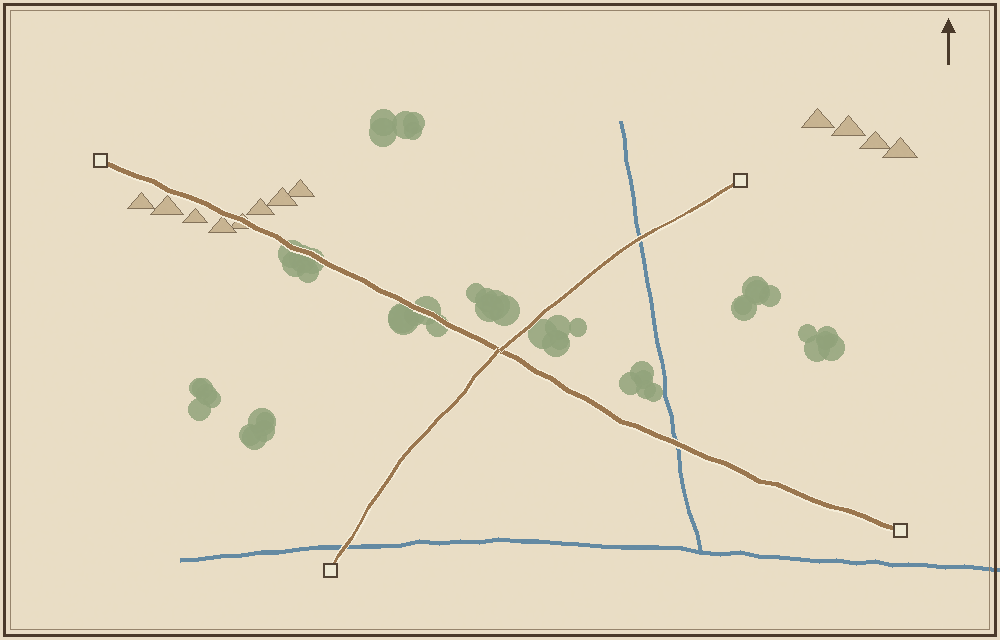 MALPLAQUET
Mons
Tournai
Bavay
Maubeuge
Sambre R.
the woods
Valenciennes
MALPLAQUET
Mons
Tournai
Bavay
Maubeuge
Sambre R.
the woods
Valenciennes
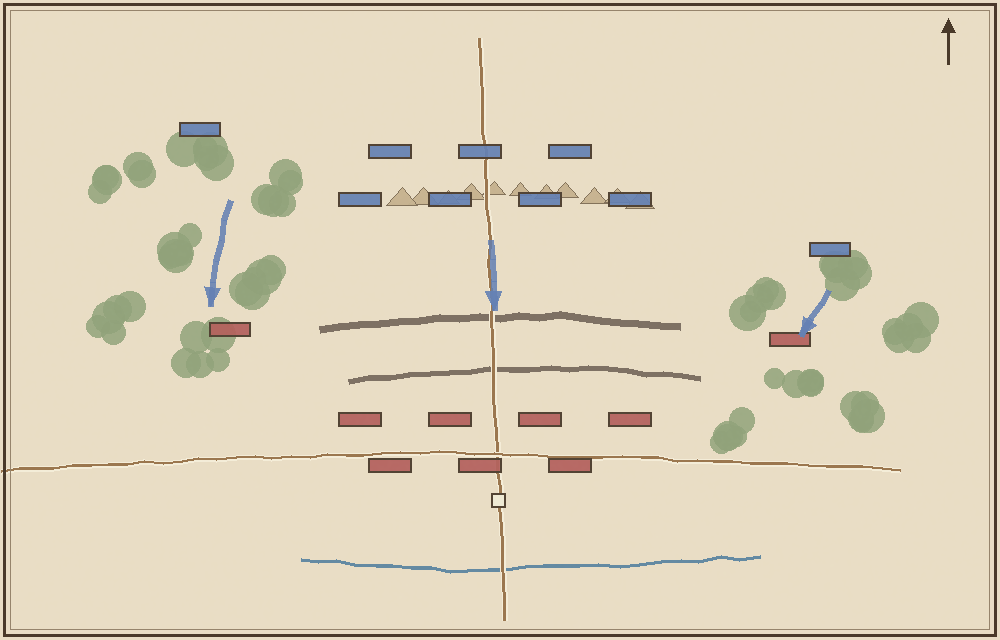 French entrenchments
Bois de Taisnieres
Bois de Lanieres
Malplaquet
the Allies come from here
to Valenciennes
French entrenchments
Bois de Taisnieres
Bois de Lanieres
Malplaquet
the Allies come from here
to Valenciennes