Battle of Westport
1864 · North America Long
Union (Army of the Border) — Confederate (Army of Missouri) · 13 turns · 78 units
Briefing
"... driving the enemy far beyond the battle-ground, beyond Missouri into Kansas and beyond the town of Santa Fé." -- Lieutenant-Colonel Frederick Benteen, report dated 3 November 1864. Twelve years later, at the Little Bighorn, he would serve under Custer.
23 October 1864, Westport, Missouri: the morning of the largest battle fought west of the Mississippi. Sterling Price's Confederates, eight and a half thousand men, nearly all mounted, and five hundred wagons, had spent a month crossing Missouri, and now they are caught between two forces.
In front, beyond Brush Creek to the north, stand Curtis and Blunt with the Army of the Border and the Kansas militia. Behind, beyond the Big Blue to the east, is Pleasonton's cavalry division, which has followed them for a month. There is only one road by which the Confederate wagons can escape: south, along the Kansas line, towards Fort Scott.
At dawn Blunt crossed the frozen Brush Creek and pushed south. Shelby's Iron Brigade threw him back. The same morning, to the east, Pleasonton struck Marmaduke at Byram's Ford.
[How to win] The result is decided by a single margin. Margin = (points of objectives you hold - points of objectives the enemy holds) + (losses inflicted - losses suffered). There are six objectives worth 120 points: Westport 30, Byram's Ford 25, Brush Creek 20, Wornall House 20, Forest Hill 15, State Line Bluff 10. The Union starts with 40 points, the Confederates with 60, and the Brush Creek crossing belongs to no one. If the margin seen from the Union side ends above the victory line (+99 points), the Union wins; below it, the Confederates win. Finish 9 points beyond the line for a tactical victory, 70 for an operational victory, and 139 for a strategic victory. Short of 9, it is a draw.
[The way back] The Confederates alone can leave the board by its southern edge, between the Fort Scott road and the Harrisonville road. Each unit that gets away scores one point per point of combat strength, and each wagon train scores a further ten. Even without winning the battle, getting the wagons away to the south brings this side close to victory. Historically, Price did exactly that behind a screen of prairie fires.
[Counters that can move at once] Union: eighteen, with two more on turn 3 (Blair's brigade arrives from Kansas City). Confederates: seventeen.
[Commanders] Union: Curtis = Samuel Curtis (Army of the Border), Blunt = James Blunt (cavalry division), Jennison = Charles Jennison, Moonlight = Thomas Moonlight, Ford = James Ford (2nd Colorado Cavalry), Blair = Charles Blair (militia and the 9th Wisconsin Battery), Deitzler and Grant = the Kansas State Militia. Pleasonton = Alfred Pleasonton (cavalry division), Philips, McNeil, Sanborn and Winslow = his four brigades (when Winslow was shot, Benteen took over), Cole = Nelson Cole (artillery).
Confederates: Price = Sterling Price (Army of Missouri), Shelby = Joseph Shelby, Thompson = M. Jeff Thompson (the Iron Brigade), Jackman and Tyler = Shelby's other two brigades, Fagan = James Fagan, Cabell, Dobbins, Slemons and McCray = his brigades, McGhee's AR = the Arkansas cavalry that charged down Wornall Lane, Marmaduke = John Marmaduke, Clark and Freeman = his brigades. On each counter, the upper name is the brigade commander and the lower is the regiment.
[Decisions this board lets you test] First (Confederates): do you strike Blunt in the north or stop Pleasonton in the east? You cannot hold both. Abandon one, and the wagons' road depends on how fast the other comes on.
Second (Confederates): when do you send the wagons south? Too early, and the escort is thin; too late, and the exit is closed.
Third (Union): where do Blunt, pushing from the front, and Pleasonton, coming from behind, join hands? Close the exit on the southern edge first, and the army caught between them cannot get out.
[Outcome] At midday, guided by an old local farmer, Curtis took the 9th Wisconsin Battery up the gully of Swan Creek and fired into Shelby's flank. About the same time, the west bank at Byram's Ford fell to Pleasonton, and the Confederates were pushed back to the line of the Wornall House and then to the line at Forest Hill. McGhee's Arkansas cavalry made a last charge down Wornall Lane and was stopped by the 15th Kansas Cavalry. Price set the prairie on fire and sent the wagons south behind the smoke. Each side lost about 1,500 men.
Two days later, at Mine Creek, Marmaduke and Cabell were taken prisoner. In early December Price passed through Arkansas and reached Texas with about a third of the men he had started with. The Confederacy never again mounted a major offensive west of the Mississippi.
In front, a frozen creek
Behind, cavalry that has followed for a month
Five hundred wagons, and one road south
From the gully, guns strike the flank
The prairie is set on fire
Behind the smoke, the wagons go
The fights at the Little Blue on 21 October, at Independence on 22 October and at Mine Creek on 25 October are left out. The ford at Hickman Mills lies off the south-eastern corner of the board, and parts of Cabell's and McNeil's commands are placed in that corner. Both armies were largely mounted and mostly fought dismounted, so the counters are not divided by arm. Each regiment is one counter; small battalions are grouped in pairs.
1 hex = 350 m, 1 turn = 1 hour, 1 CS = about 600 men. T1 = 23 Oct 07:00 (Blunt crosses Brush Creek), T3 = 09:00 (Blair arrives), T6 = 12:00, T13 = 19:00.
Maps
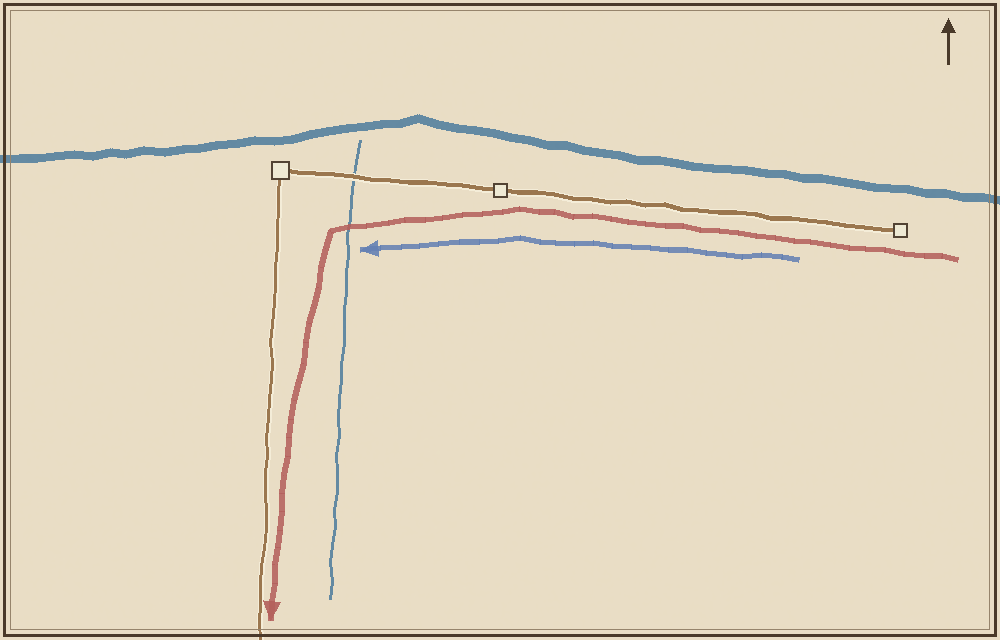 WESTPORT
Kansas City
Missouri River
Lexington (19 Oct.)
Independence (22 Oct.)
Kansas
Missouri
to Fort Scott (the way south)
Price's route (Sept.-Oct.)
WESTPORT
Kansas City
Missouri River
Lexington (19 Oct.)
Independence (22 Oct.)
Kansas
Missouri
to Fort Scott (the way south)
Price's route (Sept.-Oct.)
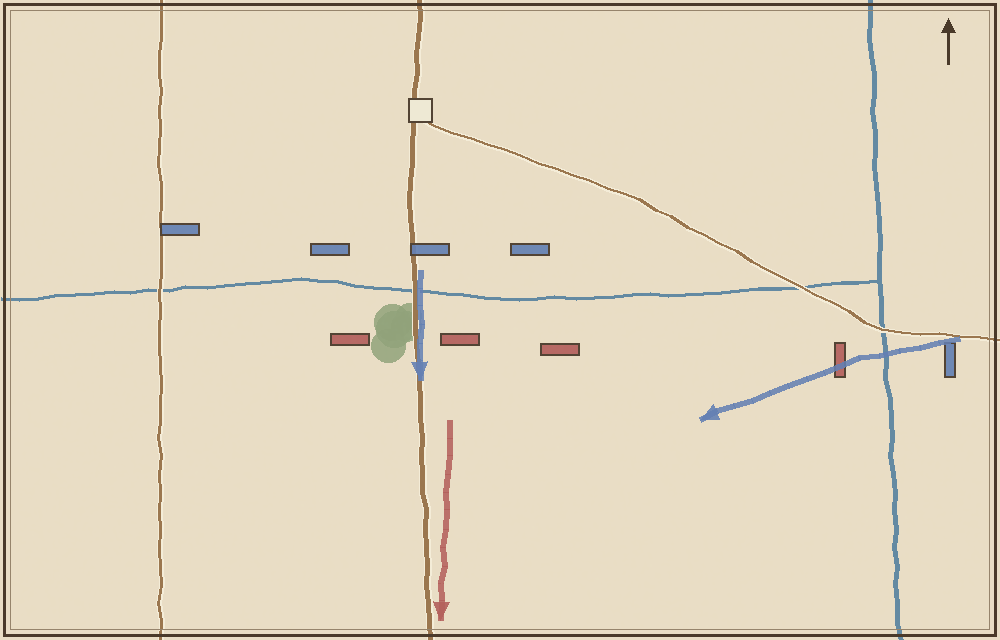 Westport
Brush Creek
Byram's Ford
Big Blue River
Wornall House
Blunt (in front)
Pleasonton (from behind)
Retreat behind prairie fires
Westport
Brush Creek
Byram's Ford
Big Blue River
Wornall House
Blunt (in front)
Pleasonton (from behind)
Retreat behind prairie fires