Battle of Leuthen
1757 · Europe Medium
Prussian Army — Austrian Army · 10 turns · 62 units
Briefing
Ich werde gegen alle Regeln der Kunst die beinahe dreimal stärkere Armee des Prinzen Karl angreifen, wo ich sie finde.
"Against all the rules of the art, I shall attack the army of Prince Charles, nearly three times stronger, wherever I find it." (Frederick II to his officers at Parchwitz, two days before the battle; tradition)
Thirty-five thousand against sixty-five thousand. Yet the smaller army can set more units in motion at once.
At noon on 5 December the Austrian army holds a line of some seven kilometres, from Nippern in the north to Sagschütz in the south, facing west. In the morning the Prussians made as if to strike the northern wing at Borne. Lucchesi called for help on the right, and Daun sent the reserve north. Meanwhile the Prussian columns swung south behind a line of low hills, and have just turned east at Lobetinz. Ahead of them lies the southern end of the line, Sagschütz, held by the auxiliaries of Württemberg and Bavaria.
[How the Prussians win] You may activate 12 units per turn; the Austrians only 10. Bring everything against the southern end and roll the line up northward from Sagschütz (15 points). Leuthen village (30) becomes the pivot of the new line, and beyond it lies the bridge at Lissa (20). Driesen's cuirassiers behind Radaxdorf (Driesen Cuirassiers) are surprise units: after the first combat they move together once more. Use them to strike the flank of Lucchesi's horse coming from the north. The victory line is -48: a Prussian score margin above -48 is a win.
[How the Austrians win] Turn the line without abandoning it. Bring the northern reserve (Daun Reserve) and Lucchesi's cavalry back south, and build a north-south front pivoting on Leuthen churchyard (Rot-Wurzburg). You have twice the men; the problem is activations and distance.
[Commanders] Prussia: Frederick II / the advance guard under Wedel (Wedel) / the right-wing infantry under Prince Moritz of Anhalt-Dessau (Moritz) / the left-wing infantry under Retzow (Retzow) and Forcade (Forcade) / the right-wing cavalry under Zieten (Zieten) and Lentulus (Lentulus) / the left-wing cavalry under Driesen (Driesen) / the 3rd Battalion of the Guard (Garde) / Regiment Meyerinck (Meyerinck) / the 12-pounders brought from the fortress of Glogau, the "Brummer" (Brummer).
Austria: Prince Charles of Lorraine (Charles) / Daun (Daun) / Lucchesi, right-wing cavalry (Lucchesi) / Nádasdy, left wing (Nadasdy) / Serbelloni, cavalry (Serbelloni) / Arenberg (Arenberg) / Regiment Rot-Würzburg (Rot-Wurzburg) / the Württemberg and Bavarian auxiliaries / the Croatian border troops.
[Decisions this board lets you try]
- (Prussia) Can you keep the left wing held back in the north (Retzow, Forcade) out of the fight to the end? The oblique order works only if one wing is refused.
- (Prussia) Once Sagschütz falls, do you go straight at Leuthen, or swing round to the south-east?
- (Austria) Do you bring the northern reserve back south? On the way it may walk into Driesen's flank.
[Outcome] The small hill south of Sagschütz (Kiefernberg) fell, and the Württembergers broke. The Austrians turned on Leuthen village and fought the Guard's 3rd Battalion inside the churchyard walls. At four o'clock Lucchesi's cavalry tried to strike the Prussian left from the north, but Driesen's cuirassiers came out from behind Radaxdorf, broke them from the flank, and Lucchesi was killed. At nightfall the Austrians fell back across the Weistritz. That night, it is said, the King entered the manor at Lissa, found it full of Austrian officers, and greeted them: "Good evening, gentlemen. Is there still room here?" (tradition). The Austrians lost more than twenty thousand men, half of them prisoners. Two weeks later Breslau capitulated, and Silesia was Prussian again. The hymn "Now thank we all our God", said to have risen from the ranks during the night march, came to be called the Leuthen Chorale. Napoleon judged the day a masterpiece of movement, manoeuvre and resolution (tradition).
Behind the hills, the columns marched south
Against an enemy three times stronger, they struck only the southern end
The churchyard wall became the last pivot
From behind Radaxdorf, the cuirassiers came out
A day fought against all the rules of the art
went into the textbooks of the art
The morning cavalry fight at Borne and the feint against the northern wing are folded into the opening set-up (the Prussian columns already swung south, Daun's reserve already sent north). The Austrian line is grouped into a few units per wing rather than by regiment.
1 hex = 300 m, 1 turn = 30 minutes, 1 CS = about 800 men. T1 = 5 December 12:00, T3 = 13:00 (Sagschütz), T8 = 15:30 (Leuthen), T10 = 16:30 (sunset).
Maps
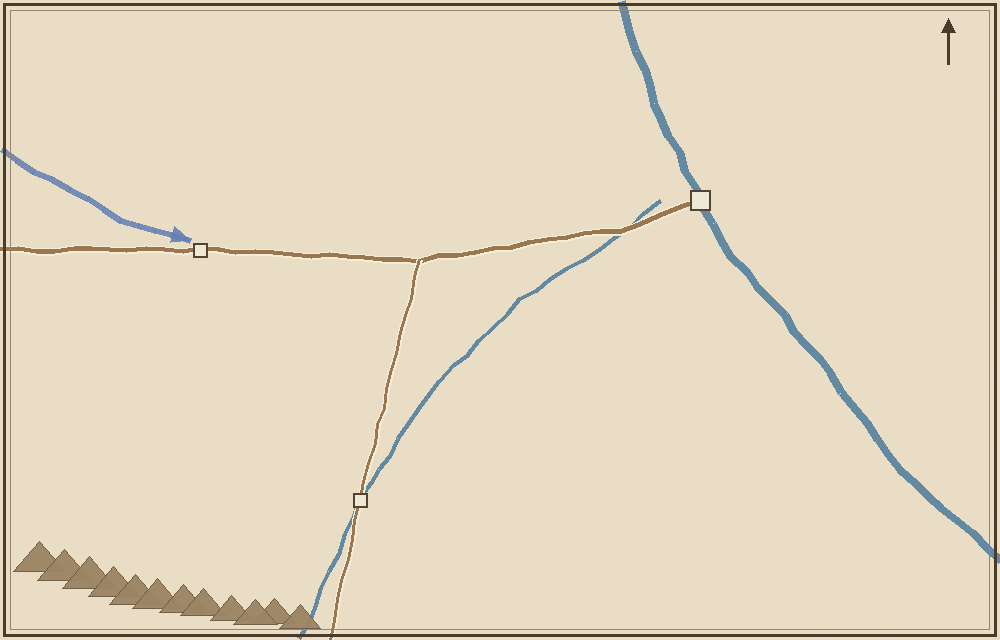 LEUTHEN
Breslau
Neumarkt
Schweidnitz (fortress taken by Austria)
River Oder
Silesia
from Rossbach (victory of 5 Nov.)
LEUTHEN
Breslau
Neumarkt
Schweidnitz (fortress taken by Austria)
River Oder
Silesia
from Rossbach (victory of 5 Nov.)
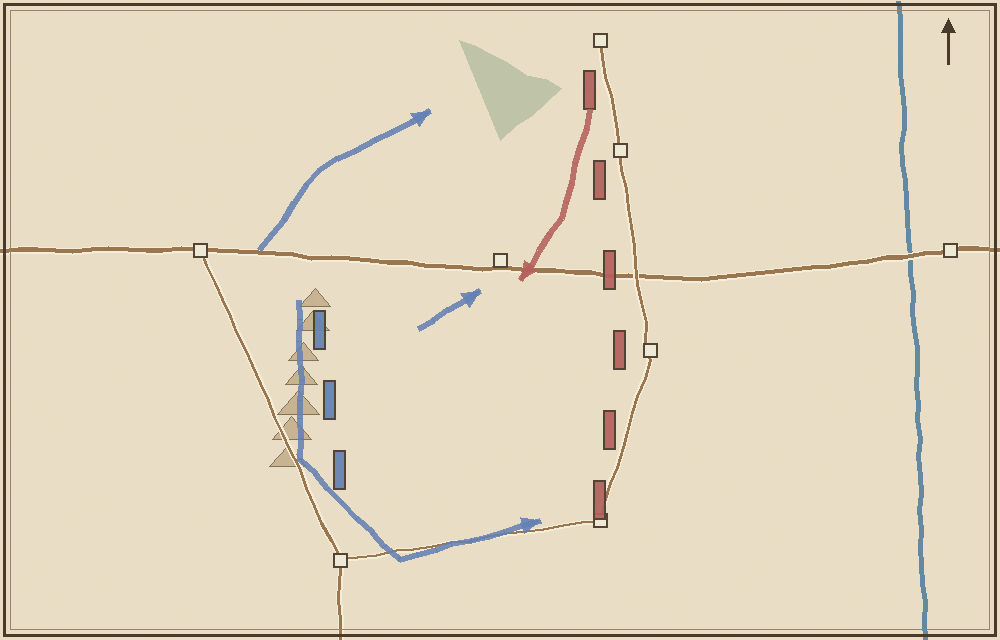 Leuthen (churchyard)
Nippern
Sagschütz
Borne
Lobetinz
Lissa
feint against the right
south behind the hills
oblique order
Württemberg troops
Lucchesi's counterstroke
Driesen (behind Radaxdorf)
Weistritz
Leuthen (churchyard)
Nippern
Sagschütz
Borne
Lobetinz
Lissa
feint against the right
south behind the hills
oblique order
Württemberg troops
Lucchesi's counterstroke
Driesen (behind Radaxdorf)
Weistritz