Battle of Franklin 1864
1864 · North America
30 November 1864 · The works south of the Harpeth River and Winstead Hill, Franklin, Williamson County, Tennessee, United States
Union (Schofield) — Confederate (Army of Tennessee, Hood) · 11 turns · 41 units
AI personality: Union (Schofield) Steady / Confederate (Army of Tennessee, Hood) Cautious
See this battle in the battle list
Briefing
30 November 1864. The works south of the Harpeth River and Winstead Hill, Franklin, Williamson County, Tennessee, United States
"Well, General, if we are to die, let us die like men."
— words Cleburne is said to have spoken to Granbury before the assault (tradition; paraphrase)
Having lost Atlanta, Hood's Army of Tennessee marched north into Tennessee to cut Sherman's communications. On the night of the 29th, at Spring Hill, Schofield's Union army slipped unnoticed along the road under the Confederates' noses and hurried north. Reaching Franklin the next morning, it dug a semicircle of works south of the town and repaired the bridges over the Harpeth, buying time to withdraw to Nashville. Furious at having let it escape, Hood ordered his whole army forward from Winstead Hill at four in the afternoon. Before it lay two miles of open field, with nothing to give cover.
[How the Union wins] Hold to the end the town and bridges of Franklin (25 points), the Carter House (20 points), the cotton gin (15 points) and the works on the Carters Creek Pike (10 points). The victory line is +15: the Union wins if the score difference from its side is above +15. The Union may activate 10 units per turn. Opdycke's brigade (Opdycke) is a standby unit waiting north of the Carter House: it rises if an enemy comes next to it or attacks it, and from turn 3 it has a 20% chance each turn to set out (rising by 30% each turn).
[How the Confederates win] Break the works and take the Carter House, the cotton gin, and the town and bridges. Winstead Hill (10 points) is Confederate at the start. The Confederates may activate 16 units per turn.
[Reinforcements and times] Confederates: Johnson's division of Lee's corps (T5, south edge, coming in on the western flank after dark). The Union receives no reinforcements. Sunset falls in turn 2 (16:35), but the assaults went on in the dark until about 21:00, so no night turns are set.
[Commanders] Union: Schofield (army commander) / XXIII Corps (Cox): Reilly's division (Reilly: Casement, Reilly, Stiles) and Ruger's division (Ruger: Moore, Strickland) / IV Corps (Stanley): Kimball's division (Kimball: Grose, Kirby, Whitaker), Wagner's division (Wagner: Conrad, Lane, Opdycke) and part of Wood's division (Wood). Units are brigades, named after their brigade commanders.
Confederates: Hood (army commander) / Cheatham's corps: the divisions of Cleburne (Cleburne), Brown (Brown) and Bate (Bate) / Stewart's corps: the divisions of Loring (Loring), French (French) and Walthall (Walthall) / Lee's corps: Johnson's division (Johnson) / Forrest's cavalry (Chalmers, Forrest).
Not on the board: Schofield, Cox, Stanley, Hood, Cheatham, Stewart and Lee (army and corps headquarters are not units).
[Decisions this board lets you try]
- (Union) Pull back Wagner's two brigades, left too far forward, or let them buy time where they are?
- (Union) Hold Opdycke's reserve until a gap opens, or put it into the line first?
- (Confederates) Where to mass for the crossing of the two miles of field: press along the whole line, or gather on one point on the Columbia Pike?
- (Confederates) Where to send Johnson's division, which arrives after dark?
[Outcome] Wagner's two brigades, left half a mile in front of the works, were swallowed by the Confederate wave and fled, and the Confederates, on the heels of the fleeing men, broke into the works at the Carter House and the cotton gin on the Columbia Pike. Then, without orders, Opdycke's brigade rushed out of its reserve position and sealed the gap hand to hand. The Confederates kept coming at the works again and again into the dark, until about nine. Confederate casualties exceeded six thousand; six generals were killed, Cleburne, Granbury, Adams, Strahl, Gist and Carter, and the bodies of five of them were laid out on the porch of Carnton. At midnight the Union army crossed the river and left for Nashville. Two weeks later, at the battle of Nashville, the Army of Tennessee fell apart.
Catching the enemy that had slipped away, the general in his anger ordered the charge
On two miles of field there was nothing to hide behind
The brigades left in front fled, and on their heels the attackers went into the works
Without orders the reserve rushed out and sealed the gap
They kept coming into the dark, and six generals did not return
At midnight, behind the Union army crossing the bridges, the Confederacy in the West was broken
Numbers: about twenty thousand Union troops in the forward position (about twenty-seven thousand including those north of the river), and about twenty thousand Confederates (estimates vary). Combat strengths are not head counts but values worked back from the ways to win (the Confederate brigades of 1864 were thin). The corps badges, the triangle of IV Corps and the shield of XXIII Corps, are shown on the units as corps-number squares. Confederate flags are not used. Brigade positions are approximate, and times differ between sources.
1 hex = 200 m, 1 turn = 30 minutes, 1 CS = about 600 men. T1 = 30 November 16:00, T11 = 21:00.
Maps
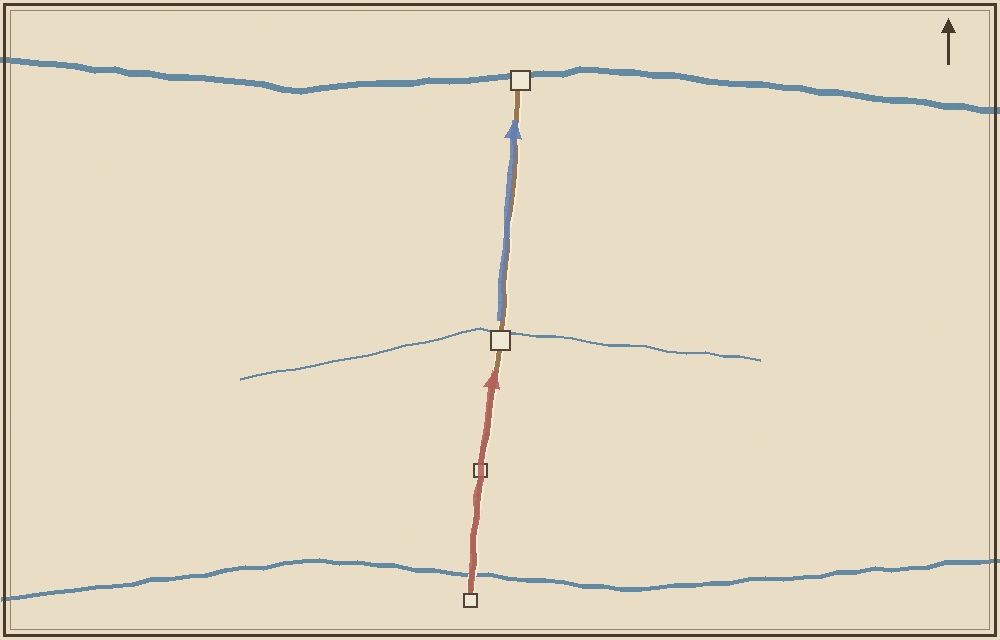 FRANKLIN
Nashville
Spring Hill (slipped past by night)
Columbia
Duck River
Cumberland River
Hood's Army of Tennessee
Schofield, for Nashville
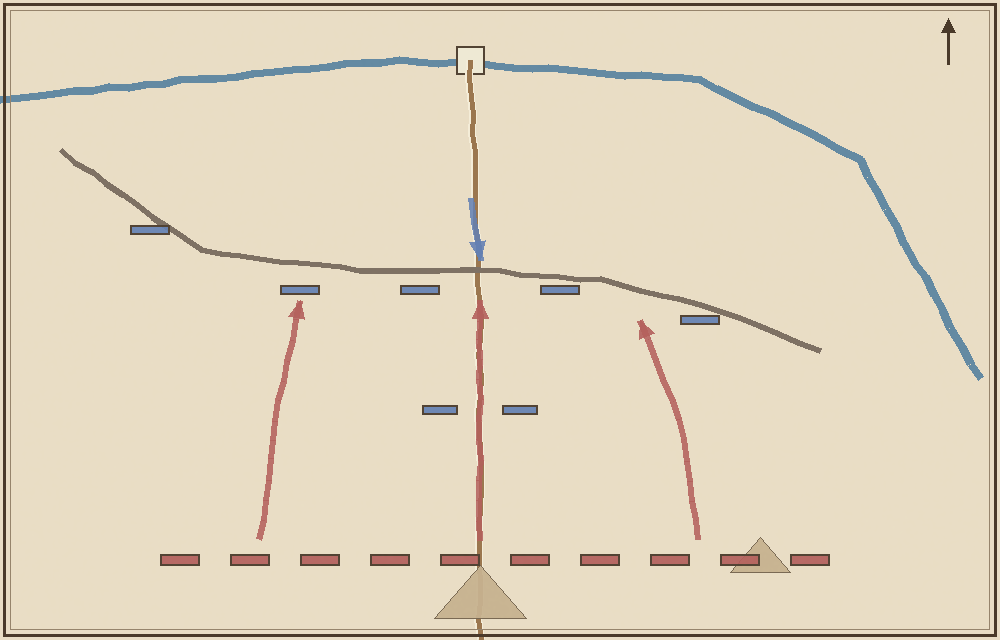 FRANKLIN
the semicircle of works
two miles of open field
Wagner, too far forward
Opdycke, without orders, into the gap
the Carter House and the cotton gin
Winstead Hill (step off at 16:00)
the guns of Fort Granger