Battle of Fredericksburg 1862
1862 · North America
13 December 1862 · The town of Fredericksburg, Virginia, United States of America, and the ridges to its west and south
Union (Army of the Potomac, Burnside) — Confederate (Army of Northern Virginia, Lee) · 12 turns · 84 units
AI personality: Union (Army of the Potomac, Burnside) Breakthrough / Confederate (Army of Northern Virginia, Lee) Cautious
See this battle in the battle list
The picture we hope to see
The only way through is the gap in the south. In the north, every attack on the stone wall only costs more.
Briefing
13 December 1862. The town of Fredericksburg, Virginia, United States of America, and the ridges to its west and south
"It is well that war is so terrible, or we should grow too fond of it."
— Robert E. Lee, watching the Union assaults from Lee's Hill
Lincoln removed McClellan and gave the Army of the Potomac to Ambrose Burnside. Burnside meant to cross the Rappahannock and march on Richmond, but the pontoons came late, and meanwhile Lee's Army of Northern Virginia lined the heights across the river. On 11 December the Union laid pontoon bridges opposite the town, drove out Barksdale's Mississippians who held it, and crossed. On the morning of the 13th, as the fog lifts, Franklin's Left Grand Division on the plain to the south and Sumner's Right Grand Division in the town to the north begin to move against the Confederates on the ridges.
[How the Union wins] Take Marye's Heights (30 points), Prospect Hill (25 points), Hamilton's Crossing (15 points) and Lee's Hill (15 points), and hold the town of Fredericksburg (10 points) and Franklin's Crossing (10 points). The stone wall below Marye's Heights and Marye's Heights itself are fortresses, and the Confederates holding them do not come out. In Jackson's line to the south there is a boggy wooded gap. VI Corps (Brooks, Howe, Newton) is a standby group: it will not move unless attacked or approached. V Corps of Hooker's Center Grand Division (Humphreys, Barnes, Sweitzer, Stockton, Buchanan, Andrews, Warren) is also a standby group, and from turn 4 it may also rise by chance (50%, +50% each turn). The victory line is -66: the Union wins if the score difference from its side is above -66. The Union may activate 15 units per turn.
[How the Confederates win] Hold the positions on the ridges, and take the town and Franklin's Crossing. Gregg's brigade behind the gap (Gregg) is resting and will not move until approached. Early's division (Lawton, Trimble, Early, Hays) and D.H. Hill's brigades (D.H. Hill) are standby groups, and from turn 5 they may also rise by chance (35%, +30% each turn). Pelham's guns (Pelham) and Stuart's cavalry (Fitz Lee, W.H.F. Lee) in the south-east corner lie on the flank of the Union left. The Confederates may activate 15 units per turn.
[Commanders] Union: Ambrose Burnside (commander-in-chief, at the Phillips House across the river) / Edwin Sumner (Right Grand Division) and Darius Couch (II Corps): William French's division (Kimball, Andrews, Palmer), Winfield Hancock's division (Zook, Meagher with the Irish Brigade, Caldwell), Oliver Howard's division (Owen, Hall, Sully) / Orlando Willcox (IX Corps): Samuel Sturgis (Nagle, Ferrero), George Getty (Hawkins, Harland), William Burns (Burns) / Joseph Hooker (Center Grand Division) and Daniel Butterfield (V Corps): Andrew Humphreys (Humphreys), Charles Griffin (Barnes, Sweitzer, Stockton), George Sykes (Buchanan, Andrews, Warren) / George Stoneman (III Corps): David Birney (Robinson, Ward, Berry), Daniel Sickles (Carr) / William Franklin (Left Grand Division) and John Reynolds (I Corps): George Meade (Sinclair, Magilton, C.F. Jackson), John Gibbon (Root, Lyle, Taylor), Abner Doubleday (Phelps, Meredith) / William Smith (VI Corps: Brooks, Howe, Newton) / George Bayard (Bayard, cavalry; killed by a shell that day) / Henry Hunt (Hunt, artillery).
Confederate: Robert E. Lee (on Lee's Hill) / James Longstreet (First Corps): Lafayette McLaws (Cobb, Kershaw, Barksdale, Semmes, Wofford), Robert Ransom (Ransom, Cooke), Richard Anderson (Wilcox, Mahone, Featherston, Wright, Perry), George Pickett (Kemper, Armistead, Garnett, Jenkins, Corse), John B. Hood (Law, Robertson, G.T. Anderson, Toombs), the Washington Artillery (Walton), E. P. Alexander (Alexander) / Thomas J. "Stonewall" Jackson (Second Corps): A. P. Hill (Pender, Lane, Archer, Brockenbrough, Thomas, Gregg), Jubal Early (Lawton, Trimble, Early, Hays), William Taliaferro (Paxton, Taliaferro), D. H. Hill (D.H. Hill), R. L. Walker (Walker, artillery) / J. E. B. Stuart (Fitz Lee, W.H.F. Lee) and John Pelham (Pelham).
Not on the board as persons: Thomas Cobb (mortally wounded at the wall) and Maxcy Gregg (mortally wounded) appear only as the names of their brigades / Joshua Chamberlain (20th Maine, Stockton's brigade) / Richard Kirkland (the Confederate sergeant who, on the 14th, carried water to Union wounded in front of the wall).
[Decisions this board lets you try]
- (Union) Keep attacking the stone wall, or mass troops on the gap in the south?
- (Union) When V Corps comes across, which front do you send it to?
- (Confederate) Bring the brigades behind forward to close the gap, or let the enemy in and envelop him from behind?
- (Confederate) Can you thin the wall to send troops south?
[Outcome] In the south, Pelham's two guns raked the flank of Meade's left for an hour and stopped it. At about one o'clock Meade's division plunged into the boggy wooded gap, broke Gregg's resting brigade and came out behind Jackson's line, but apart from Gibbon no one followed, and Early's counterattack drove them back beyond the railroad. Franklin left most of his sixty thousand men unused. In the north, from noon until dark, the divisions of French, Hancock, Howard, Sturgis, Griffin, Humphreys and Sykes charged the stone wall below Marye's Heights some fourteen times. No one reached the wall. The Union lost over 12,000 men, the Confederates over 5,000. On the night of the 15th the Union withdrew across the river. The following January, after the failure of the "Mud March", Burnside was relieved of command of the Army of the Potomac.
The pontoons came late, and the enemy lined the ridges first
As the fog lifted, blue columns marched out of the town onto the plain
In the south, one division entered the boggy gap and was driven back
In the north, fourteen times the charges went at the wall of the sunken road
Lest we grow too fond of it, said the general
No one reached the wall
Strengths: about 114,000 Union (engaged on the field) and 72,000 Confederates (estimates vary). Brigade positions are approximate; the northern half uses the same terrain points as next year's board (mFredericksburg1863), the southern half is approximate. The Union pontoon bridges are not drawn, and all Union units start on the west bank (V Corps "crossing in the afternoon" is represented as a standby group). Brigade and commander names are from memory (the author has yet to check them against sources).
1 hex = 400 m, 1 turn = 40 minutes, 1 CS = about 500 men. T1 = 10:00, T5 = 12:40, T12 = 17:20.
Maps
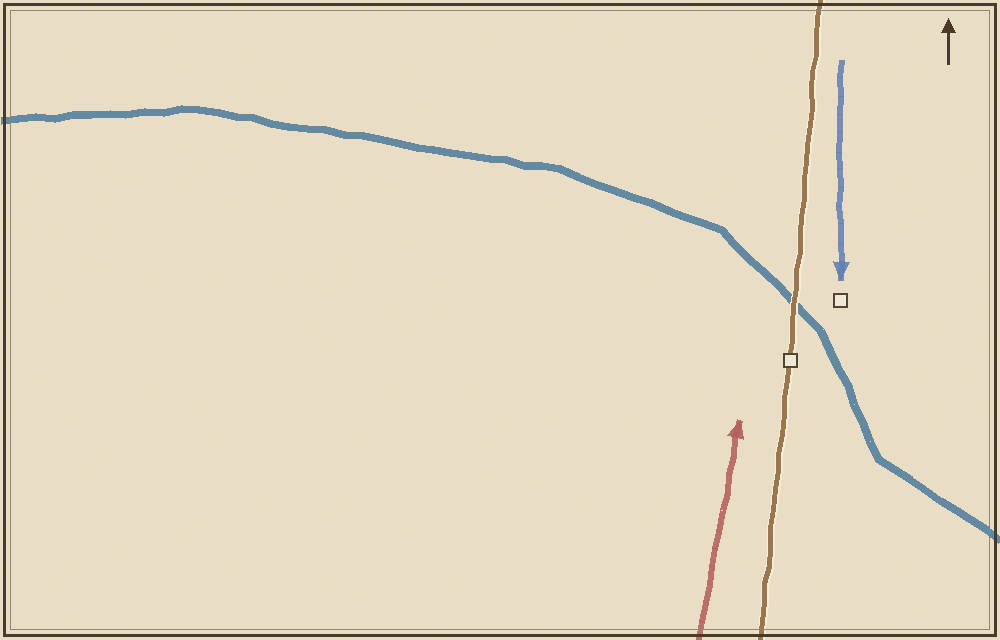 FREDERICKSBURG
Rappahannock River
to Washington
to Richmond
Falmouth (Union camps)
the pontoons arrive late (November)
Lee lines the ridges
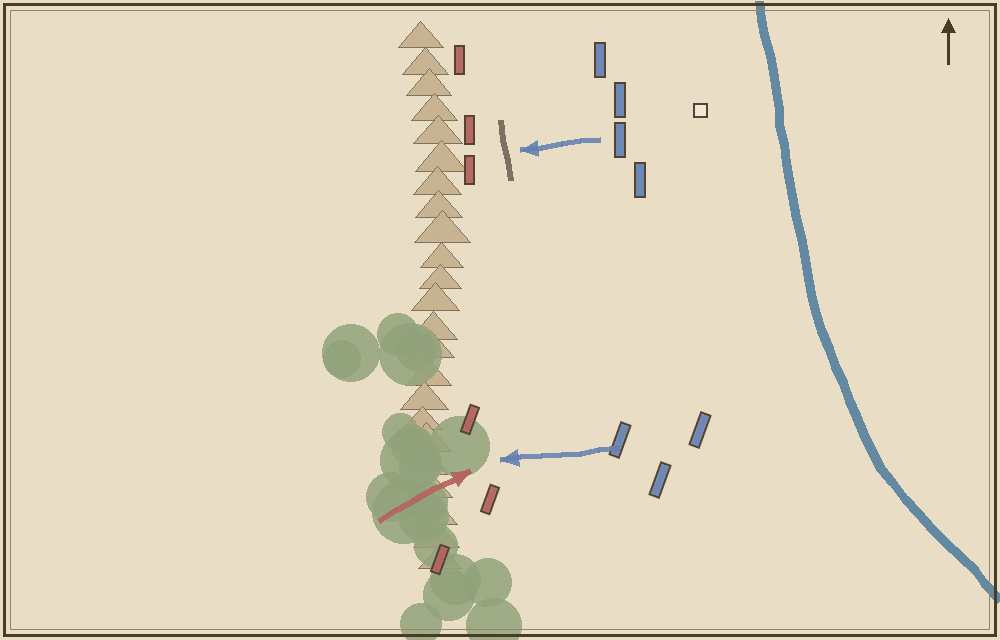 the stone wall below Marye's Heights (fourteen charges)
the boggy gap (Meade breaks in)
Early's counterattack
Pelham's two guns
Franklin (half his force never engaged)
Sumner and Hooker
Stafford Heights (Union guns)
Prospect Hill