Battle of Bicocca 1522
1522 · Europe
27 April 1522 · La Bicocca, Milan, Lombardy, Italy
French and Swiss — Imperial and Papal · 8 turns · 38 units
AI personality: French and Swiss Manoeuvre / Imperial and Papal Delay
See this battle in the battle list
Briefing
27 April 1522. La Bicocca, Milan, Lombardy, Italy
"Money, leave, or battle."
– the demand of the unpaid Swiss to Lautrec (paraphrased)
Driven out of Milan, the French commander Lautrec came back to retake it with Swiss mercenaries and Venetian troops. Prospero Colonna's Imperial and Papal army took up a position in front of the villa of La Bicocca, north of the city. He deepened the sunken lane before the villa and threw up a bank behind it, set the Marquis of Pescara's arquebusiers four ranks deep behind the bank, and placed Frundsberg's landsknechts behind them. The Swiss, angry at not being paid, demanded to be led into battle at once or they would go home.
[How the French and Swiss win] Take the sunken lane (10 points), the villa of La Bicocca (20) and the bridge to the south (10). All the objectives are on the Imperial side; without attacking there are no points. The victory line is -33: the French win if the margin from their side exceeds it. The French move first. Up to 12 units may move at once, falling by 5 to 7 from turn 6 (the Swiss begin to leave).
[How the Imperials win] Hold the objectives and destroy the units that come on; the Imperials win if the margin falls below the line. Up to 9 units may move at once. Hexes behind the bank defend at double strength, and arquebusiers and guns have range 2.
[Commanders] French and Swiss: Lautrec, Anne de Montmorency, Lescun, Albert von Stein, Arnold Winkelried and Pedro Navarro.
Imperial and Papal: Prospero Colonna, Fernando d'Ávalos, Marquis of Pescara, Georg von Frundsberg, Antonio de Leyva and Francesco Sforza.
[Decisions this board poses]
- (French) Where to throw how many units before the activation limit falls: the bank in front, or the way round to the bridge in the south.
- (French) Whether to wait for the guns to be ready, or to attack at once.
- (Imperials) Whether to stay behind the bank, or to come out after a broken column.
[Outcome] Without waiting for the guns, the Swiss went straight at the lane in two columns. Unable to get over the bank, they were shot down by the arquebusiers and fell back after about half an hour, having lost three thousand men and twenty-two captains. Lescun's cavalry, riding round to the bridge, was also driven back by Sforza's troops. A few days later the Swiss went home, and France lost Lombardy.
The numbers, the frontage, the positions of the lane and the bank, and the times differ between sources and are estimated. The departure of the Swiss is not a special rule; it is expressed by the falling activation limit of the French. Combat strengths are not head counts but values worked back from the paths to victory.
1 hex = 200 m, 1 turn = 20 minutes, 1 CS ≈ 400 men. T1 = 08:00, T8 = 10:20 (times estimated).
Maps
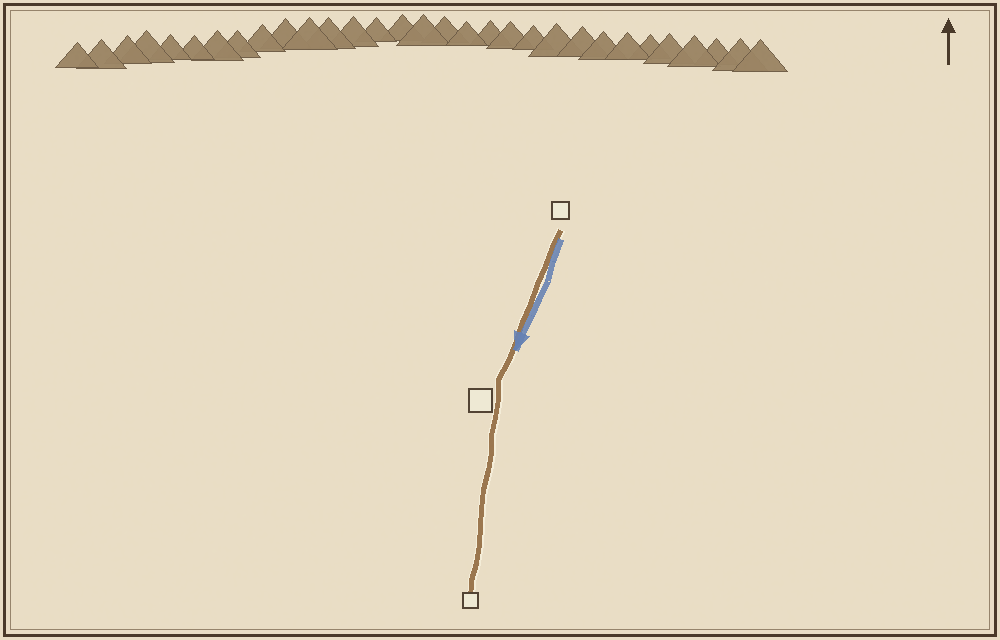 BICOCCA
Milan
Monza
Pavia
to Switzerland (Alps)
Lautrec marches south
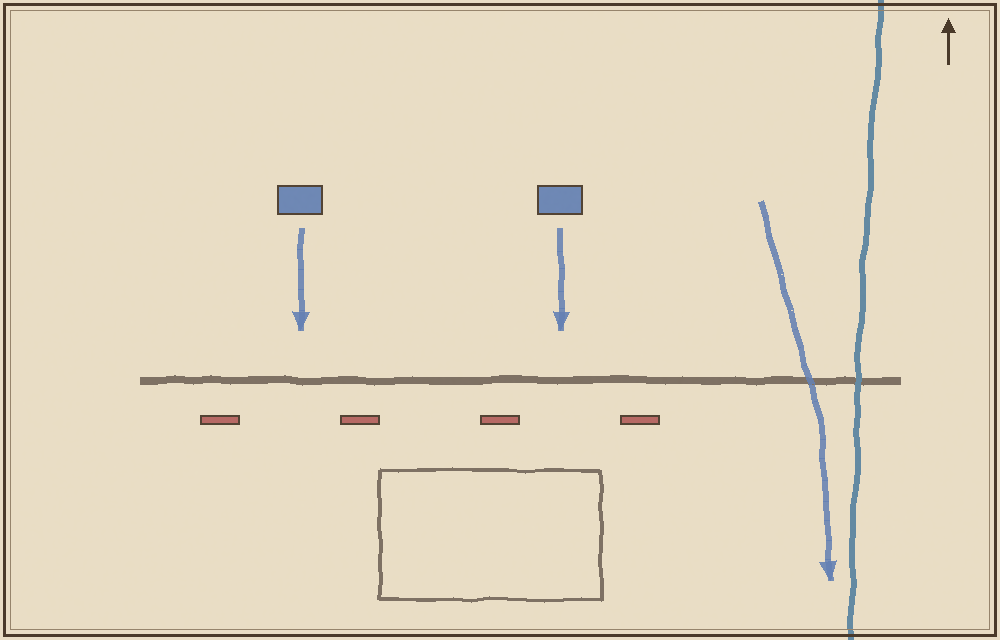 sunken lane and rampart
the Swiss columns attack head-on
Lescun rides for the bridge
arquebusiers four ranks deep
BICOCCA