Battle of Guilford Court House
1781 · North America Medium
British (Cornwallis) — Americans (Greene) · 11 turns · 44 units
Briefing
"We fight, get beat, rise, and fight again." -- Nathanael Greene, letter to the French minister La Luzerne, April 1781, six weeks after Guilford Courthouse.
Early afternoon, 15 March 1781, west of the courthouse of Guilford County, North Carolina. Greene, chased by Cornwallis throughout February's "Race to the Dan", has gathered reinforcements, turned back, and chosen to stand here. He lays out at the scale of an army what Morgan told his militia at Cowpens two months before: "two volleys, then fall back." The first line is North Carolina militia behind a rail fence at the edge of the woods; the second, three hundred yards back in the woods, Virginia militia; the third, five hundred and fifty yards further back on the hill before the courthouse, the Continental regulars. Cornwallis has nineteen hundred men. Against an enemy more than twice his number, he walks straight in.
[How to win] The result is decided by a single margin. Margin = (points of objectives you hold - points of objectives the enemy holds) + (losses inflicted - losses suffered) + (exit points of your own units that leave the map). There are five objectives worth 80 points: Guilford Courthouse 30, Third Line 20, Second Line 10, First Line 10, Hoskins Farm 10. The Americans start with 70 points, the British with 10. American units that leave by the Reedy Fork Road at the north edge score ten points per point of combat strength (a retreat; keeping the army intact was how Greene won). Exit points are capped at 28 in total. If the margin seen from the British side ends above the victory line (+23 points), the British win; below it, the Americans win. Finish 7 points beyond the line for a tactical victory, 56 for an operational victory, and 112 for a strategic victory. Short of 7, it is a draw.
[Who moves first] The British move first.
[The regulars on the hill] The Continental regulars of the third line (the 4th and 5th Virginia, the 1st and 2nd Maryland, and Finley's guns) are on standby. They begin to wake little by little from turn 4 (14:15), and wake on the spot if attacked. Greene kept them waiting on the hill while the two lines in front bought time.
[The fence] The militia of the first line stand behind a rail fence (an entrenchment) at the edge of the woods. Attacked across the fence, their defence is doubled.
[Counters that can move at once] British: fifteen (nearly the whole army). Americans: fourteen.
[Beyond the flanks] Beyond the southern flank stand Lieutenant Colonel Lee's Legion (horse and foot) and Colonel Campbell's riflemen; beyond the northern flank, Kirkwood's Delaware company, Lynch's riflemen and Lieutenant Colonel Washington's dragoons. Riflemen, Jägers and guns can fire two hexes.
[Commanders] British: Cornwallis = Charles, Earl Cornwallis; Webster = Colonel James Webster (23rd and 33rd Foot); O'Hara = Brigadier Charles O'Hara (2nd Guards Battalion); Leslie = Major General Alexander Leslie, and du Buy (the Hessian von Bose Regiment); Fraser = the 71st Foot (Fraser's Highlanders); Norton = 1st Guards Battalion; Hall = the Guards grenadiers; von Wurmb = the Jägers; Guards = the Guards light infantry; Tarleton = Banastre Tarleton's British Legion; MacLeod = the Royal Artillery. Americans: Greene = Nathanael Greene; Butler and Eaton = North Carolina militia; Stevens and Lawson = Virginia militia; Green and Hawes = the 4th and 5th Virginia; Gunby and Ford = the 1st and 2nd Maryland; Washington = William Washington's dragoons; Lee = Henry Lee's Legion; Campbell and Lynch = riflemen; Kirkwood = the Delaware company; Singleton and Finley = Continental guns. The upper name on each counter is the commander, the lower the unit.
[The decisions this board asks] First (British): break the three lines one by one from the front, or first clear the small lines beyond the flanks. The further you drift outward, the thinner the main body becomes.
Second (British): after the second line, climb the third hill with what remains. The hollow before it is open, and the regulars are waiting.
Third (American): how long to make the militia lines hold. The first line is weak; it will be broken sooner or later, and the question is how many turns it lasts.
Fourth (American): fight the regulars of the third line on the hill to the end, or pull them out north along the Reedy Fork Road and keep the army intact.
[Outcome] The militia of the first line fired their volley; when the British halted, returned fire and came on at the run with the bayonet, they went over the fence and vanished into the woods. The Virginia militia of the second line held for more than half an hour in the woods, and the British wings drifted south and north into separate fights. Webster's 33rd ran up the third hill and was driven back by the 1st Maryland. The 2nd Guards Battalion broke the 2nd Maryland and took its guns, but the 1st Maryland struck it from the flank and Washington's dragoons from behind. Cornwallis ordered grapeshot fired into the mass of friend and foe, and the melee stopped.
Greene would not risk his regulars and withdrew north along the Reedy Fork Road. The British held the field and lost more than a quarter of their number. Webster died of his wound. In London, Charles James Fox said that another such victory would ruin the British army. Cornwallis fell back to Wilmington, and from there marched north into Virginia. The road ended at Yorktown.
Two volleys, then you may fall back
The militia behind the fence vanished into the woods
In the woods, the second line bought half an hour
On the hill, the regulars waited with bayonets fixed
The army that held the field would lower its colours that autumn by the sea
The board runs from 13:30 to 16:00 on 15 March. The artillery exchange before the battle and the gathering of the British wounded in the evening rain are not on the board. Off the board to the north, Greene fell back ten miles and re-formed his army at the ironworks on Troublesome Creek.
1 hex = 120 m, 1 turn = 15 minutes, 1 CS = about 50 men. T1 = 15 March 13:30 (the British advance), T3 = 14:00, T4 = 14:15 (the regulars of the third line begin to wake), T6 = 14:45, T11 = 16:00.
Maps
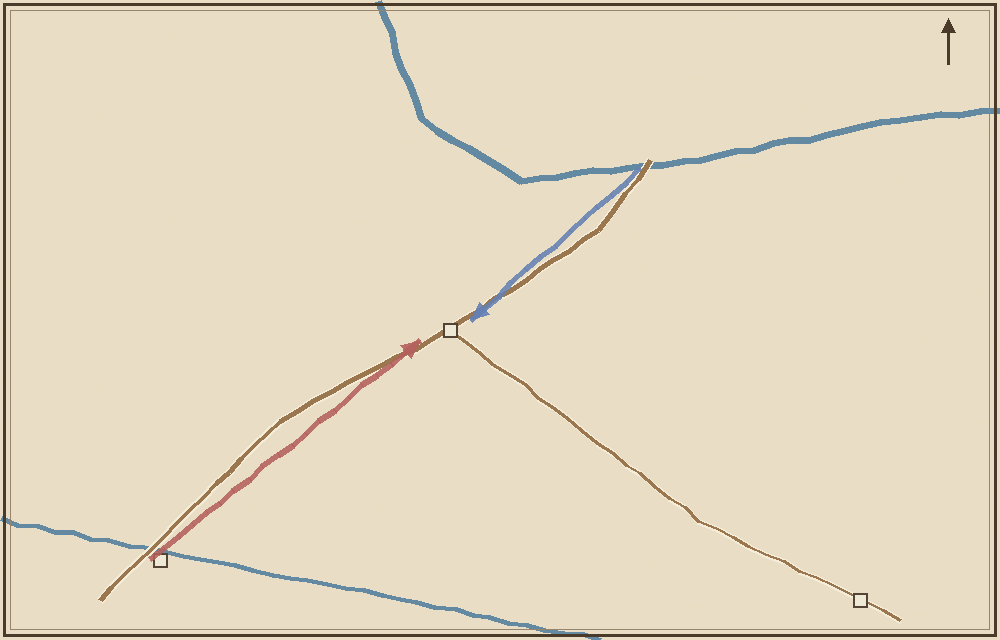 GUILFORD COURTHOUSE
Dan River (the "Race to the Dan", February)
Cowpens (17 January)
Wilmington (British withdrawal)
to Yorktown (October)
Cornwallis (1,900)
Greene (4,400)
GUILFORD COURTHOUSE
Dan River (the "Race to the Dan", February)
Cowpens (17 January)
Wilmington (British withdrawal)
to Yorktown (October)
Cornwallis (1,900)
Greene (4,400)
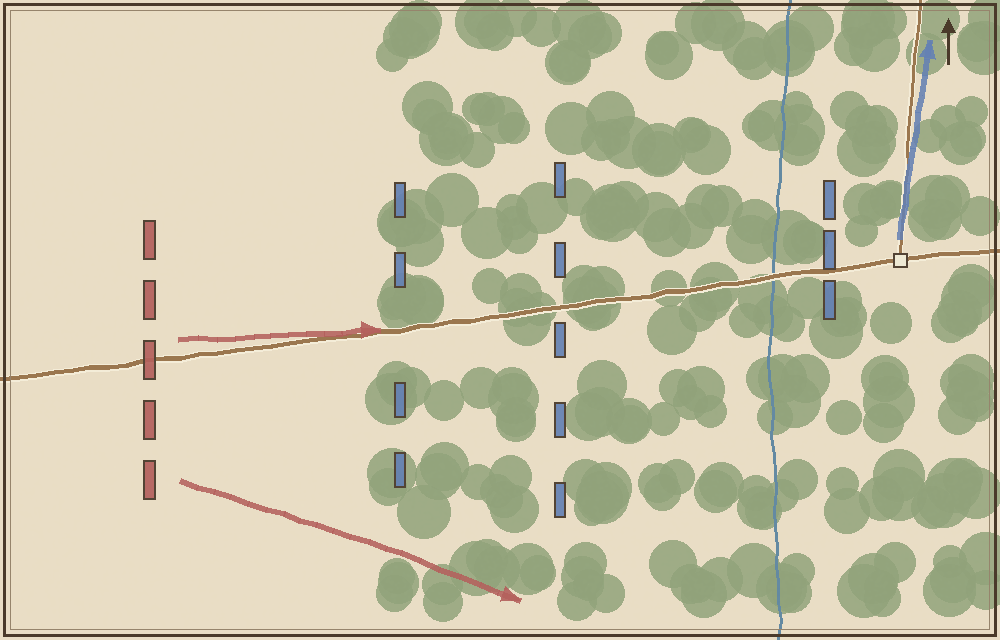 First line: North Carolina militia ("two volleys")
Second line: Virginia militia
Third line: Continentals
Cornwallis (1,900)
the separate fight on the flank (von Bose and Campbell)
grapeshot into the melee
GUILFORD COURTHOUSE
Reedy Fork Road (Greene's withdrawal)
First line: North Carolina militia ("two volleys")
Second line: Virginia militia
Third line: Continentals
Cornwallis (1,900)
the separate fight on the flank (von Bose and Campbell)
grapeshot into the melee
GUILFORD COURTHOUSE
Reedy Fork Road (Greene's withdrawal)