Battle of the Granicus 334 BC
334 BC · Europe
May 334 BC · The Granicus (Biga River), Biga, Çanakkale Province, Turkey
Macedonians — Persians · 8 turns · 43 units
AI personality: Macedonians Cautious / Persians Seize
See this battle in the battle list
Briefing
May 334 BC. The Granicus (Biga River), Biga, Çanakkale Province, Turkey
"It would be a disgrace, having crossed the Hellespont, to be held back by this little stream."
– Alexander's reply to Parmenion, who urged him to wait for the morning, as reported by Arrian (paraphrased)
Alexander had crossed the Hellespont into Asia, and the satraps of Asia Minor waited for him on the Granicus. The Persian cavalry lined the steep bank on the eastern side, and the Greek mercenary infantry was posted on the high ground behind. Parmenion advised him to cross the next morning, but the king resolved to cross that same day.
[How the Macedonians win] Take the three crossings on the eastern bank (10 points each) and the mercenary hill (10). The victory line is +6: the Macedonians win if the margin from their side exceeds it. The Macedonians move first. Up to 11 units may move at once. If Alexander (Alexander King) is eliminated, the Macedonians lose at once.
[How the Persians win] Hold the crossings and the hill and destroy the units that cross; the Persians win if the margin falls below the line. Up to 10 units may move at once. Units attacked across the river defend at double strength, and so do those on the bank. The Greek mercenaries on the hill are a standby group and do not move until an enemy comes next to them or attacks them (from turn 4 they may also move by chance). Eliminating Alexander wins at once.
[Commanders] Macedonians: Alexander III, Parmenion, Cleitus the Black, Amyntas, Socrates, Calas, Nicanor, Perdiccas, Coenus and Craterus.
Persians: the satrap Arsites, Spithridates and his brother Rhoesaces, Darius's son-in-law Mithridates, Memnon of Rhodes, Arsames, Rheomithres and the mercenary commander Omares.
[Decisions this board poses]
- (Macedonians) At which crossing, and with what first. Whether to send a decoy across first to draw the cavalry.
- (Macedonians) Whether to put the king at the head, or keep him back.
- (Persians) Whether to wait in line on the bank, or to strike at the enemy as he crosses. When to wake the mercenaries.
[Outcome] Amyntas's scouts and Socrates's squadron crossed first on the right and drew the Persian cavalry, and the king led the Companions across at a slant. In the melee on the bank Spithridates raised his axe over the king, and Cleitus the Black cut off his arm. The Persian cavalry broke, and the Greek mercenaries, who had not moved, were surrounded and most of them killed. The gate of Asia Minor was open.
The numbers, the position and course of the river, the order of the lines and the times differ between ancient writers and are estimated. Combat strengths are not head counts but values worked back from the paths to victory.
1 hex = 200 m, 1 turn = 20 minutes, 1 CS ≈ 1,000 men. T1 = 16:00, T8 = 18:20 (times estimated).
Maps
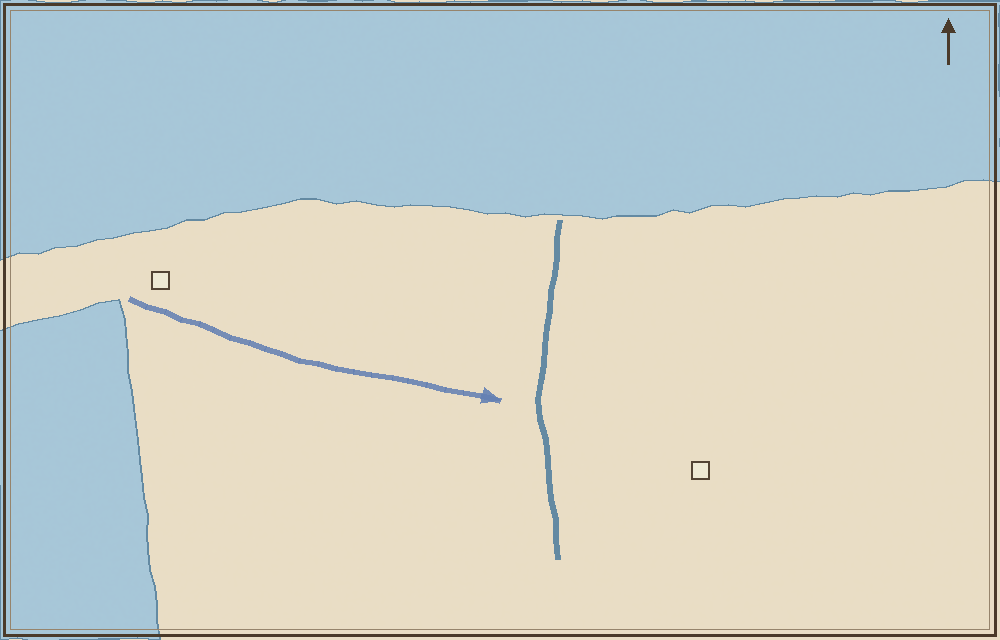 GRANICUS
Hellespont
Abydos
Zeleia (the satraps)
Propontis
Alexander crosses into Asia
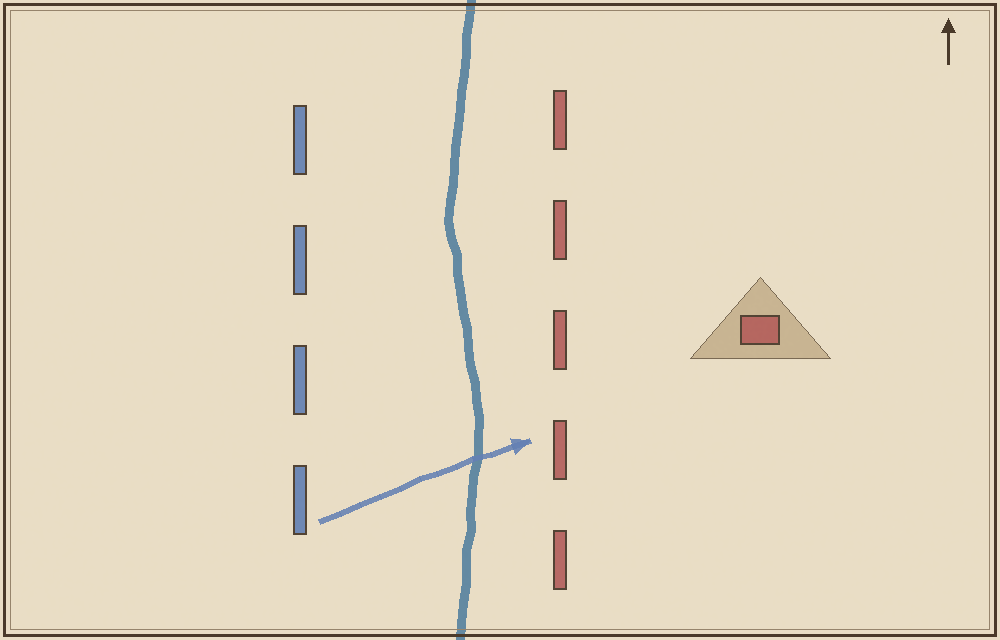 Persian cavalry on the bank
the Greek mercenaries wait
the king crosses obliquely
GRANICUS