Battle of Seven Pines
1862 · North America Long
Confederate (Army of N. Virginia) — Union (Army of the Potomac) · 13 turns · 77 units
Briefing
Impossible? Sir, I tell you I can cross! I am ordered!
(Sumner before the swaying Grapevine Bridge over the flooded river; tradition)
By three roads, all at once.
One o'clock in the afternoon, 31 May 1862, east of Richmond. After the downpour of the day before, the Chickahominy has burst its banks, and McClellan's army is split between the north and south of the river. Left on the south bank are only Keyes's IV Corps and, behind it, Heintzelman's III Corps. Johnston's plan was to strike with three divisions by three roads at once. But only D. H. Hill's division has come down the Williamsburg Road, and in front of it lies Casey's redoubt.
[How the Confederates win] You may activate 12 units per turn; the Union 10. D. H. Hill is on the board from the start. Longstreet's division enters from the west edge on turns 3 to 6, behind him on the same Williamsburg Road (it took the wrong road). G. W. Smith's wing (Whiting's division) and Johnston enter on turns 7 to 8 by the Nine Mile Road in the north-west, and Huger on turns 9 to 10 by the Charles City Road in the south-west. The Union begins holding the Seven Pines crossroads (25 points), Fair Oaks Station (20), Casey's redoubt (15), Savage's Station (10) and the Trent House (10). The Confederates hold Old Tavern (10). The victory line is -58: if the score margin seen from the Confederate side exceeds -58, you have done better than history.
[How the Union wins] Hold the south bank until the river falls. Casey's division is made up of new recruits, and the redoubt has works only on its west and south-west sides. Couch's division at Seven Pines and Fair Oaks Station (Couch and others) are standby units: from turn 3 (14:00) each turn there is a chance they rouse, starting at 40% and rising by 30% per turn. If they are attacked, or an enemy comes next to them, they rouse at once. On turns 3 to 6, Heintzelman and Kearny's division come in from the east edge. On turns 9 to 10, Sumner and Sedgwick's division come from the north edge by the Trent House road, across the swaying bridge.
[Commanders] Confederate: Joseph E. Johnston (Johnston); D. H. Hill (D.H. Hill) with Rodes, Garland, G. B. Anderson and Rains; Longstreet (Longstreet) with R. H. Anderson, Kemper, Pickett, Pryor, Wilcox and Colston; G. W. Smith (G.W. Smith) and Whiting (Whiting), with Hood, Hampton, Pettigrew (Pettigrew), who was wounded and captured, Hatton (Hatton), who was killed, and Law; Huger (Huger) with Mahone, Armistead and Blanchard.
Union: Erasmus Keyes (Keyes); Casey (Casey) with Naglee, Wessells and Palmer; Couch (Couch) with Abercrombie, Peck and Devens; Heintzelman (Heintzelman) and Kearny (Kearny), with Berry, Jameson and Birney; Sumner (Sumner) and Sedgwick (Sedgwick), with Gorman, Dana and Burns, and Kirby (Kirby), who hauled his guns through the mud.
[Decisions to try on this board]
- (Confederate) Strike first with D. H. Hill alone, or wait for Longstreet to catch up?
- (Confederate) Once Seven Pines falls, push east, or swing north to Fair Oaks Station to join hands with Smith?
- (Union) Hold on at Casey's redoubt, or fall back to the Seven Pines line and wait for Heintzelman?
- (Union) Use Sumner's division to hold Fair Oaks Station, or to retake Seven Pines?
[Outcome] D. H. Hill's division carried Casey's redoubt and took the Seven Pines crossroads as well. But Longstreet's division was jammed up behind it, and Huger's division hardly fought. In the evening G. W. Smith attacked Fair Oaks Station, but was stopped by Sumner and Sedgwick's division, which had crossed the swaying bridge over the flooded river, and by Kirby's guns, dragged through the mud. At dusk Johnston, watching the front, was shot and badly wounded. The attacks of the next day, 1 June, came to nothing, and that afternoon President Davis gave the army to Robert E. Lee. More than eleven thousand men fell on the two sides together, and the lines barely moved. Three weeks later, Lee began the Seven Days.
After the rain, the river split the army in two
Of the three roads, only one arrived in time
The redoubt fell, and then the crossroads
Across the swaying bridge came men who had their orders
At dusk the commanding general was carried to the rear
and the next day Lee took his place
The fighting of 1 June is off the board; the board shows only the afternoon of 31 May. The part of McClellan's army north of the river is not on the board, except for Sumner's leading division. Large brigades are split into two units. Unit suffixes (Bde I, Ala. Bde II and so on) are names given by the designer, not regimental names from the sources.
1 hex = 250 m, 1 turn = 30 minutes, 1 CS ≈ 600 men. T1 = 31 May 13:00, T3 = 14:00 (Longstreet and Heintzelman), T7 = 16:00 (G. W. Smith), T9 = 17:00 (Sumner and Huger), T13 = 19:00 (Johnston is shot).
Maps
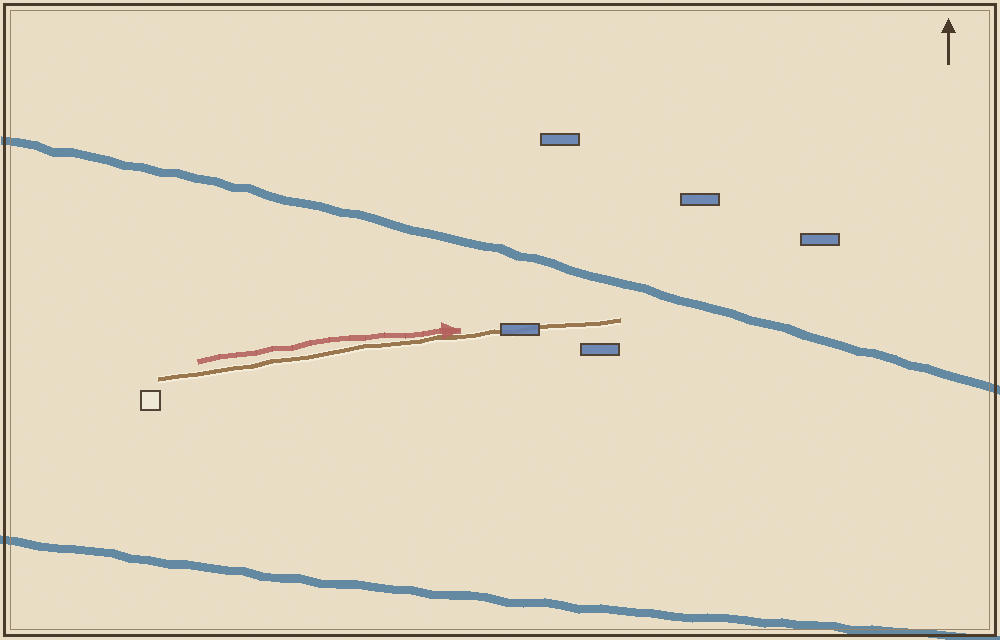 SEVEN PINES
Richmond
Chickahominy (in flood)
Three Union corps (north of the river)
Keyes and Heintzelman (south of the river)
James River
SEVEN PINES
Richmond
Chickahominy (in flood)
Three Union corps (north of the river)
Keyes and Heintzelman (south of the river)
James River
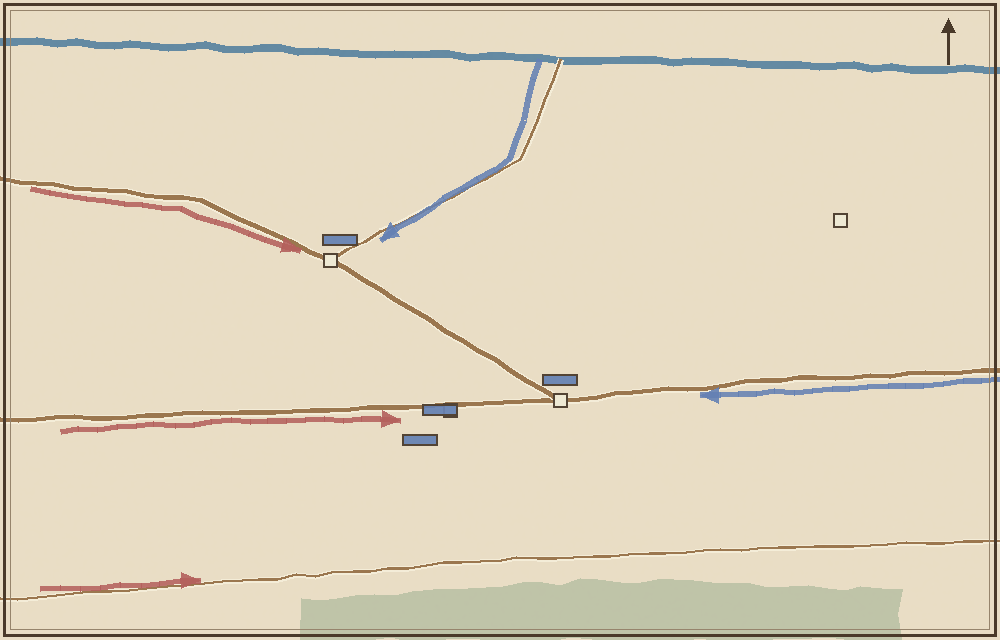 Seven Pines (crossroads)
Fair Oaks Station
Casey's redoubt
D. H. Hill (attacks alone)
Longstreet (wrong road, stuck behind)
G. W. Smith and Johnston
Huger (late)
Sumner (crosses the swaying bridge)
Kearny (from the east)
White Oak Swamp
Chickahominy (in flood)
Seven Pines (crossroads)
Fair Oaks Station
Casey's redoubt
D. H. Hill (attacks alone)
Longstreet (wrong road, stuck behind)
G. W. Smith and Johnston
Huger (late)
Sumner (crosses the swaying bridge)
Kearny (from the east)
White Oak Swamp
Chickahominy (in flood)