Battle of Naseby 1645
1645 · Europe
14 June 1645 (Julian calendar) · Broad Moor, north of the village of Naseby, Northamptonshire, England, United Kingdom
Royalist Army (Charles I, Prince Rupert) — Parliamentarian Army (New Model Army, Fairfax) · 10 turns · 40 units
AI personality: Royalist Army (Charles I, Prince Rupert) Auto / Parliamentarian Army (New Model Army, Fairfax) Delay
See this battle in the battle list
The picture we hope to see
Victorious cavalry: does it ride off the field, or come back to strike the infantry in the flank?
Briefing
14 June 1645 (Julian calendar). Broad Moor, north of the village of Naseby, Northamptonshire, England, United Kingdom
"Sir, this is none other but the hand of God."
— Oliver Cromwell, in his letter to the Speaker, William Lenthall, written on the day of the battle
Where does a victorious cavalry go? In June 1645 the army of King Charles I stormed Leicester and moved on, and Fairfax's New Model Army followed it. At Market Harborough the King decided to turn and fight, and the two armies faced each other north of Naseby across Broad Moor, the low ground between Dust Hill and Red Hill. The King had about nine thousand men, Parliament about fourteen thousand. The New Model Army had been raised only that spring.
[How the Royalists win] Take Red Hill (20 points) and hold Dust Hill (20 points) and the Royal Baggage (10 points). Prince Rupert's horse on the right wing (Rupert, Maurice, Queen, Northampton) is the strongest cavalry on the board and can break Ireton's horse opposite (Ireton, Butler, Vermuyden, Rich). Beyond them, Parliament's wagon laager behind its left is a CP: if the Royalists take it, they gain 3 activations, but it earns no points. The King's reserve (King Charles, Lichfield, King's Lifeguard Foot) is a standby group: it rises when an enemy comes next to it or attacks it, and from turn 6 it may also rise by chance (25% on turn 6, +25% each turn). The victory line is -19: the Royalists win if the score difference from their side is above -19. The Royalists may activate 9 units per turn.
[How Parliament wins] Take Dust Hill and the Royal Baggage, and hold Red Hill. Parliament may activate 13 units per turn, more than the King. Cromwell's horse on the right (Cromwell, Whalley, Fleetwood, Sheffield, Pye, Rossiter) can beat Langdale's Northern Horse opposite and then wheel onto the flank of the Royalist foot. Okey's dragoons in the Sulby Hedges to the west (Okey) hold hex sides facing east that count as entrenchments, doubling their defence.
[Commanders] Royalists: King Charles I (King Charles) / Prince Rupert (Rupert, general of horse) and Prince Maurice (Maurice) / Lord Astley (Astley, the foot) with the tertias of Sir Bernard Astley (B. Astley), Sir Henry Bard (Bard) and Sir George Lisle (G. Lisle), and Prince Rupert's Bluecoats (Rupert Bluecoats) / Sir Marmaduke Langdale (Langdale, Northern Horse) / the Earl of Lichfield (Lichfield, the King's Lifeguard of Horse).
Parliament: Sir Thomas Fairfax (Fairfax, Lord General) / Oliver Cromwell (Cromwell, Lieutenant-General of Horse) / Henry Ireton (Ireton, horse of the left wing) / Philip Skippon (Skippon, the foot) / John Okey (Okey, dragoons) / Edward Whalley (Whalley), Charles Fleetwood (Fleetwood) and the other colonels of horse / the foot regiments of Pickering (Pickering), Montagu (Montagu), Waller (Waller), Hammond (Hammond), Rainsborough (Rainsborough) and Harley (Harley).
Not on the board: the Earl of Carnwath (who seized the King's bridle and turned him back) / Thomas Pride (lieutenant-colonel of Harley's regiment, who later purged Parliament) / the commander of Parliament's artillery.
[Decisions this board lets you try]
- (Royalists) Use Rupert's horse to take the baggage for more activations, or bring it back onto the flank of Skippon's foot?
- (Royalists) When to commit the King's reserve?
- (Parliament) Pursue the Northern Horse with Cromwell's cavalry, or wheel it onto the flank of the foot?
- (Parliament) Keep Okey's dragoons in the hedges, or send them in?
[Outcome] When Rupert's horse came back from the baggage, the Royalist foot was already surrounded. As the King made to lead his reserve forward, the Earl of Carnwath seized his bridle and turned him back: "Will you go upon your death?" Most of the Royalist foot surrendered; Prince Rupert's Bluecoats fought on to the last and fell where they stood. The Royalist baggage and guns were taken, and with them the King's cabinet of letters, which Parliament later printed and spread as The King's Cabinet Opened. The King's main field army was lost that day. The next year he gave himself up to the Scots, and in January 1649 he was beheaded at Whitehall in London.
The victorious horse galloped off to the baggage
The victorious horse came back and struck the flank
"Will you go upon your death?" — a hand on the bridle
A regiment in blue coats stood to the last
This is none other but the hand of God
Four years on, a scaffold was raised outside a window at Whitehall
Numbers: about 9,000 Royalists and 13,000 to 14,000 Parliamentarians (estimates vary). The date is in the Julian calendar (24 June in the Gregorian). The positions of the armies and the extent of the hedges and the rabbit warren are approximate; the village of Naseby is folded in against the southern edge. The details of Parliament's guns and the pursuit along the Harborough road after the battle are not on the board.
1 hex = 100 m, 1 turn = 15 minutes, 1 CS = about 150 men. T1 = 10:00, T5 = 11:00, T10 = 12:15.
Maps
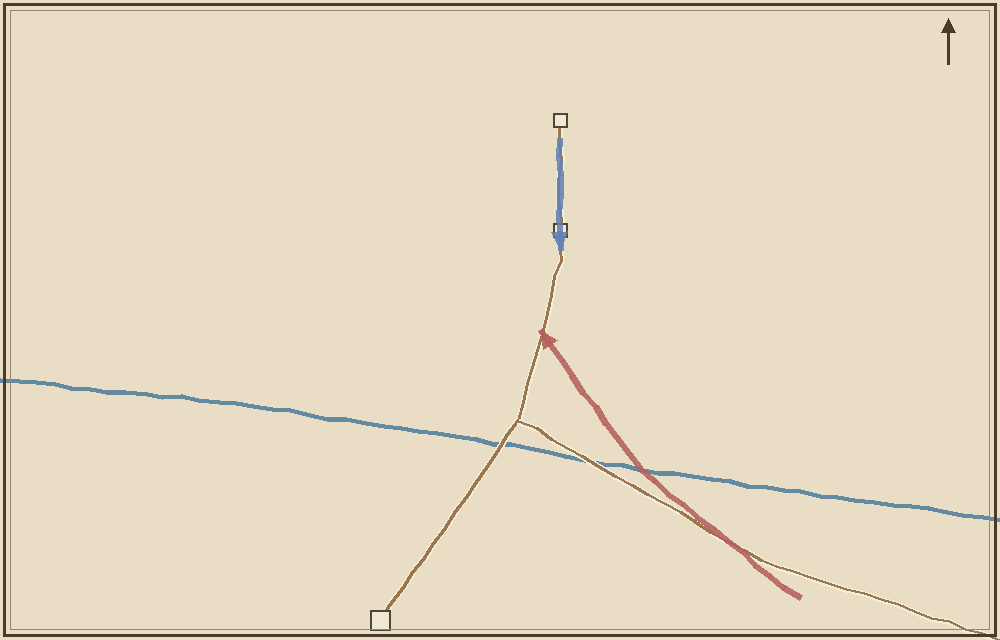 NASEBY
Oxford (the King's headquarters)
Leicester (stormed by the Royalists in May)
to London (Parliament)
Market Harborough
the New Model Army marches north
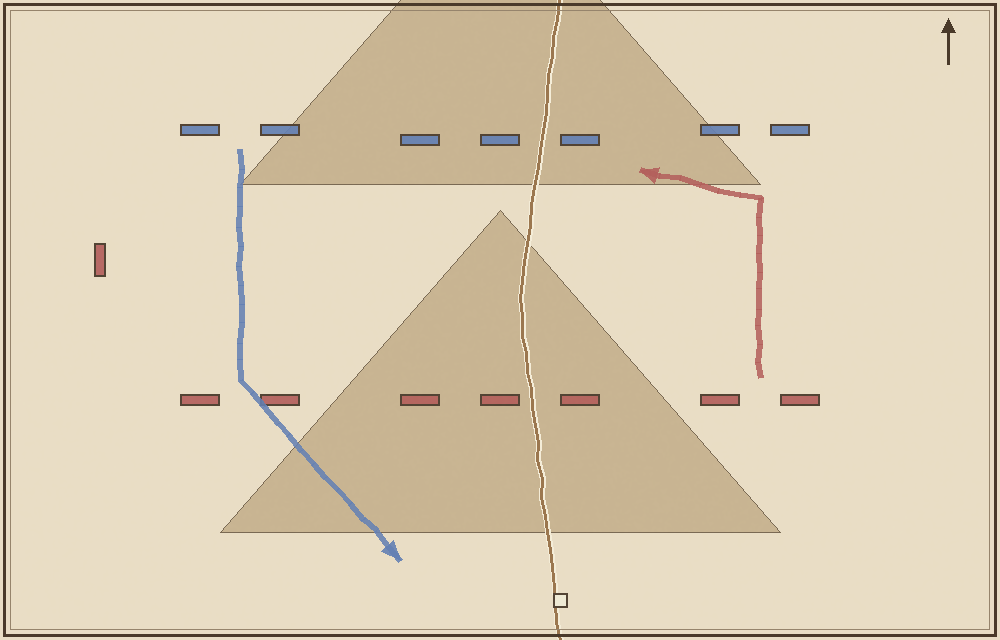 Dust Hill (Royalists)
Red Hill (New Model Army)
Broad Moor
Rupert gallops off to the baggage
Cromwell wheels his horse
Okey's dragoons (Sulby Hedges)
Naseby village (Parliament's baggage)
the King's reserve (Carnwath seizes the bridle)