Battle of Pavia
1525 · Europe Long
French Army — Imperial Army · 13 turns · 84 units
Briefing
"Of all things, nothing remains to me but honour and life, which is safe."
— Francis I to his mother, Louise of Savoy, after his capture
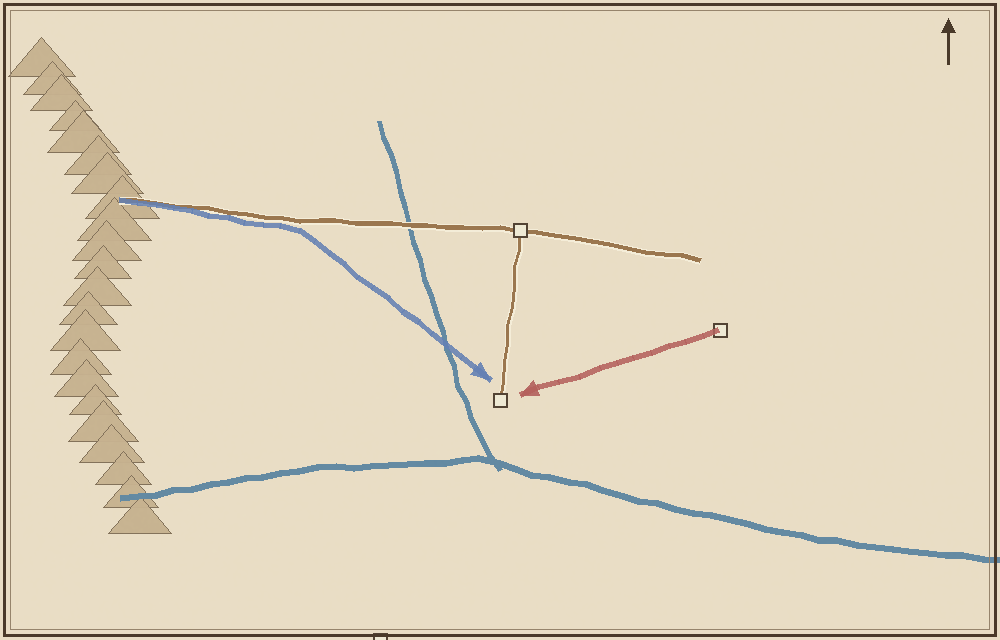
Pavia, in Lombardy. Since the autumn Francis I has been besieging the city, with his camp in the walled Visconti hunting park of Mirabello that stretches north of the town, a country of woods and meadows. The Imperial relief army has faced him from its camp outside the east wall.
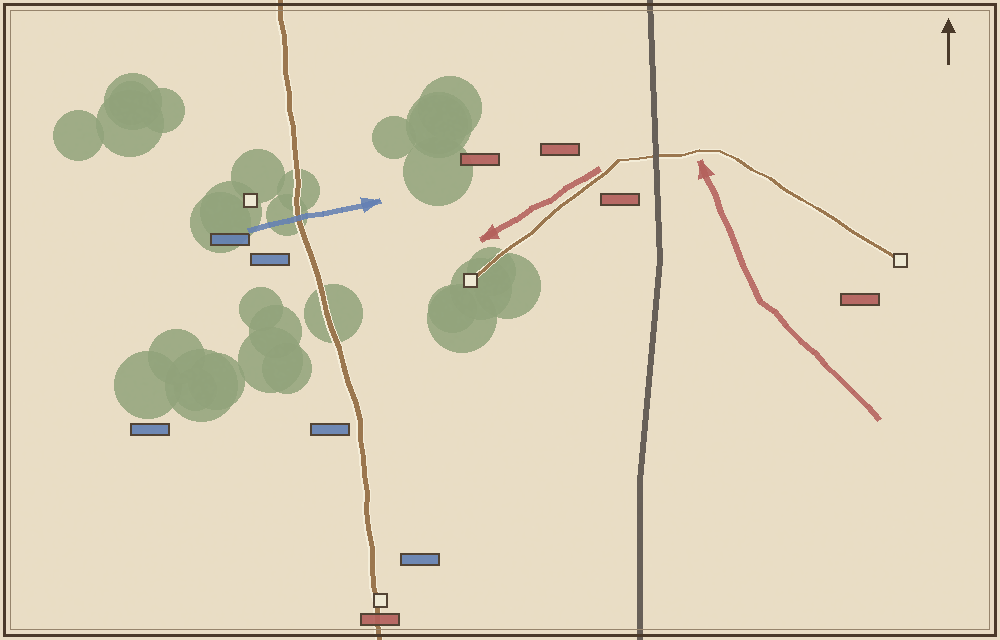
On the night of 23 February 1525 the Imperials set fire to their tents, marched north along the wall, and broke through it near San Genesio (the Porta Pescarina). At 5 a.m. on the 24th, the Marquis of Vasto's 3,000 arquebusiers are already inside the park and heading for the castle of Mirabello. Frundsberg's landsknechts are coming through the breach, while Lannoy's horse and Pescara's Spanish foot work round through the woods to the west. There is fog.
[How the French win] Twelve units may be activated each turn. The French begin holding Mirabello (20 points), the royal camp (10) and the siege lines north of the town (10); taking Pavia (30) and the breach (10) from the Imperials widens the margin. The east wall of the park cannot be crossed except at the breach. King Francis I is a sudden-death unit: if he is destroyed or taken, the Imperials win. Alençon's rearguard in the west is a standby group and will not move on its own (it wakes if attacked). The victory line is +1. If the margin from the French side exceeds +1, they have done better than history.
[How the Imperials win] Fourteen units may be activated each turn. Strike at the royal camp with the arquebusiers and horse already in the park and the landsknechts at the breach. The Pavia garrison under Leyva is a standby group that sallies from the city on Turn 8.
[Commanders] French: Francis I; Admiral Bonnivet, Marshal La Palice, La Trémoille, Marshal Lescun and the king's uncle René of Savoy, all killed; Henri, King of Navarre, captured; Fleuranges (Robert de La Marck), who led the Swiss, captured; François of Lorraine and Richard de la Pole, the last of the Yorkists, of the Black Band, both killed; Montmorency at the siege lines, captured; the Duke of Alençon with the rearguard.
Imperials: the Viceroy Lannoy; Fernando d'Ávalos, Marquis of Pescara; Alfonso d'Ávalos, Marquis of Vasto; Frundsberg; the Duke of Bourbon, the former Constable of France; the Count of Salm; Cesare Hercolani, said to have brought down the king's horse; and Antonio de Leyva, commanding the Pavia garrison.
[Decisions this board poses]
- (French) Charge the horse that has come through the breach with the king's gendarmes? The charge masks your own guns and leaves the infantry behind.
- (French) Bring the Swiss from the siege lines into the park? Doing so leaves the way open for the Pavia garrison, which sallies on Turn 8.
- (Imperials) Keep the arquebusiers waiting at the edge of the woods, or march straight on the royal camp?
[Outcome] At 7:40 the king led his gendarmes against Lannoy's horse and scattered it, but the charge blocked the fire of his own guns and carried him away from his infantry. Pescara lined up his Spaniards at the edge of the wood and called for help, and by 8 o'clock arquebusiers and landsknechts closed on the king's gendarmes from all sides. Unable to manoeuvre among the trees, the gendarmes were cut down one after another, and the Black Band was surrounded by Frundsberg's landsknechts and destroyed where it stood. The king's horse was killed under him; wounded in the face and hand, he fell and was taken by soldiers who did not know him. When the Viceroy Lannoy arrived the king made himself known, and Lannoy is said to have kissed his hand and received him prisoner in the Emperor's name. Meanwhile Leyva sallied from the city and broke the Swiss in the siege lines, and Alençon's rearguard withdrew towards Milan without fighting. By 9 o'clock it was over. The king was taken to Spain; by the Treaty of Madrid the following year he swore to give up Milan and Burgundy, and broke the oath as soon as he was free.
In the night the wall was breached
On the foggy morning arquebuses lined the wood
The king's knights rode across their own guns
Among the trees the knights could not turn
The king was taken by men who did not know him
Nothing remained but honour and life
The armies numbered roughly 26,000 and 28,000 (including the 6,000-man garrison). The positions of the royal camp, Mirabello and the breach follow the place names that have come down to us. Tradition places the king's capture at the Repentita farm. Who took him is disputed; the Emperor himself honoured several men for it.
1 hex = 300 m, 1 turn = 20 minutes, 1 CS = about 600 men. Turn 1 = 5 a.m. on 24 February; Turn 13 = 9 a.m.
Maps
 PAVIA
Milan
Lodi (Imperial retreat, 1524)
Ticino
River Po
to the Alps and France
Genoa
Francis I's march (October 1524)
Imperial relief army
PAVIA
Milan
Lodi (Imperial retreat, 1524)
Ticino
River Po
to the Alps and France
Genoa
Francis I's march (October 1524)
Imperial relief army
 PAVIA
Visconti hunting park
Park wall
Breach in the wall (night)
Mirabello castle
King's camp and gendarmes
Garrison (Leyva)
Imperial camp
Alençon's rearguard
Arquebusiers
PAVIA
Visconti hunting park
Park wall
Breach in the wall (night)
Mirabello castle
King's camp and gendarmes
Garrison (Leyva)
Imperial camp
Alençon's rearguard
Arquebusiers