Battle of Antietam 1862 (Brigades)
1862 · North America
17 September 1862 · Antietam Creek, near Sharpsburg, Maryland, United States
Union (Army of the Potomac) — Confederate (Army of N. Virginia) · 12 turns · 100 units
AI personality: Union (Army of the Potomac) Line / Confederate (Army of N. Virginia) Breakthrough
See this battle in the battle list
The picture we hope to see
The Union attacks piecemeal, north, then centre, then south; the thin Confederate line shifts troops each time to hold, and reinforcements arrive in the evening.
Briefing
17 September 1862. Antietam Creek, near Sharpsburg, Maryland, United States
"Here is a paper with which if I cannot whip Bobbie Lee, I will be willing to go home."
(McClellan, holding the captured Confederate orders (Special Orders No. 191), 13 September; as recalled by Gibbon)
Six in the morning, the Cornfield in the north. Ten o'clock, the Sunken Road in the centre. One in the afternoon, the stone bridge in the south.
On this board the three Union attacks come in that order, separately. I Corps can move from the start and XII Corps (Mansfield) arrives from the north edge on T2, but II Corps (Sedgwick, French, Richardson) waits east of Pry's Ford and wakes by chance from T2, and IX Corps waits east of the stone bridge and wakes from T4. V Corps will not move unless attacked: it is the last reserve.
The Confederates are fewer than half as many. But from the town of Sharpsburg all three fields are close. Each time one field fell quiet, Lee moved the same troops sideways to meet the next.
[How the Union wins] You may activate 14 units per turn. The Union may activate fewer units than the Confederates because McClellan committed his corps one at a time. The objectives ahead are the Dunker Church (25 points), the Cornfield (10), the Sunken Road (15), the stone bridge (10), and the town (30). The victory line is -10: a Union score margin above -10 is a win. You cannot change the order in which the corps wake. What you can change is where each corps goes once it wakes. At T5, VI Corps arrives from the east edge.
[How the Confederates win] You may activate 18 units per turn, and you begin holding every objective. When the north falls quiet, go to the centre; when the centre falls quiet, go south. The Sunken Road hexes have entrenchments (their north-facing edges). At T10, A.P. Hill (A.P. Hill Light Div) arrives on the Harpers Ferry road at the south edge.
[Commanders] Union: McClellan (headquarters at the Pry House; not on the board) / I Corps: Hooker, Doubleday, Gibbon (Iron Brigade), Ricketts, Meade / XII Corps: Mansfield (mortally wounded), Williams, Greene / II Corps: Sumner, Sedgwick, French, Richardson (mortally wounded), Meagher (Irish Brigade) / IX Corps: Burnside, Cox, Sturgis, Rodman (mortally wounded), Willcox, Crook / V Corps: Porter, Sykes (Regulars), Morell / VI Corps: Franklin, Smith, Slocum / cavalry: Pleasonton.
Confederate: Lee / Jackson, J.R. Jones, Lawton, Early, Hood (Texans), Stuart, Pelham (horse artillery), S.D. Lee (artillery) / D.H. Hill, Ripley, Colquitt, McRae's brigade (formerly Garland's), Rodes, G.B. Anderson (mortally wounded) / Longstreet, Toombs (the Georgians at the stone bridge), Kemper, Drayton, Jenkins, Garnett, G.T. Anderson / Walker, McLaws, R.H. Anderson / A.P. Hill, Gregg, Branch (killed), Archer.
[Decisions this board lets you try]
- (Union) Once II Corps wakes, do you send it north to the Dunker Church or to the Sunken Road in the centre? The historical Sedgwick went into the West Woods and was fired on from three sides.
- (Union) Do you force the stone bridge head-on, or go round to Snavely's Ford in the south?
- (Confederate) When the north falls quiet, where do you send McLaws and Walker, resting west of the town?
- (Confederate) Can you hold the hill east of the town until A.P. Hill arrives?
[Outcome] Towards evening IX Corps climbed the heights just short of Sharpsburg. Then A.P. Hill's division, having marched seventeen miles from Harpers Ferry, came up and struck its left. IX Corps was driven back almost to the stone bridge. In one day the two armies lost some 23,000 killed and wounded; no single day of battle in American history has been bloodier. On the 18th the armies faced each other without moving, and that night Lee crossed the Potomac and went home. Most of V Corps and VI Corps never fought at all. On 22 September Lincoln issued the preliminary Emancipation Proclamation. In November McClellan was relieved of command.
The Cornfield in the morning, the Sunken Road at noon, the stone bridge in the afternoon
The same troops ran sideways and held three times
The last reserve did not move
A division that had marched seventeen miles arrived at evening
A day that one sheet of paper should have won
became five days before emancipation
Units are brigades for the most part (54 Union and 46 Confederate units, cavalry and artillery included). A unit is named for its brigade commander (or the brigade's nickname); corps and division commanders are not on the board. The number in the square on Union units is the corps number (corps badges did not yet exist in September 1862). The Confederate army was not yet organised into corps in September 1862; it had the "wings" of Jackson and Longstreet. The waking times of the Union corps are set by chance to match the historical times of their attacks.
1 hex = 200 m, 1 turn = 1 hour, 1 CS = about 500 men. T1 = 17 September 6:00 (Cornfield), T5 = 10:00 (Sunken Road), T8 = 13:00 (stone bridge), T10 = 15:00 (A.P. Hill), T12 = 17:00.
Maps
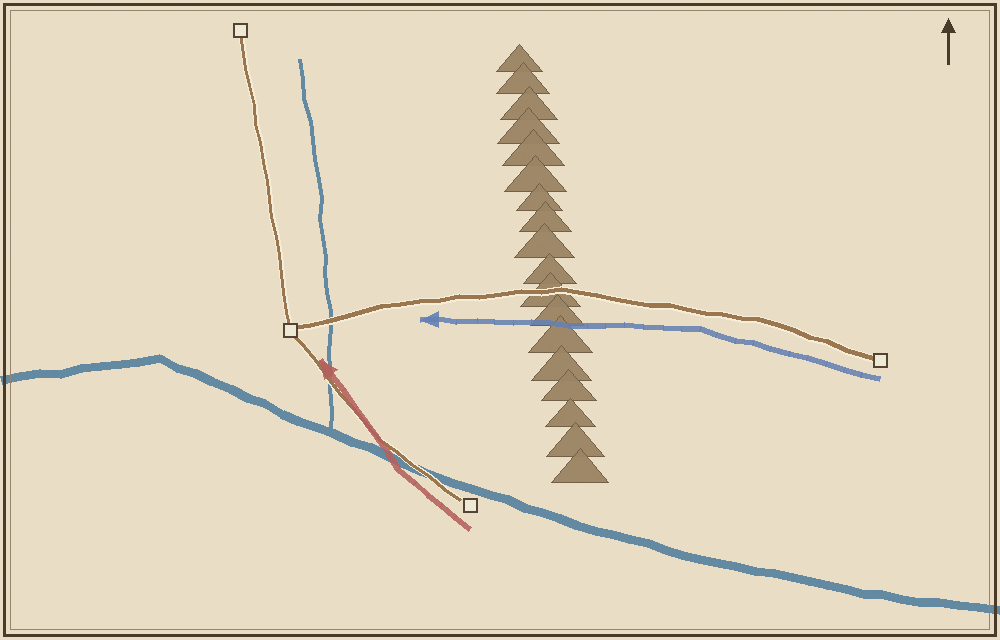 ANTIETAM
Harpers Ferry (surrendered 15 Sept.)
South Mountain (14 Sept.)
Frederick
to Washington
Hagerstown
Potomac River
Maryland
Virginia
A.P. Hill, 17 miles
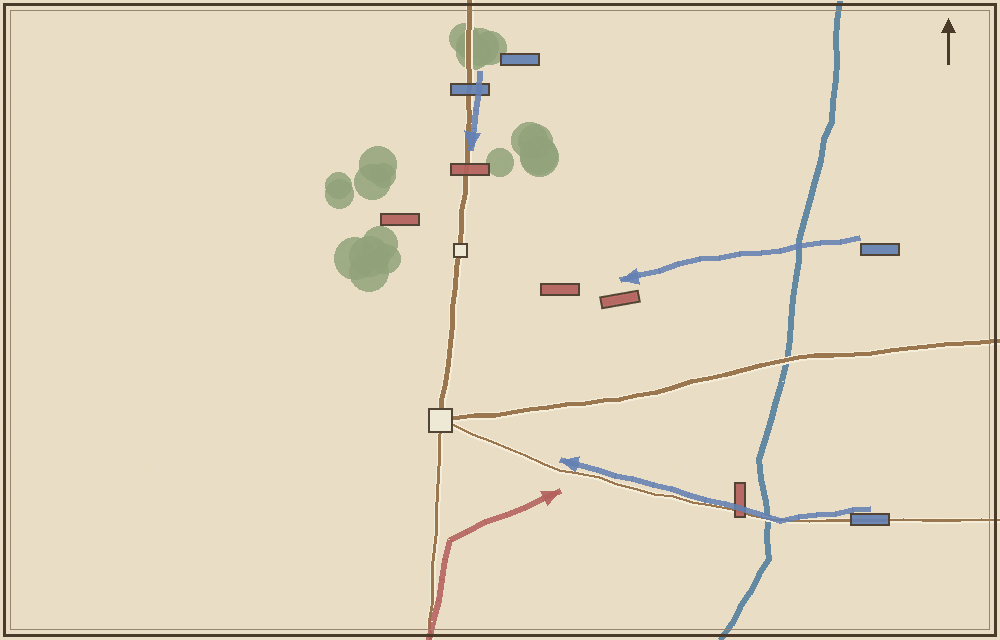 Sharpsburg
The Cornfield (morning)
Dunker Church
Sunken Road (midday)
Stone bridge (afternoon)
Antietam Creek
Pry House (McClellan)
V Corps (last reserve)
A.P. Hill, 17 miles