Battle of Gaines' Mill
1862 · North America Long
Confederate (Army of N. Virginia) — Union (Army of the Potomac) · 13 turns · 83 units
Briefing
The men who carried this position were soldiers indeed!
(Stonewall Jackson the next morning, looking at the slope the Texas Brigade had climbed; from Hood's memoirs)
Together, they can break it.
Two o'clock in the afternoon, 27 June 1862, north of the Chickahominy. Porter's V Corps holds a line three deep on the plateau inside the half-circle drawn by Boatswain's Swamp. The swamp is a deep ravine; whoever crosses it and climbs faces a defender at double strength. The Confederates have swung north from in front of Richmond to strike the half of the Union army left north of the river. But they are arriving piecemeal. A. P. Hill's division has just reached the swamp, first of all.
[How the Confederates win] You may activate 13 units per turn; the Union 11. On turn 6 (16:30), when Jackson's column arrives, the Confederate limit rises by 5 to 18. Reinforcements enter in the order they arrived: Longstreet (turns 2 to 3, west edge); D. H. Hill and Stuart's cavalry (turns 3 to 4, north edge); Ewell (turns 4 to 5, north); Jackson's division (turns 6 to 7, north); and Whiting with Hood and Law (turn 7, north). The Union begins holding the Watt House (25 points), McGehee Hill (15), Porter's headquarters at the Adams House (15), Grapevine Bridge (15) and Alexander's Bridge (10). The Confederates hold New Cold Harbor (10) and Old Cold Harbor (15). The victory line is -20: if the score margin seen from the Confederate side exceeds -20, you have done better than history.
[How the Union wins] Hold the plateau until nightfall. Use the three lines one at a time to stop the Confederates as they come in piecemeal. On turns 6 to 7, Slocum's division (VI Corps) crosses the river from the south edge. On turn 12, French and Meagher's Irish Brigade (II Corps) reach the bridges.
[Commanders] Confederate: Robert E. Lee (Lee); A. P. Hill (A.P. Hill), first to arrive, with the brigades of Gregg, Branch, Pender, Field, Archer and J. R. Anderson; Longstreet (Longstreet) with Pickett, Wilcox, Pryor, Featherston, Kemper and R. H. Anderson; D. H. Hill (D.H. Hill) with Rodes, Garland, G. B. Anderson, Colquitt and Ripley; Ewell (Ewell) with Trimble, Elzey and Seymour (Seymour) of the Louisiana Tigers; Jackson (Jackson) with Winder of the Stonewall Brigade, Lawton, Cunningham and Fulkerson; Whiting (Whiting) with Hood (Hood) and Law (Law) of the Texas Brigade; and Stuart (Stuart) with the cavalry.
Union: Fitz John Porter (Porter); Morell (Morell) with the brigades of Martindale, Griffin and Butterfield; Sykes (Sykes) of the Regulars with Buchanan and Lovell, and Warren (Warren) with the Zouaves; McCall (McCall) of the Pennsylvania Reserves with Reynolds, Meade and Seymour (Seymour); Cooke (Cooke) with the cavalry; Slocum (Slocum) with Taylor, Newton and Bartlett; French (French) and Meagher (Meagher). Note that there is a Seymour on each side: Isaac Seymour for the Confederacy and Truman Seymour for the Union.
[Decisions to try on this board]
- (Confederate) Attack in the order you arrive, or wait until the whole army is up? Waiting brings on the dark.
- (Confederate) Where to break through: at Old Cold Harbor in the north, where the ravine grows shallow, or in the centre at the Watt House?
- (Union) When and into which gap do you commit the third-line reserve (McCall, Reynolds, Meade, Seymour)?
- (Union) Start falling back to guard the bridges before nightfall, or fight on the plateau to the end?
[Outcome] A. P. Hill's brigades crossed the swamp and were thrown back, and the attacks of Longstreet and Ewell were also stopped. Jackson took a wrong road and was late, and the Union held on by calling Slocum's division across the river. Around seven, before sunset, Lee pressed forward with every man he had. In front of the Watt House, Hood's Texas Brigade crossed the swamp without stopping to fire, ran up the slope and broke the line. The Union line gave way, and Cooke's cavalry charge broke too. The brigades of French and Meagher caught the retreating men at the bridges, and Porter crossed the river during the night. Reynolds was captured in the woods the next morning. It was the largest single day of the Seven Days: more than fifteen thousand men fell on the two sides together. It was Lee's first victory, and that night McClellan gave up the advance on Richmond and decided to fall back to the James.
One division reached the swamp first of all
They attacked as they arrived, and were stopped as they arrived
The general who took the wrong road came in just before dusk
The Texans climbed the slope without loading
Soldiers indeed, said a general the next morning
and the four days left of the Seven Days became days of Union retreat
The battle of Mechanicsville the day before, and the Union fall-back to this plateau that morning, are off the board. McClellan's main army (some sixty thousand south of the river) and Magruder's feint are not on the board. Union brigades are split into two units each; only the large Confederate brigades are split. Unit suffixes (Bde I, Regulars II and so on) are names given by the designer, not regimental names from the sources.
1 hex = 200 m, 1 turn = 30 minutes, 1 CS ≈ 700 men. T1 = 27 June 14:00, T6 = 16:30 (Jackson and Slocum), T11 = 19:00 (the general assault), T13 = 20:00 (sunset).
Maps
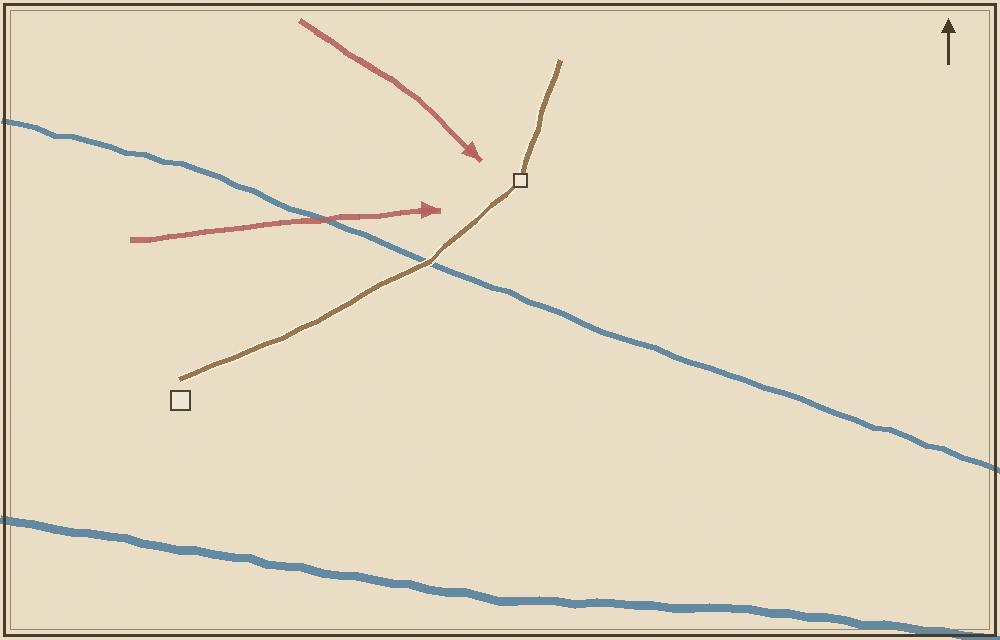 GAINES' MILL
Richmond
Chickahominy River
James River
McClellan's main army (south of the river)
Magruder (holds them with a show of force)
Jackson (from the Shenandoah)
GAINES' MILL
Richmond
Chickahominy River
James River
McClellan's main army (south of the river)
Magruder (holds them with a show of force)
Jackson (from the Shenandoah)
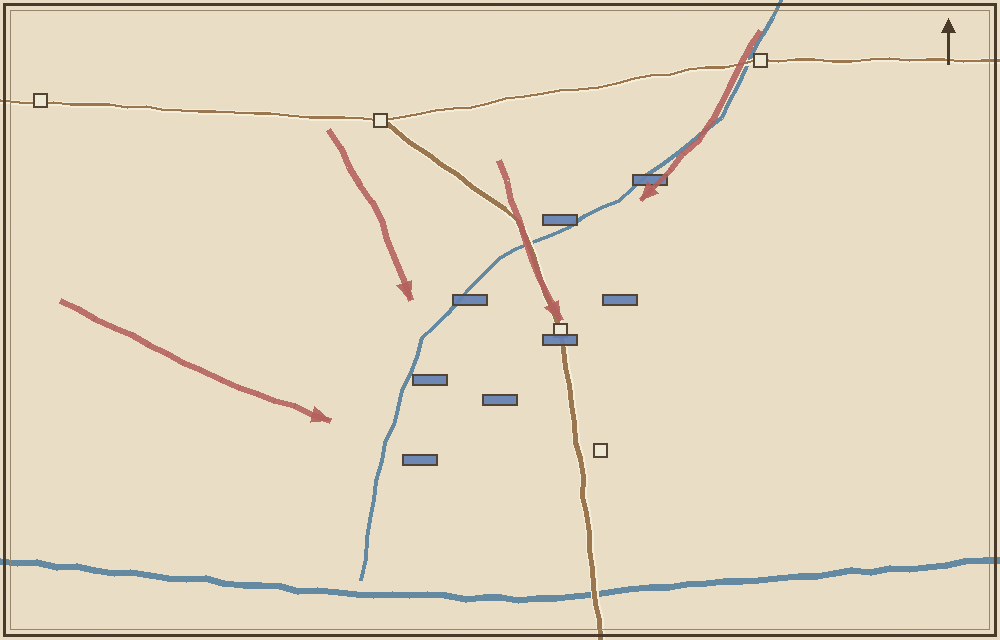 Watt House (centre)
Boatswain's Swamp
Porter's V Corps
A. P. Hill (arrives first, attacks alone)
Longstreet
Jackson, Ewell, D. H. Hill (late, from the north)
Hood's Texans break through
Bridges (retreat south of the river)
Slocum (crosses to help)
Watt House (centre)
Boatswain's Swamp
Porter's V Corps
A. P. Hill (arrives first, attacks alone)
Longstreet
Jackson, Ewell, D. H. Hill (late, from the north)
Hood's Texans break through
Bridges (retreat south of the river)
Slocum (crosses to help)