Battle of Bunker Hill
1775 · North America Short
British Army — New England Army · 9 turns · 42 units
Briefing
"A dear bought victory, another such would have ruined us."
-- Henry Clinton, in his notes of that day (Clinton Papers)
On the night of 16 June, twelve hundred men carrying spades and pickaxes entered the Charlestown peninsula, and by morning they had raised an earthen redoubt some forty metres square on the summit of Breed's Hill. The fleet noticed it at daybreak and opened fire, but the earth swallowed the shot. From the northern shoulder of the redoubt a breastwork ran on; beyond it lay two hundred metres of nothing at all, and further still a rail fence stuffed with hay ran down to the Mystic River. Seen from Boston, it looked like a single line. Seen up close, there was a hole in the middle.
At one in the afternoon, 2,200 redcoats landed on the eastern point of the peninsula, and by two o'clock a second wave had brought them to 2,700. Major General William Howe did not choose to go around. He went straight up the front. He was thrown back twice, and at the third attempt he took the redoubt. By the third attempt, the men inside the redoubt had nothing left to fire.
[How to win] The margin on screen is counted from the British side. It opens at -90, because the redoubt, the breastwork, the fence, the beach and Bunker Hill all belong to the other side. The victory line is -15: the British do not win unless they push the margin back that far. The historical British took the redoubt and the breastwork at a cost of 1,054 men, which yields a margin of exactly -14, only just above the line. In other words, fighting the battle as history did earns no more than a draw. Only by taking the hill more cheaply than history did can the British win. The New England army wins if it keeps the British from crossing the line. It does not need to retake lost hexes; it need only stop the line being crossed.
[Commanders] British: Howe = Major General William Howe (overall command) / Pigot = Brigadier Robert Pigot (left wing) / Clinton = Major General Henry Clinton (put off in boats without waiting for orders and landed at the town wharf) / Grenadiers Abercromby = Lieutenant Colonel James Abercrombie (grenadiers; mortally wounded) / Marines Pitcairn = Major John Pitcairn (marines; killed) / R.Artillery Cleaveland = Lieutenant Colonel Samuel Cleaveland (the shot that reached his field guns was of the wrong calibre) / 63rd Foot Rawdon = Lord Rawdon / 5th Foot Harris = Captain George Harris (shot in the head, and survived).
New England: Prescott = Colonel William Prescott (in command of the redoubt) / Warren = Dr Joseph Warren (held a commission as major general, yet entered the redoubt as a volunteer and was killed) / Putnam = General Israel Putnam (gathered the men on Bunker Hill) / Stark = Colonel John Stark and Reed = Colonel James Reed (New Hampshire; the northern end of the line) / Knowlton = Captain Thomas Knowlton (built the fence) / Gridley = Colonel Richard Gridley (the engineer who laid out the redoubt) / Nixon = Colonel John Nixon / McClary = Major Andrew McClary (killed by a cannonball on the Neck after the withdrawal) / Dearborn = Captain Henry Dearborn (the stone wall on the beach) / Callender = Captain John Callender (withdrew his guns and was later court-martialled) / Doolittle = Colonel Ephraim Doolittle (the marksmen in the town).
[Decisions this board lets you test]
1. The Gap. The two hundred metres between the northern end of the breastwork and the fence have no fence at all. Howe never once struck there. Will you?
2. Charlestown Neck. Hold the Neck and every man on the peninsula is in a sack: the number of counters the New England army can move at once falls from seven to four. Clinton proposed this, and Howe did not take it up. It is ten hexes around the north of Bunker Hill. Is it worth giving up the frontal attack?
3. Charlestown. Drive out the marksmen in the town and the left wing gains more moves. But the town is worth not a single point.
4. Ammunition. The New England army's activation limit stays at seven to the end. The British limit rises on T4 and T7. Whose side is time on?
[Outcome] The redoubt fell to the third assault. Prescott backed away parrying bayonets with his sword, crossed Bunker Hill and passed over the Neck. Joseph Warren was shot in the head behind the redoubt and buried where he fell. When he was dug up ten months later, Paul Revere identified him by the silver wire of the false teeth he had made with his own hands. The British lost 1,054 men: two in every five of those who had landed, in an hour and a half. Nineteen officers alone were killed. The hill became British, and the siege of Boston did not ease for a single day. The following March, when the Continental Army mounted guns on Dorchester Heights, Howe abandoned the town and put to sea.
Earth piled up in the night; in the morning, the ship's guns counted.
No one struck the two-hundred-metre hole.
The silver wire of false teeth proved the doctor's name.
Two in every five: that was the price of one hill.
A dear-bought victory.
One more, and it would have been the end.
The previous night's entrenching and the landing at one o'clock itself have been folded away. The board begins at 14:20, when the British had finished forming their ranks on the eastern point. The several hundred men who stayed behind Bunker Hill and never moved are not on the board (adding them would shift only the denominator of the result). The ships' guns are not counters either: the fire that burned the town is written as terrain, and the danger of crossing the Neck is written as "reinforcements arrive one unit at a time".
1 hex = 100 m, 1 turn = 20 minutes, 1 CS = about 30 men. T1 = 6/17 14:20, T3 = 15:00 (first assault), T5 = 15:40 (second assault), T7 = 16:20 (third assault; Clinton crosses), T9 = 17:00 (the redoubt falls).
Maps
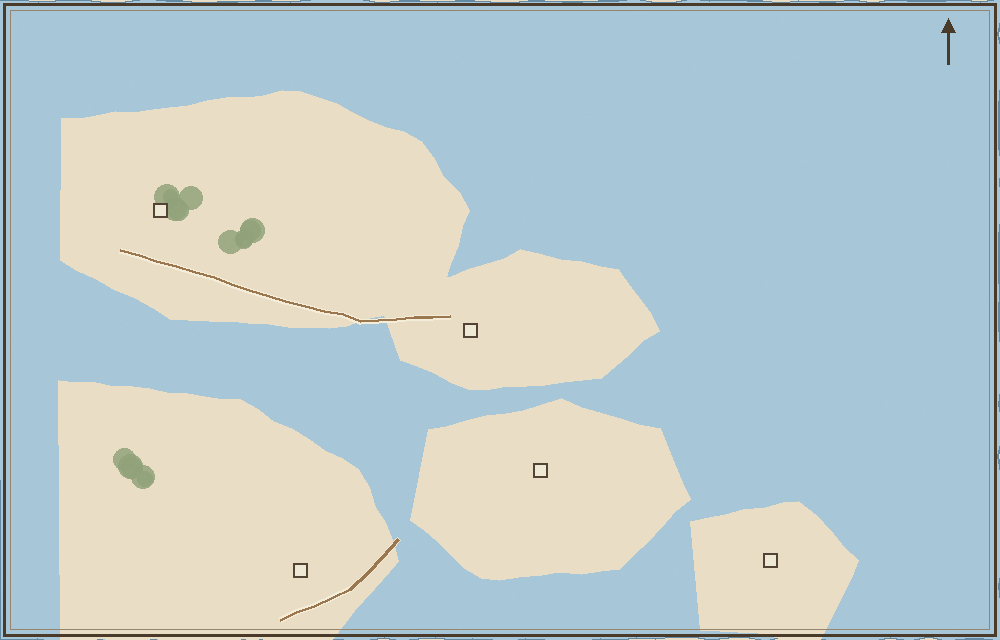 CHARLESTOWN
Cambridge
Boston
Roxbury
Dorchester Heights
Mystic R.
Charles R.
Boston harbour / the fleet
the Neck
CHARLESTOWN
Cambridge
Boston
Roxbury
Dorchester Heights
Mystic R.
Charles R.
Boston harbour / the fleet
the Neck
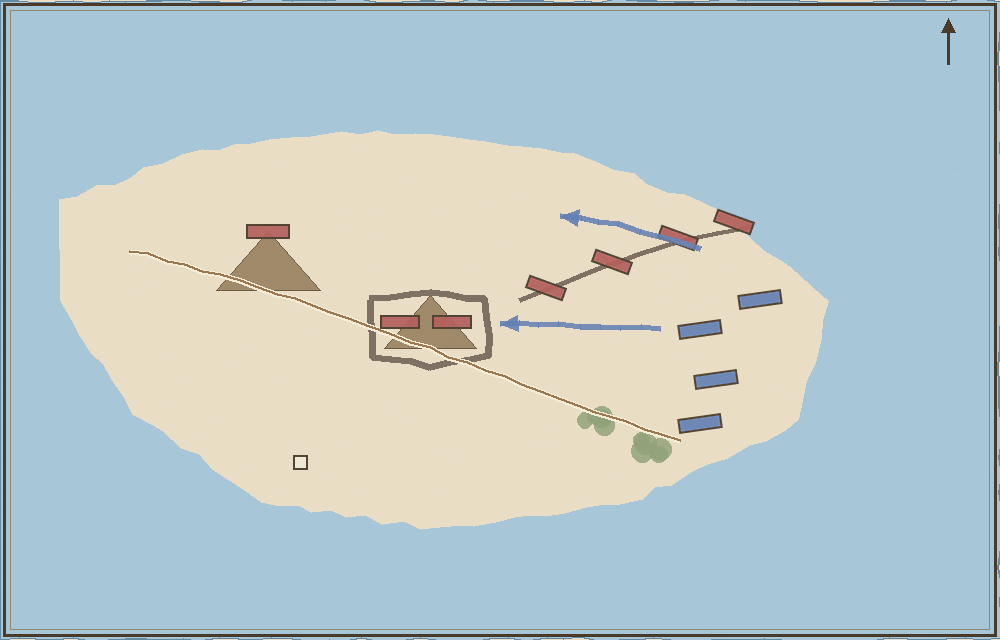 Breeds Hill redoubt
Bunker Hill
rail fence and stone wall
Charlestown (burned)
Mystic R.
Charles R.
British landing
the Neck
Breeds Hill redoubt
Bunker Hill
rail fence and stone wall
Charlestown (burned)
Mystic R.
Charles R.
British landing
the Neck