Battle of Nancy
1477 · Europe Short In the demo
Swiss-Lorraine — Burgundy · 5 turns · 43 units
Briefing
Je l'ay emprins.
"I have undertaken it." -- the motto of Charles the Bold
Nancy, 5 January 1477, Duchy of Lorraine. Charles the Bold, Duke of Burgundy, had besieged Nancy, the capital of Lorraine, since the previous October. Twice beaten by the Swiss, at Grandson and at Murten, he now faced his third winter in the field. Frost, desertion and disease had worn his army down from some 20,000 men to fewer than 8,000. His captains urged him to withdraw; the Duke would not move. René II, Duke of Lorraine, called upon the Swiss Confederacy, the cities of Alsace and Austria, and gathered an army of 20,000. Charles drew up south of the city: Nancy at his back, the Jarville brook to his front, his right resting on the Saurupt woods and high ground, his left on the Meurthe, and thirty guns trained on the mouth of the road. The allies did not come from the front. Guided by a local man, they followed a woodcutters' track through the forest and turned the Burgundian right. At noon (T4) the horns of Uri and Lucerne sounded three times, and the blocks of pikemen struck from the flank. It was over within an hour. There was no line of escape either: the renegade Count of Campobasso held the bridge at Bouxières.
[How to win] The result is decided by a single margin. Margin = (points of objectives you hold - points of objectives the enemy holds) + (losses inflicted - losses suffered). The dividing line is Allied +40. The allies win with a lead of +47 or more; Burgundy wins by holding the allied lead to +33 or less. Anything in between is a draw. A further 59 points beyond the line gives an operational victory, and 118 a strategic victory (for Burgundy, -19 and -78). The objectives on the board are worth 90 points in all. Nancy itself, worth 25, belongs to the allies from the start, because the city is still holding out; if it falls, the allies lose 25 and Burgundy gains 25. A single objective moves the margin by 50 points.
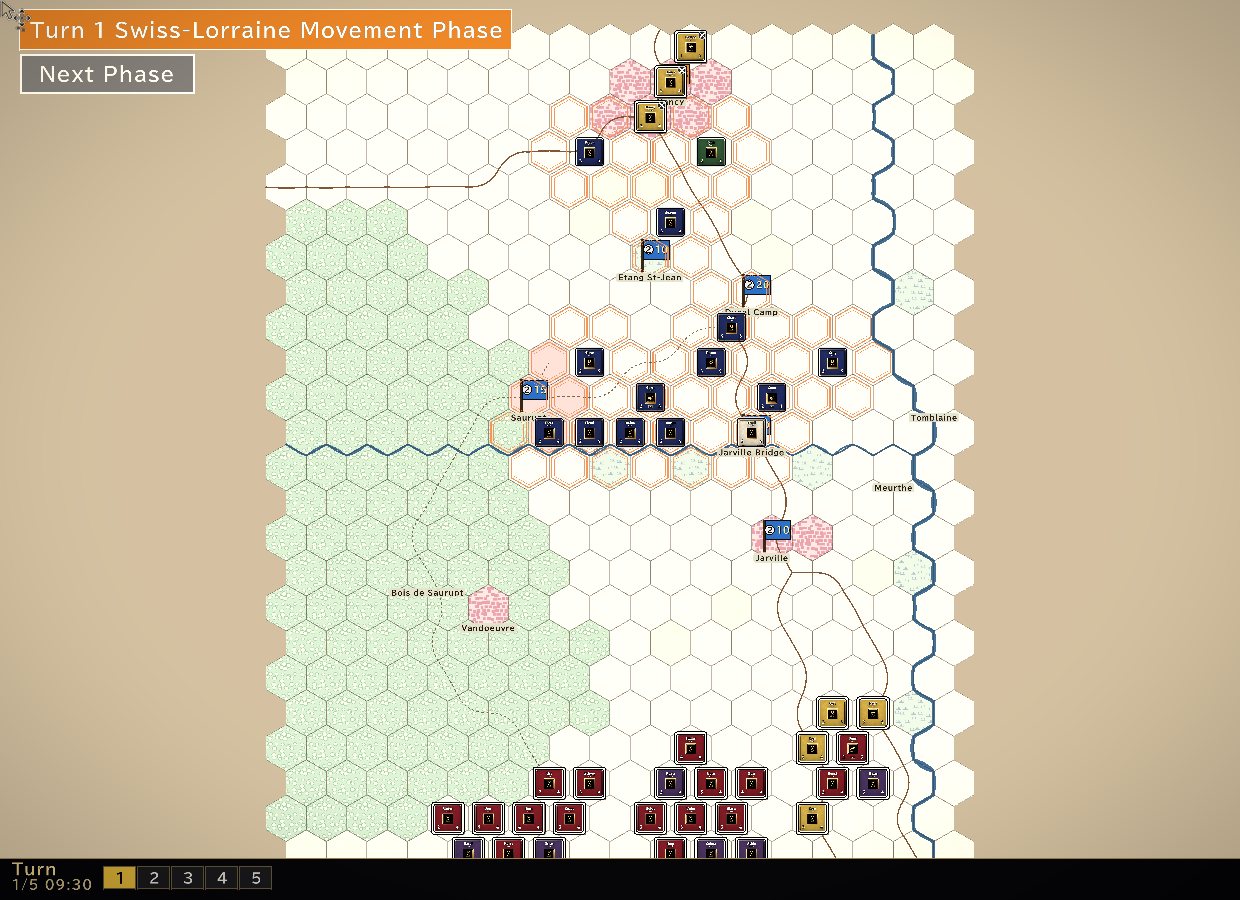
[What matters most on this board: the brook] The Jarville brook runs east to west across the centre. An attack across it doubles the defence. Only two routes avoid crossing it: the road bridge (Jarville Bridge, covered by the guns) and the woodcutters' track through the Saurupt woods.
[Burgundy] Charles the Bold (Charl, killed in this battle), the Grand Bastard Anthony (Anton, captured), Philippe de Croÿ, Count of Chimay (Croy, captured), Philip of Cleves (Cleve). English archers (Engli Bows), and the thirty guns combined into two batteries, Guns No1/No2. The pike levies of Brabant, Flanders, Hainaut, Luxembourg, Picardy and Burgundy proper (Braba/Flemi/Haina/Luxem/Picar/Burgu), and Italian mercenaries (Itali Foot). Braba, Luxem and Itali are committed to the siege lines.
[The Allies] In command, René II, Duke of Lorraine (Rene). The vanguard under Wilhelm Herter von Hertneck (Herte) is the column that passes through the woods. Hans von Hallwyl (Hallw) and Klaus von Bonstetten (Bonst). The Swiss Confederates of Bern, Zurich, Lucerne, Uri, Schwyz, Unterwalden, Zug, Glarus, Solothurn, Fribourg and Basel (Bern/Zuri/Luzer/Uri/Schwy/Unter/Zug/Glaru/Solot/Fribo/Basel). The Alsatian cities of Strasbourg, Colmar and Sélestat (Stras/Colma/Schle/Alsac). The suffixes give the echelon: Van = vanguard, Main = main body, Rear = rearguard. The Nancy garrison (Nancy Foot1/2) is a standby force; it sallies out when the besiegers within 3 hexes fall below 4 CS. The renegade Count of Campobasso (Campo) is an allied unit but will not move of his own accord: his task is to close the line of retreat.
[Decisions this board lets you test] Go straight at the front, or around through the woods? There are only five turns; if you mean to go around, you must start on the first turn. As Burgundy, how much of the siege line do you keep? Thin it too far and the garrison comes out behind you. Burgundy needs only to deny the allies a lead for five turns. Units with their backs to the Meurthe cannot retreat.
[Outcome] Charles rode into his collapsing line and was not seen again. His body was found two days later beside a frozen pond: stripped, the face torn by animals, identified by his physician only from old wounds and uncut nails. He was forty-three. At Grandson he lost his treasure, at Murten his army, and at Nancy himself. The Duchy of Burgundy ended that day. Of the richest middle realm between Paris and Vienna, only his daughter Mary remained. She married Maximilian of Habsburg; the wool and gold of Flanders passed to the Empire, and the duchy itself was absorbed by the King of France. Over this inheritance, dropped on the snow of Lorraine, France and Austria would contend for four hundred years. It was also the day on which men marching on foot with pikes brought the age of the mounted knight to a close.
Beside a frozen pond, the Duke was found,
stripped of banner, armour, and even of his name.
Old wounds, and nails left uncut:
these alone proved him to be himself.
He left behind a single daughter,
and her dowry was four hundred years of war.
Some unit names follow their place of levy, and some pairings of commanders and units are our own reconstruction.
1 hex = 200 m, 1 turn = 45 minutes, 1 CS = about 250 men. T1 = 09:30, T4 = the general assault at noon, T5 = 13:15.
Maps
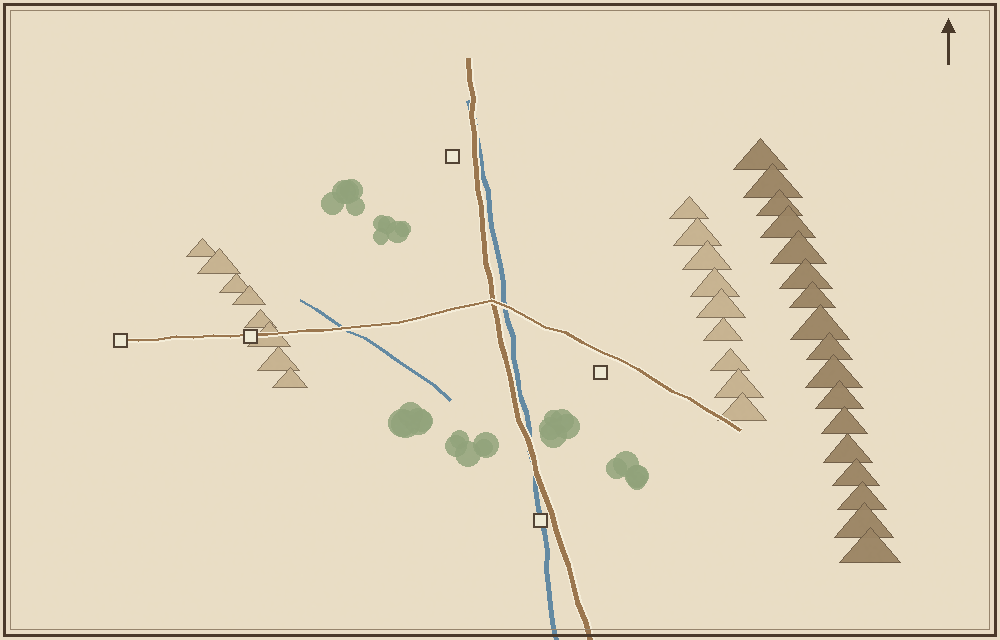 NANCY
Metz
Toul
St-Nicolas-de-Port
Epinal
to Burgundy
Meurthe R.
Vosges
the Swiss come up
NANCY
Metz
Toul
St-Nicolas-de-Port
Epinal
to Burgundy
Meurthe R.
Vosges
the Swiss come up
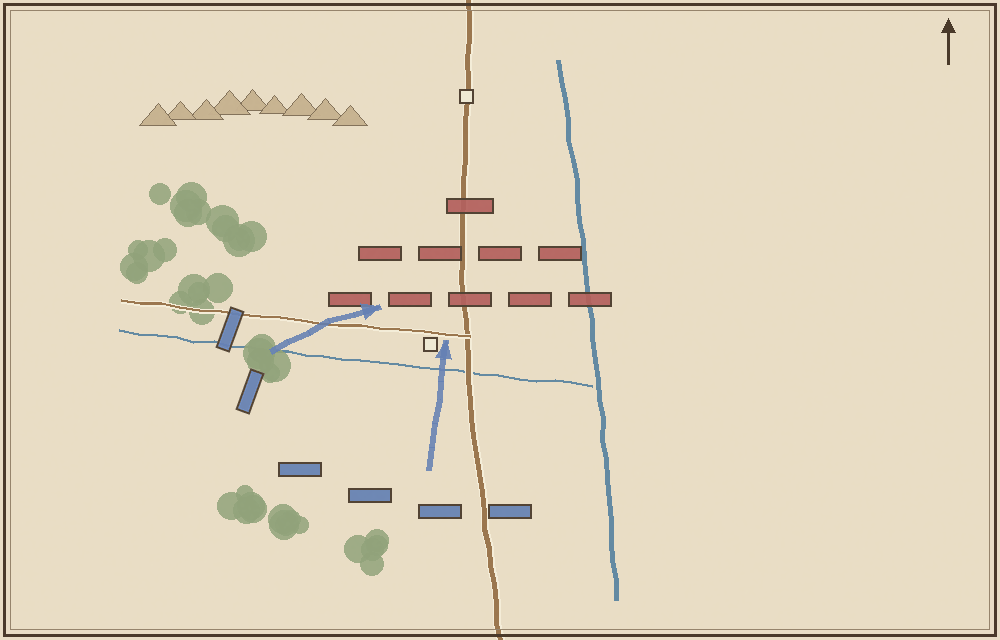 Burgundian line
Nancy (besieged)
Jarville bridge
the woods / the flank march
Meurthe R.
Swiss-Lorraine
from the south
Burgundian line
Nancy (besieged)
Jarville bridge
the woods / the flank march
Meurthe R.
Swiss-Lorraine
from the south