Battle of Grunwald
1410 · Europe Long
Polish-Lithuanian Army — Teutonic Order · 10 turns · 77 units
Briefing
"Your Majesty. Grand Master Ulrich, through us his envoys, sends two swords to Your Majesty and to your brother, as a help, so that you may hesitate less and fight more bravely. And if you find the ground too narrow, we shall withdraw from the field to make room for you."
-- the heralds of the Order, before the battle (Jan Dlugosz, Annals)
"We accept the swords you have sent us, and in the name of Christ, before whom all stubborn pride bows its head, we shall fight."
-- Wladyslaw II Jagiello, in his letter to his wife Anna of Celje
To pursue, or not to pursue. The six hours and forty minutes of this board turn on that single question.
15 July 1410, deep in Prussia, on the rolling heath between Grunfelde and Tannenberg. It was a hot July day. The Order had finished forming up in the morning and stood waiting on the sunlit field. Jagiello's army did not come out of the woods to the south. The king remained in the shade, heard Mass twice, and was slow to put on his armour. While both sides waited, it was the side standing in iron under the sun that was losing. Grand Master Jungingen, his patience exhausted, sent heralds bearing two swords, and at noon the battle opened, first on the side of Grand Duke Vytautas of Lithuania.
[The Two Swords] On the eastern wing of the board, the pieces with blue backgrounds are the army of the Grand Duchy of Lithuania: Vytautas himself (Vytau Grand), the Tatar horse of Jalal ad-Din Khan (Jalal Tatar), and the banners of Trakai, Grodno, Vilnius, Polotsk, Vitebsk and Kiev. Above them, where they must climb, stand the stone-throwing guns of Bombd Guns. The powder had been soaked by a thunderstorm the night before, and in history these guns fired only two shots. The only range-2 piece on this board is a battery that proved useless in this battle. Within about an hour the Lithuanian wing broke and fell back to the east. Whether this was a true rout or a feigned one is still disputed six hundred years later.
[The Open Ground to the East] At the eastern edge of the board, beyond the point where both battle lines end, stands a flag marked Road to Dabrowno. It carries no victory points at all. While the Order holds it, the number of pieces it may move at once rises from 14 to 17; that is all. In history, when the Lithuanians fell back, Marshal Wallenrode's left wing pursued them in this direction and vanished from the field. Not all of it, however: six banners did not pursue, but wheeled round against the flank of the Polish army. The banners that pursued and the banners that did not decided the day. The bait is visible to both sides. It is visible, and still, every turn, one hesitates.
[How to win] The result is decided by a single margin. Margin = (points of objectives you hold - points of objectives the enemy holds) + (losses inflicted - losses suffered). The dividing line is Allies +64. The Allies win with a lead of +76 or more; the Order wins by holding the Allied lead to +52 or less. Anything in between is a draw. A further 99 points beyond the line gives an operational victory, and 199 a strategic victory (for the Order, -35 and -135). The objectives on the board are worth 140 points in all. The board opens at a margin of -40, because everything that scores lies behind the Order's battle line (the Wagenburg 34, Tannenberg 26, Grunfelde 22; the Allies hold only the camp by Lake Lubien, 24, and Ludwigsdorf, 18, and only Great Stream, 16, between the two armies, is neutral). If the Allies break the Order's line and step onto the Wagenburg beyond it, the margin moves by 68, to +28. That is still not enough. Taking both the Wagenburg and Tannenberg brings it to +80, which is a win; with Grunfelde instead it is +72, still within the draw band. Only by breaking the line, driving on beyond it, and wearing down the broken Order to the end can the Allies win. Night falls after ten turns (T10 begins at 18:00 and ends at 18:40).
For the Order, it is enough not to be broken. It is outnumbered: 34 pieces against 43, a combat strength of 96 against 121. Yet both armies may move the same 12 pieces at a time, which for the Order is 12 of 34 and for the enemy 12 of 43. An army that can move a third of its strength faces one that can move only a quarter. The Grand Master's reserve of sixteen banners is released on T5 (the limit rises from 12 to 14). It is also worth remembering that, to escape northwards, there is only one bridge across the Maranga marsh on the board.
[The Banner of Kulm] In the middle of the Order's line stands Renys Kulm, the banner of the land of Kulm (Chelmno). Its bearer, Nikolaus von Renys, was the head of the Lizard Union, a league of the local nobility. He was accused of having lowered his banner on the field, and was beheaded the following year. On this board the piece may change sides, with a chance of 15% from T6, rising by 10% each turn. This is shown to both sides: the Order would do well not to place it at a critical point, and the Allies would do well not to attack it.
[Commanders] The Polish-Lithuanian army: King Wladyslaw II Jagiello (Jagie Rex) and Grand Duke Vytautas of Lithuania (Vytau Grand). The great banner of Cracow (Krakw Great), commanded by Zyndram of Maszkowice, borne by Marcin of Wrocimowice of the Polkozic arms, with Zawisza the Black of Garbow in its ranks. The Marshal of the Kingdom, Zbigniew of Brzezie (Brzez Marsh). The court banner under Jedrzej Ciolek (Ciolk Court). Private banners of Jan of Tarnow (Tarnw), Krystyn of Ostrow (Ostro), Jakub Skarbek of Gora (Skarb), and the Bishop of Poznan, Wojciech Jastrzebiec (Jastr Bishp). Land banners of Poznan, Sandomierz, Kalisz, Sieradz, Leczyca, Lublin, Kujawy, Wielun, Przemysl, Lwow, Halicz, Podolia and Chelm. The banners of Janusz I, Duke of Masovia (Janus Mazov), and Siemowit IV, Duke of Plock (Siemo Plock). The Bohemian and Moravian mercenaries under Jan Sokol of Lamberk (Sokol Czech). The Moldavian detachment (Molda Corps) was sent by Alexander the Good, who did not come himself. On the Lithuanian side, the king's brother Lengvenis (Simeon Lingwen Olgierdovich) led the banners of Smolensk (Lengv Smoln). The Tatars were under Jalal ad-Din Khan. The story that Jan Zizka was on this field is widely told but appears in no contemporary record, so he is not given a piece.
The army of the Teutonic Order: Grand Master Ulrich von Jungingen (Ulric Mastr; killed) and his personal banner, the Rennbanner (Renn Bannr). Marshal Friedrich von Wallenrode (Walln Marsh; killed) on the left wing, and the Grand Commander Kuno von Lichtenstein (Licht Grand; killed) on the right. The Commander of Elbing, Werner von Tettingen (Tetti Elbng). Heinrich von Schwelborn of Tuchel (Schwe Tuchl; killed). Markward von Salzbach of Brandenburg (Salzb Brand; executed after the battle). The Grand Treasurer Thomas von Merheim was also killed, but carried no banner and is not given a piece. Among the guests were Duke Casimir V of Stettin (Casim Stetn; captured), Duke Konrad VII "the White" of Oels (Konrd Oels; captured), and the banner of St George under Georg von Gersdorf, leading mercenaries and guests from western Europe (Gersd StGeo). There were also the headquarters of Marienburg, the advocacy of Samland, the bishoprics of Ermland and Pomesania, the city banners of Konigsberg, Danzig and Thorn, and the commanders' banners of Balga, Ragnit, Rhein, Braunsberg, Graudenz, Schlochau, Mewe, Rehden, Strasburg, Golub, Christburg, Nessau, Dirschau and Papau. The Commander of Schwetz, Heinrich von Plauen, is not here this day: he remained behind with three thousand men, and after the collapse he would hold Marienburg and preserve the Order.
[What these six hours and forty minutes decide] Jagiello: he has the numbers, but at the start he can move only 12 of his 43 pieces. The number rises to 15 on T4 and to 17 on T7, which reflects the way the king sent his three lines forward one after another. Should he push head-on with the Polish left in the west, or support the Lithuanian wing in the east? If he supports it, the axis will be the two pieces of Smolensk that did not retreat (Lengv Smoln and Smoln Bannr). Jungingen: waiting costs him no points. But if he only waits, sooner or later numbers will overwhelm him. Should he send horse to the open ground in the east, or not? Doing so gains moves and thins the left wing, and unless the pieces sent there stop on it, the extra moves do not come.
[Outcome] When the returning Lithuanians appeared in his rear, the Grand Master was leading his sixteen banners in person. The chronicle says he was struck down by the Polish knight Mszczuj of Skrzynno. Without its leader, the Order fell back to its own camp in the west and tried to form a laager by chaining its wagons together, but the laager was broken. One account says that more men died in that camp than on the field. Of some two hundred and seventy knight-brothers, more than two hundred died that day. According to the rolls, the men who returned to Marienburg to draw their pay numbered one thousand four hundred and twenty-seven. The Order, having lost almost its entire leadership, still did not perish: Plauen, who had stayed at Schwetz, hurried back to the castle and withstood the siege. But its state would never recover. The medieval notion of a monastic order ruling a state began, from this one day, to come to an end. Poland and Lithuania, for their part, would remain one state for nearly four hundred years. Five hundred years later, the same village name appeared once more in the newspapers of Europe, when the Germans gave the name "Tannenberg" to the field where they defeated the Russians in 1914, as a reply to this day.
Since morning, men in iron had stood on the July field.
Two swords arrived, and they were accepted.
The eastern wing fell back, and the banners that pursued it did not return.
Of two hundred and seventy, two hundred were dead by nightfall.
One thousand four hundred and twenty-seven went home to draw their pay.
All stubborn pride bows its head; for that head to reach the ground took another hundred years.
The manoeuvres of the preceding days (the detour to avoid the crossing at Kurzetnik, and the capture of Dabrowno on 13 July), and the pursuit after nightfall and the march on Marienburg, are omitted. The board covers only the six hours and forty minutes from the opening attack at noon until nightfall. The 90 Allied banners are combined into 43 pieces, and the Order's 51 into 34. The positions of the villages follow the sources' description ("Grunfelde to the west, Tannenberg to the north-east, Ludwigsdorf to the south, Lake Lubien to the south-east, the Maranga marsh to the north") as a schematic layout, not measured distances. The pits said by Dlugosz to have been dug by the Order are not included, as recent excavation has not confirmed them. In men the Allies had 29,000 against the Order's 21,000 (1.38 to 1), but on the board combat strength is 121 against 96 (1.26 to 1), because the scale for the best-armed army in Europe at the time has been set above its numbers.
1 hex = 250 m, 1 turn = 40 minutes, 1 CS = about 250 men. T1 = 15 July 12:00 (the opening attack), T5 = 14:40 (the Grand Master's reserve is released), T10 = 18:00 (the final turn, ending at 18:40 at nightfall). Both armies may move 12 pieces at a time (the Allies 15 from T4 and 17 from T7; the Order 14 from T5, or 17 if it holds the Road to Dabrowno).
Maps
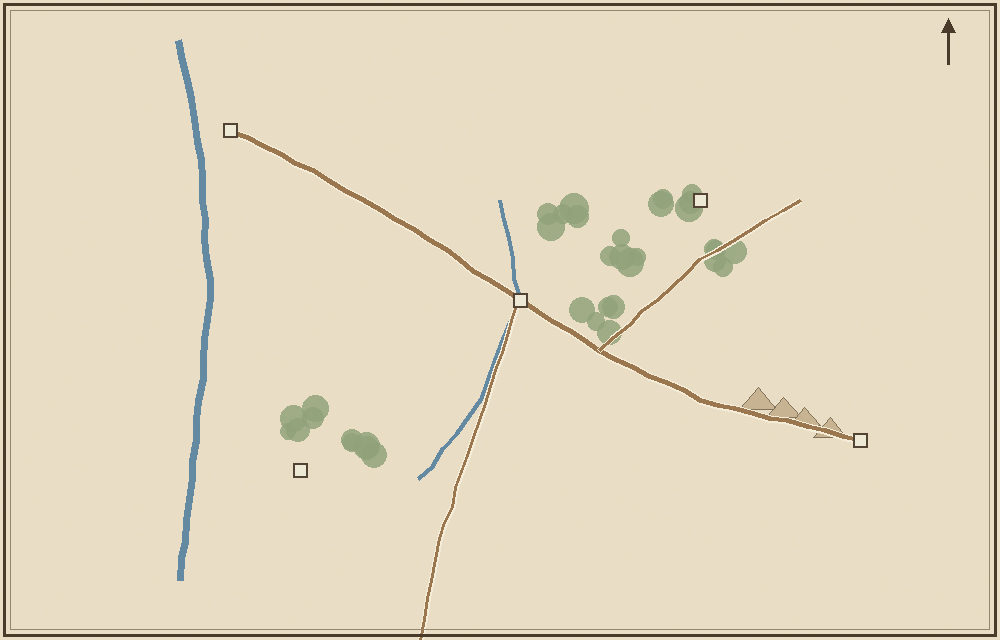 GRUNWALD / TANNENBERG
Marienburg
Thorn
Dabrowno
to Lithuania
Osterode
Vistula R.
Drweca R.
from Poland
GRUNWALD / TANNENBERG
Marienburg
Thorn
Dabrowno
to Lithuania
Osterode
Vistula R.
Drweca R.
from Poland
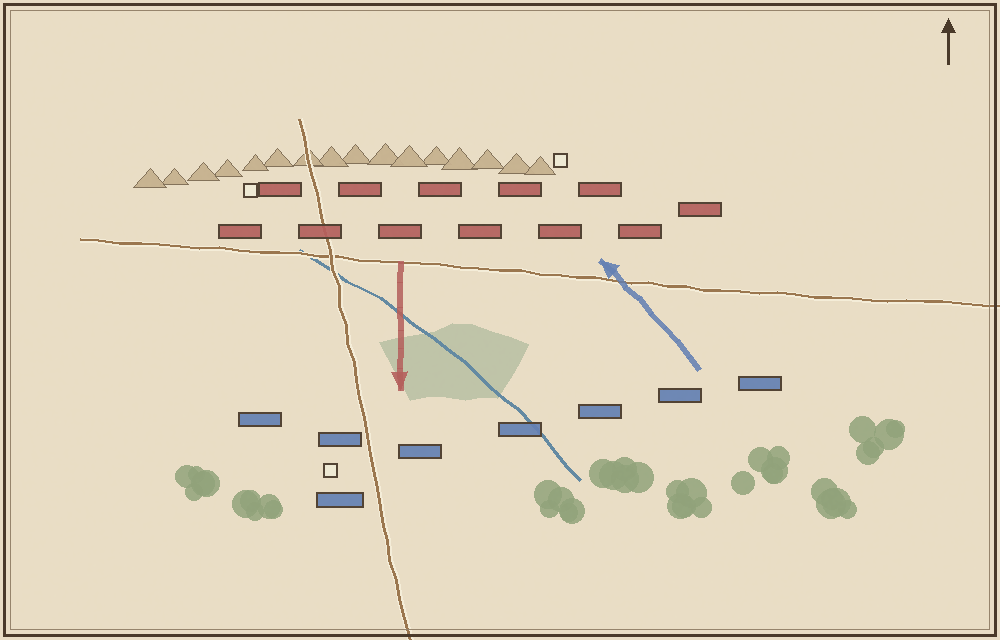 Grunwald
Tannenberg
Lodwigowo
Teutonic line
Poles (left)
Lithuanians (right)
marsh
the woods
Grunwald
Tannenberg
Lodwigowo
Teutonic line
Poles (left)
Lithuanians (right)
marsh
the woods