Battle of Kurikara
1183 · Japan Long
Heike (Taira) — Genji (Minamoto) · 13 turns · 82 units
Briefing
So deep was that ravine, and the Heike filled it with more than seventy thousand horsemen.
— The Tale of the Heike, Book 7, "The Fall at Kurikara"
Mount Tonami, on the border between Kaga and Etchu. The great Heike army that marched north has dismounted in the hills at a place called Saru-no-Baba to rest its horses. On the slope ahead, at Kurosaka, thirty white Genji banners stand in a row, and they look like a great host. The Heike decide not to descend into the open country. "These hills are walled with rock on every side. No one can come round behind us."
It is 4 p.m. on the 11th day of the 5th month of Juei 2. The two camps are barely three hundred metres apart. The Genji send forward fifteen riders, then thirty, then a hundred, to loose whistling arrows, but they will not let the fighting begin. They are waiting for nightfall. From north and south, Higuchi Kanemitsu's flanking force of ten thousand horsemen is working its way round the hills toward the Kurikara hall, behind the Heike. South of Saru-no-Baba lies the cliff of Jigoku-dani.
[How the Heike win] Twelve units may be activated each turn. The Heike begin holding Saru-no-Baba (30 points), the Kurikara hall (20) and Takenohashi (10); taking the Genji positions at Hanyu Hachiman (20) and Kurosaka (10) widens the margin. The commander, Taira Koremori, is a sudden-death unit: if he is destroyed, the Genji win at once. Jigoku-dani hexes cannot be entered, so a unit whose only retreat leads there is destroyed. The victory line is +30. If the margin from the Heike side exceeds +30, they have done better than history.
[How the Genji win] Eight units may be activated during the day, and eighteen from Turn 7 (7 p.m., sunset). The flanking force of eleven units (Higuchi Kanemitsu, Tomoe and others) enters on Turn 6 from the north and south edges of the map. Catch the Heike between front and rear and press them against the edge of the ravine. Destroying Koremori wins the game at once.
[Commanders] Heike: Taira Koremori (commander-in-chief), Taira Michimori, Taira Yukimori, Taira Tsunemasa, Taira Tadanori (Governor of Satsuma), Taira Moritoshi (former Governor of Etchu), Ito Kageie (Governor of Hida), Fujiwara Tadatsuna, Fujiwara Kagetaka, Taira Hidekuni, Senoo Kaneyasu, and Saimei, the abbot of Heisenji. Saito Sanemori, Matano Kagehisa, Ito Sukekiyo, Takahashi Nagatsuna and Musashi Arikuni, who served in the northern campaign, are also on the map. The rest are levies raised from the provinces.
Genji: Kiso Yoshinaka; Tezuka Mitsumori, Ochiai Kaneyuki, Nishina Moriie and Takanashi Takanobu; Ishiguro Mitsuhiro and Miyazaki Nagayasu of Etchu; the scribe Kakumei; at the Matsunaga willows, Nenoi Yukichika, Unno Yukihiro, Mochizuki Shigetaka and Yoda Jiro, with Hayashi Mitsuaki and Kuramitsu Narizumi of Kaga; at Hinomiya wood, Imai Kanehira; with the flanking force, Higuchi Kanemitsu, Tomoe, Nenoi Koyata and Tate Chikatada. Yoshinaka's uncle Minamoto Yukiie was facing the other Heike army at Mount Shiho to the north and is not on this map.
[Decisions this board poses]
- (Heike) Strike at the white banners on Kurosaka during the day, or hold position in the hills and wait? Only twelve units can move.
- (Heike) When the flanking force appears at the hall behind you, abandon the front and fall back toward Takenohashi, or turn to retake the hall?
- (Genji) What to do with eight units by day: press forward and shoot, or draw the troops at Matsunaga and Hinomiya closer until sunset?
[Outcome] As darkness fell, the flanking force raised its war cry near the Kurikara hall, and white banners rose behind the Heike like clouds. The main Genji force answered, and the troops at Matsunaga and Hinomiya shouted with them. Many Heike cried "Turn back, turn back!", but a great army that has begun to give way cannot be halted. Because those who went over the edge first could no longer be seen, the men behind took it that there was a path at the bottom, and son followed father, younger brother followed elder, into the ravine. Fujiwara Tadatsuna, Fujiwara Kagetaka and Taira Hidekuni were buried there, and Senoo Kaneyasu was taken alive by Kuramitsu Narizumi of Kaga. Koremori and Michimori escaped into Kaga; according to The Tale of the Heike, only some two thousand of more than seventy thousand got away (the courtier Kujo Kanezane, in his diary Gyokuyo, puts the Heike at about forty thousand). The next day Yoshinaka turned north to relieve Yukiie at Mount Shiho, and on the 1st day of the 6th month he defeated the Heike again at Shinohara in Kaga. In the 7th month the Heike abandoned the capital, taking the young emperor with them.
Thirty white banners stood upon the slope
The Heike rested their horses in the hills
Arrows flew, but no battle was given
At dusk a war cry rose at the hall behind them
Before and behind, every voice was the enemy's
The ravine was filled with seventy thousand men
The Genpei Seisuiki says that Yoshinaka tied torches to the horns of oxen and drove them into the Heike camp. The story does not appear in any version of The Tale of the Heike and is thought to be a later embellishment modelled on the Chinese tale of Tian Dan, so it is not part of this board. The dispositions follow Book 7 of The Tale of the Heike; the names of the seven Genji detachments are taken from the Genpei Seisuiki. The position of Kurosaka is an estimate.
1 hex = 250 m, 1 turn = 30 minutes, 1 CS = about 400 men. Turn 1 = 4 p.m. on the 11th day of the 5th month; Turn 7 = 7 p.m. (about sunset); Turn 13 = 10 p.m.
Maps
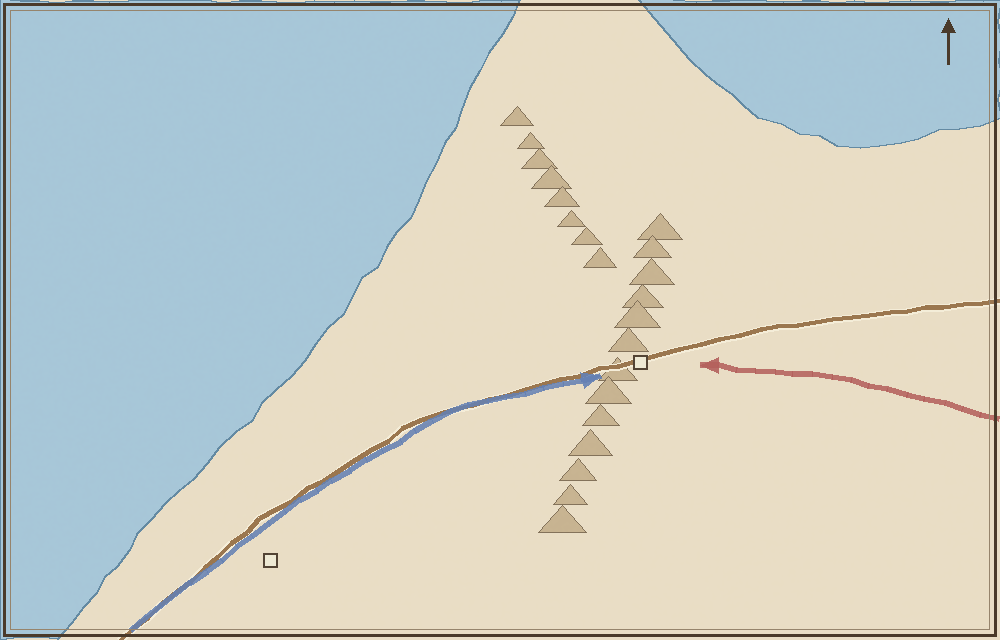 KURIKARA PASS
Kaga
Etchu
Noto
Echizen
Hiuchi castle (taken by the Heike in April)
Hannyano (9th day: Imai routs the Heike vanguard)
Mt. Shiho (Heike flank force)
Heike northern expedition (April-May)
Sea of Japan
to Shinano
to Kyoto
KURIKARA PASS
Kaga
Etchu
Noto
Echizen
Hiuchi castle (taken by the Heike in April)
Hannyano (9th day: Imai routs the Heike vanguard)
Mt. Shiho (Heike flank force)
Heike northern expedition (April-May)
Sea of Japan
to Shinano
to Kyoto
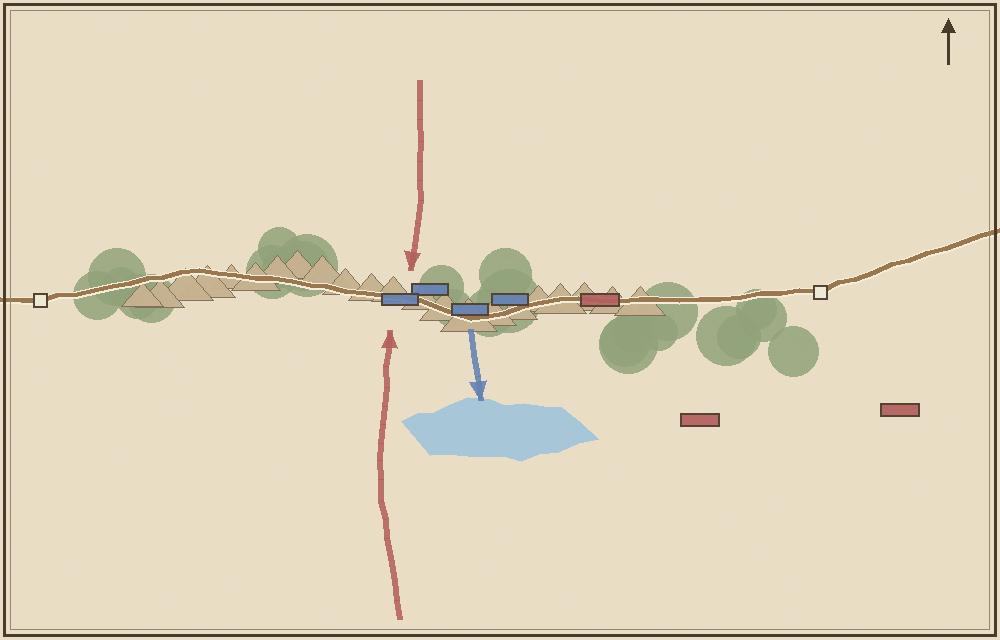 Saru-no-Baba (Heike camp)
Kurikara hall
Jigoku-dani ravine
Kurosaka (thirty white banners)
Hanyu (Yoshinaka, Hachiman shrine)
Matsunaga willows (10,000 horse)
Hinomiya wood (Imai, 6,000)
Flanking force, 10,000 (Higuchi)
Takenohashi (to Kaga)
Hokurikudo road
Saru-no-Baba (Heike camp)
Kurikara hall
Jigoku-dani ravine
Kurosaka (thirty white banners)
Hanyu (Yoshinaka, Hachiman shrine)
Matsunaga willows (10,000 horse)
Hinomiya wood (Imai, 6,000)
Flanking force, 10,000 (Higuchi)
Takenohashi (to Kaga)
Hokurikudo road