Battle of An
589 BC · China Medium
Jin Coalition — Qi Army · 10 turns · 49 units
Briefing
"Let me first finish these off, and then take my breakfast." -- Duke Qing of Qi, at An on the morning of the day guiyou (Zuo Zhuan, 2nd year of Duke Cheng)
In the north-east of the board a single hill rises abruptly out of the plain: Huabuzhu. No ridges surround it; its skirts fall straight into the fields. So a fleeing army cannot cross it, and a pursuing army must go around it. To the north is the Ji River, to the east the Qi camp, and the only way out is a single road along the foot of the hill. The Qi army was driven three times around this hill because the ground is made that way.
The plain spreading at its foot is An. In the sixth month of the Zhou calendar, on the day renshen, the army of Jin came to the foot of Miji and made camp, and Duke Qing sent an envoy to agree on battle. At dawn of the following day, guiyou, the two armies drew up at An. Duke Qing charged off without even putting armour on his horses. Breakfast after victory: that was the order of the morning. The board begins here and ends before noon.
[The measure of victory] The result is decided by a single margin: (points of your objectives) - (points of the enemy's objectives) + (losses inflicted) - (losses suffered). The opening is even at 25 to 25, and the only neutral objective is An itself (30 points). Behind the Jin coalition lie Miji (15) and Luo (10); behind Qi, the Qi camp (15) and Huabuzhu (10). A margin short of 7 is a draw; 58 is an operational victory and 116 a strategic victory.
[The Duke of Qi's chariot] Duke Qing's counter is a single war chariot. His driver, and Feng Choufu, the warrior on the right, ride on this one counter. Historically the Jin marshal Han Jue caught up with this chariot, and the history of the Spring and Autumn period came within a step of changing; how it ended is told under [Outcome]. The board provides no mechanism for a stand-in. Nor does it provide sudden death. If Duke Qing falls, Qi loses 4 of its 64 and the battle goes on. **Not letting one head end the battle is the question this board sets.**
[Moves] The Jin coalition has 26 counters and Qi 23. Yet at any one time Jin can move only 10 and Qi 11. The side with more counters has fewer moves. The reason is not strength but that Jin, Lu, Wey and Cao are four states thrown together. Holding a ford of the Ji River gives the holder two more moves for each ford. There is one ford to the west and one to the east, both outside the northern end of the line. Going to take them stretches your wing by that much, and does not add a single point.
[Commanders] Jin: Xi Ke, commanding the central army. Shi Xie (Fan Wenzi), second of the upper army (its commander had stayed at home). Luan Shu, commanding the lower army. Han Jue, the marshal. Qiwu Zhang, who lost his chariot and rode in Han Jue's. Xie Zhang, who drove Xi Ke's chariot, and Zheng Qiuhuan, the warrior on its right, led no troops and are not counters. It was this Xie Zhang who, with an arrow through his hand to the elbow and the left wheel stained dark red with blood, said "The eyes and ears of the army are on our banner and our drum; advance and retreat follow them," gathered the reins in his left hand and beat the drum with his right. Lu: Jisun Hangfu, Zangsun Xu, Shusun Qiaoru and Gongsun Yingqi (the Chunqiu records that these four led the army). Wey: Sun Liangfu, the commander defeated by Qi at Xinzhu that spring, who came on to An. Cao: Prince Shou.
Qi: Duke Qing (named Wuye). Gao Gu with the army of the Gao clan. This is the man who drove into the Jin lines, struck their soldiers with stones, seized a chariot, hung a mulberry root from it and rode round his own camp crying "Whoever wants courage, buy my surplus!" Guo Zuo (Bin Meiren) with the army of the Guo clan. No text says that he led an army, but by rule the three armies of Qi were led by the duke and by the Guo and Gao clans, so he has been placed that way. Duke Qing's driver, Feng Choufu on the right, and Zheng Zhoufu, whose spare chariot carried off his fleeing lord, had no troops and are not counters. The rest are the men of Linzi, Gu and Ji.
Note: the pairing of units with commanders includes inferences from the organisation of the time (listed in the author's notes).
[What you can test in this half day] Qi: having said "before breakfast", any delay makes the words an empty promise. Can you take all 30 points of An in the first half of ten turns? Put Duke Qing forward and the line stiffens, but if that one chariot is lost, the backbone of the centre goes with it. Jin coalition: do you gather your mere 10 moves at An, or reach out to the fords of the Ji? The fords give no points, only moves. And if you first seize the foot of Huabuzhu, that becomes the only road by which Qi can escape east. The historical Duke Qing judged that this was an enemy for whom breakfast could wait. What do you judge?
[Outcome] The Qi army broke and went three times around Huabuzhu. When Han Jue caught up with Duke Qing's chariot and stood before its horses, Feng Choufu on the right had already changed places with his lord. Choufu sent Duke Qing down from the chariot, saying "Go and fetch water from Huaquan," and the duke walked away and was picked up by the spare chariot. Duke Qing afterwards turned back into the Jin lines three times looking for Choufu. The Di soldiers screened him with halberds and shields and let him through, and the army of Wey also let him pass. The captured Choufu cried out, "From today no one will take his lord's peril upon himself. Here is one who did, and will you kill him?" Xi Ke said, "A man did not shrink from death to save his lord. To kill him would bring ill fortune. Pardon him, and encourage those who serve their lords," and set him free. Qi offered the steamer of Ji, a jade chime and land, and sued for peace. Jin replied: send the duke's mother as a hostage, and re-lay every field boundary in Qi to run east and west. With the boundaries running east to west, chariots coming from the west could drive straight in. Guo Zuo refused this, the covenant was sworn at Yuanlou, and the fields of Wenyang were returned to Lu. With this one battle Jin regained the name it had lost to Chu, and the following year it enlarged its three armies to six.
At dawn they charged, the horses unarmoured.
Blood ran down into his shoes, and still the drum went on.
The man told to fetch water from the spring went three times round the hill, and walked away.
Only surplus courage no one bought, and field boundaries to be turned east, remained.
Breakfast was served after noon.
The months before the battle (Qi's invasion of Lu and the fall of Long, the battle of Xinzhu, the contact at Shen) have been folded away; the board covers only the half day of guiyou. The sources give numbers only for Jin's 800 chariots, so Qi has been set at about the same. The city of Lixia was built in later ages, so there is not a single town on the board. The crossbow is a weapon of the Warring States period, so no counter has ranged fire.
Of the flags on the counters, the commander's banner marked 帥 follows a convention of novels and comics; it is not a flag attested in the sources. The Big Dipper banner of the centre army follows the Book of Rites (Quli I).
1 hex = 600 m, 1 turn = 40 minutes, 1 CS = about 500 men. T1 = dawn of the day guiyou, T10 = before noon.
Maps
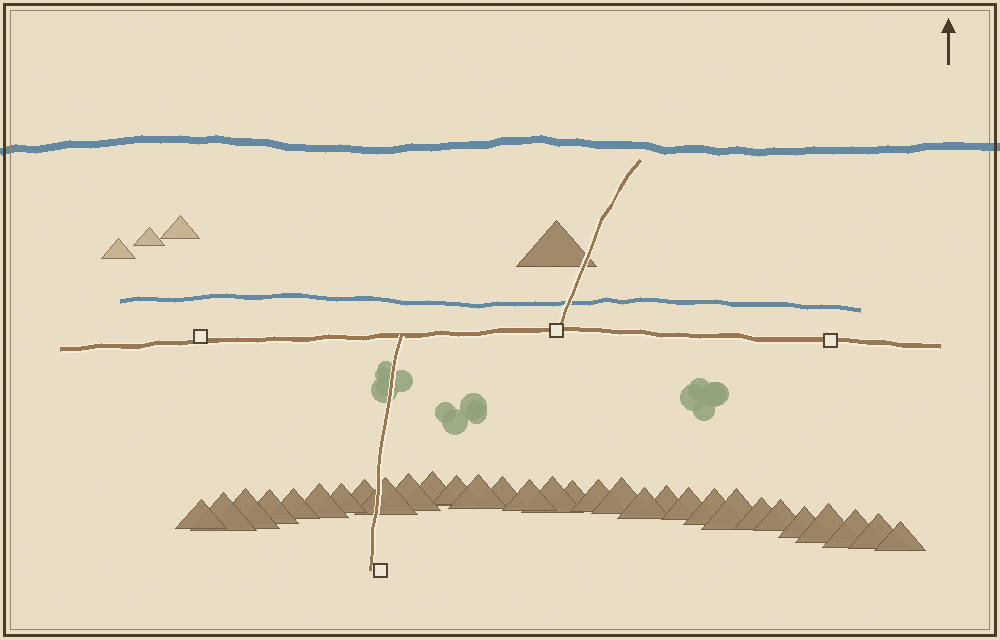 AN
Linzi (Qi)
from Jin and Wey
from Lu
Yellow River
Ji River
Mt Huabuzhu
Mt Tai
AN
Linzi (Qi)
from Jin and Wey
from Lu
Yellow River
Ji River
Mt Huabuzhu
Mt Tai
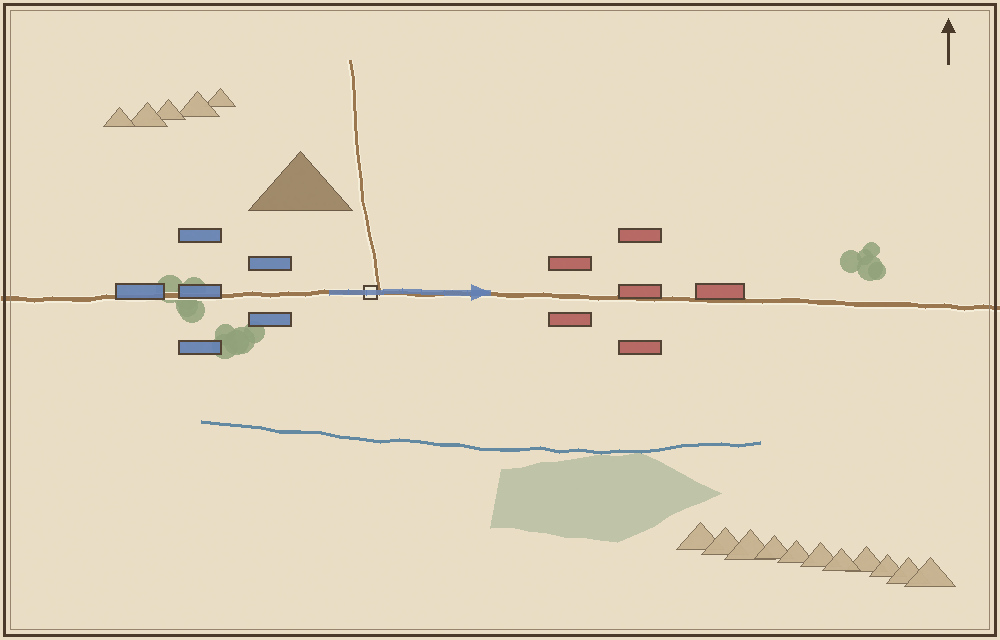 Mt Huabuzhu
An
Jin coalition
Qi army
marsh
the Ji ford
Mt Huabuzhu
An
Jin coalition
Qi army
marsh
the Ji ford