Battle of Guandu
200 · China Medium
Cao Cao's Army — Yuan Shao's Army · 13 turns · 69 units
Briefing
"When the enemy is at our backs, then report it." -- Cao Cao, as he set fire to the grain at Wuchao, to a soldier who warned him that Yuan Shao's relieving horsemen were near (Records of the Three Kingdoms, Annals of Emperor Wu)
Go and burn the grain, or hold the front? This night and day consist of that one question. The 10th month of Jian'an 5 (AD 200), Guandu, south of the Yellow River. Cao Cao had held out for months behind his earthworks and ditches, but his grain was nearly gone. Then Xu You, who had left Yuan Shao's camp, came over and told him where the grain was stored: Wuchao, forty li to the north-east. That night Cao Cao gave five thousand foot and horse the banners of the Yuan army, left his headquarters to Cao Hong and Xun You, and marched out. The board begins immediately after. That is why Cao Cao is not on the board at the start. He enters at the mouth of the eastern byroad on T3.
Yuan Shao has 42 units at hand. But he can move only 15 of them in a turn. The rest stand waiting for orders. That is what this battle truly was: Yuan Shao was not weak. He could not move.
[How to win] The result is decided by a single margin. Margin = (points of objectives you hold - points of objectives the enemy holds) + (losses inflicted - losses suffered). Finish 10 points ahead for a tactical victory, 79 for an operational victory, and 158 for a strategic victory. If neither side reaches 10, it is a draw.
[The quick road, and the fire that scores nothing] Yuan Shao has one path that has nothing to do with the margin: stand on the fortifications of Guandu, and the game is decided at that moment (sudden death), whatever the margin. Conversely, burning Wuchao does not add a single victory point for Cao Cao. All it does is cut down the enemy's moves. On this board, the move that burns the grain and the move that scores points are different moves.
[The five mounds of Wuchao] According to the official history, Chunyu Qiong and four others escorted the grain with more than ten thousand men and camped at Wuchao. So five mounds have been placed. Each time Cao Cao takes one, the number of counters Yuan Shao can move falls by two (one for losing the mound, and one more for its passing into enemy hands). With all five, an army of 42 units can move only five at a time: from 15 to 5, one third. The five commanders stand around the town of Wuchao, and the mounds are scattered outside them.
[The shape of the board] The Honggou canal crosses the board from north-west to south-east. It can be crossed, but attacking across it doubles the defender's combat strength. Three crossings (bridges) avoid that penalty, at the cost of a longer way round. Along the fortifications of Guandu, a palisade facing north runs for 17 hexes from east to west. The Putian marsh in the western third and the marshes in the south-east are hard going, so the main forces meet from the centre of the board southward. The marsh at the northern edge is the south bank of the Yellow River: Yuan Shao's back.
[Commanders] Yuan Shao's army: Yuan Shao. Ju Shou, Guo Tu and Chunyu Qiong each lead an army as the three commanders-in-chief. His eldest son Yuan Tan, and the halberdiers of his guard. On the left, Zhang He, Gao Lan, Ma Yan and Zhang Yi. On the right, Jiang Qi, Han Meng, He Mao, Wang Mo, Lü Kuang and Lü Xiang. At Wuchao, the five: Chunyu Qiong, Sui Yuanjin, Han Juzi, Lü Weihuang and Zhao Rui. Qian Zhao, who commanded the Wuhuan cavalry. The rest are the troops of Ji, Qing, You and Bing: the four provinces Yuan Shao ruled.
Cao Cao's army: at the fortifications of Guandu, Cao Hong, Xun You, Yu Jin, Xiahou Dun, Xiahou Yuan, Li Dian, Zhu Ling and Cao Ren; Shi Huan, who burned Han Meng's supply train; Ren Jun, who managed the army's grain; Zhang Xiu, who fought hard at Guandu and was promoted General Who Breaks the Qiang; Han Hao of the central guard; Cao Xiu of the bodyguard; and Xianyu Fu, who came over from You province. The detachment entering from the east is led by Cao Cao, with Xu Chu, Zhang Liao, Xu Huang, Yue Jin, and Cao Chun commanding the guard cavalry. It was this Yue Jin who killed Chunyu Qiong. Yan Liang and Wen Chou had been killed half a year earlier at Baima and Yanjin, and Guan Yu had already gone. Tian Feng is in prison, and Xun Yu is in the capital at Xu. Xu You, who revealed where Wuchao was, led no troops and is not a counter.
[Defection] Zhang He and Gao Lan begin rolling to defect from T9 (25%, rising by 15% each turn thereafter). Historically they surrendered to Cao Hong on hearing that Wuchao had fallen. The roll on the board, however, does not look at whether Wuchao has burned; it looks only at the turn and the probability.
[What you can test in this night and day] Cao Cao: how many units do you send to Wuchao? Burn all five, or go back after two? For how many turns can the 21 units left in the fortifications hold off Yuan Shao's 15 moves? Yuan Shao: how many units do you leave at Wuchao (every one left there is one fewer to attack Guandu)? Which of the three crossings do you use? The historical Yuan Shao sent only light cavalry to the rescue and turned his main force against Guandu, because Guo Tu said, "Strike his headquarters and Cao Cao will have to come back." The result was that Wuchao fell and Guandu did not.
[Outcome] Wuchao burned. The fire was out within the night, but by its light Zhang He and Gao Lan gave up on their lord and laid down their arms before the earthworks they had been attacking. An army of a hundred thousand fell apart before it fought. Yuan Shao abandoned his tent and crossed the Yellow River northward with only eight hundred horsemen. What Cao Cao burned was not grain. It was the one idea Yuan Shao still held: "This time I can win." Tian Feng in his prison was killed before the news of victory could come, just as he himself had said: if the army wins I live, and if it loses I die. Two years later Yuan Shao died vomiting blood; the sons he left divided the lands north of the river and fought over them, and the more they fought, the sooner they were swallowed. The Central Plain began to gather into one man's hands. Of the shape later called the division of the realm into three, this was the first move.
The night fire rose at Wuchao,
an army of a hundred thousand fell apart without fighting.
What burned was not the grain.
It was a single thought: we can still win.
From then on, the lands north of the river became an open plain for the wind.
The months of confrontation have been folded away; the board covers only the decisive night and day. Strength, a hundred thousand against some twenty thousand, has been compressed into combat strength of 105 against 100 (the board would not work with the raw ratio of numbers; the solidity of Cao Cao's entrenched defence has been added to combat strength). Baima and Yanjin were separate battles in the fourth month of that year and are off the board.
Of the flags on the counters, the commander's banner marked 帥 follows a convention of novels and comics; it is not a flag attested in the sources. The characters 冀 and 兗 on the counters are the names of the two commanders’ home provinces, Ji and Yan; there were no states in this battle.
1 hex = 1,000 m, 1 turn = 90 minutes, 1 CS = about 1,000 men. T1 = night, T3 = the detachment enters, T9 = the defection rolls begin, T13 = end.
Maps
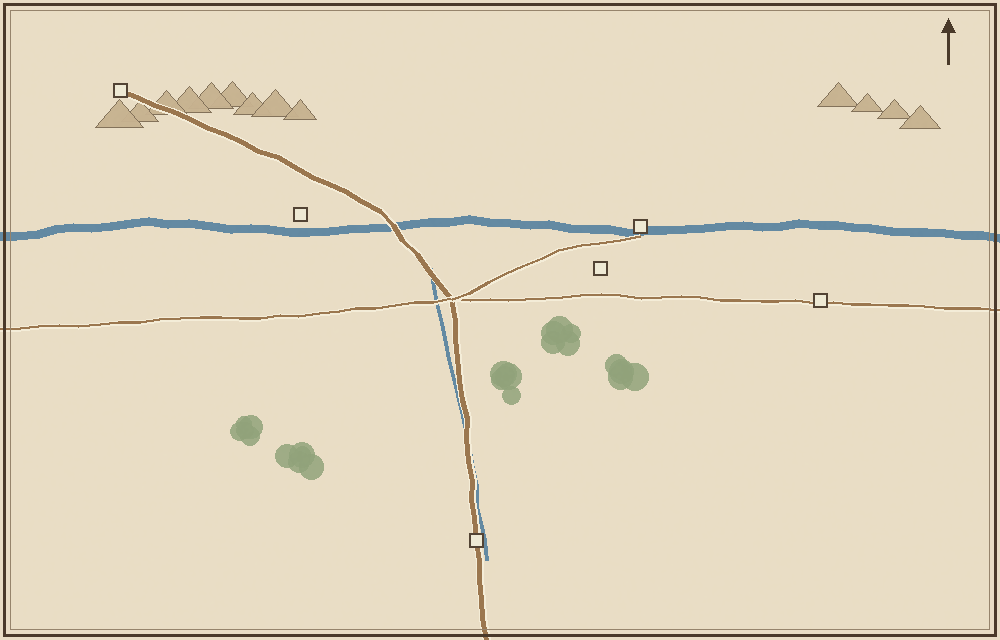 GUANDU
Ye (Yuan Shao)
Yanjin
Baima
Xudu (Cao Cao)
Wuchao
Chenliu
Yellow River
Honggou canal
GUANDU
Ye (Yuan Shao)
Yanjin
Baima
Xudu (Cao Cao)
Wuchao
Chenliu
Yellow River
Honggou canal
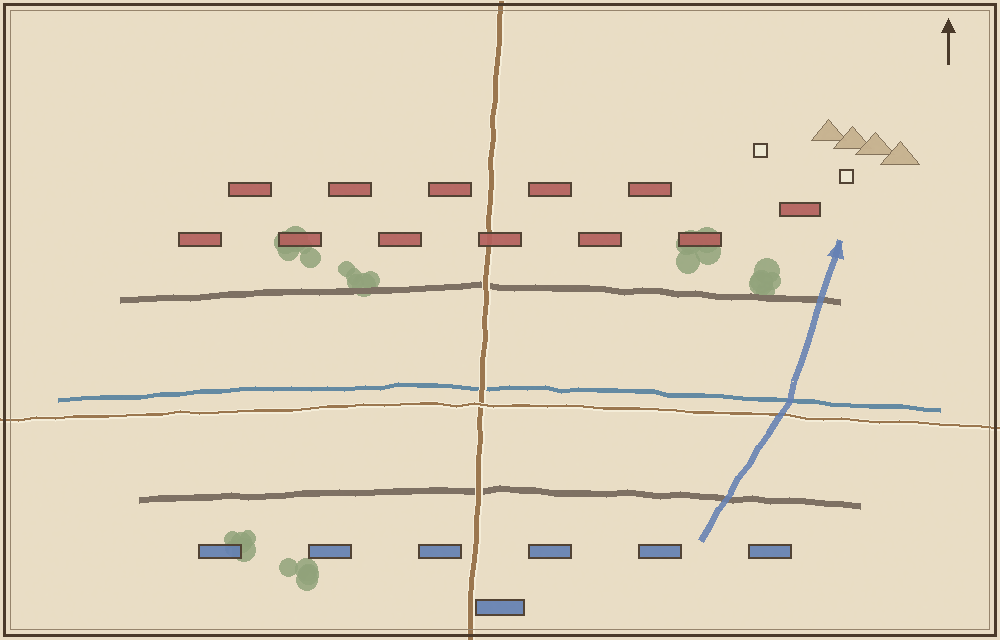 Yuan Shao lines
Cao Cao lines
Wuchao granary
Chunyu Qiong camp
Guandu stream
to Xudu
to the Yellow River
Yuan Shao lines
Cao Cao lines
Wuchao granary
Chunyu Qiong camp
Guandu stream
to Xudu
to the Yellow River