Battle of Shiloh
1862 · North America Long
Union — Confederate · 26 turns · 59 units
Briefing
"Well, Grant, we've had the devil's own day, haven't we?" "Yes. Lick 'em tomorrow, though."
-- Sherman and Grant under an oak in the rain on the night of 6 April (a later anecdote; attributed)
Shiloh, 6-7 April 1862, Hardin County, Tennessee. Pittsburg Landing on the west bank of the Tennessee River: the bottom of a sack between Snake Creek to the north and Lick Creek to the south-east. Grant's Army of the Tennessee was camped there, without entrenchments. It was an assembly area for the advance on Corinth, not a position for defence. At dawn on 6 April, A. S. Johnston's Army of the Mississippi, having marched 22 miles from Corinth, poured straight into those camps. As the attack went in, Johnston said, "Tonight we will water our horses in the Tennessee River." The camps of Sherman and Prentiss were overrun, and in the centre of the crumbling Union army one sunken road remained. There W. H. L. Wallace and Prentiss threw back eleven or twelve assaults over six hours. From the sound of the bullets flying about, the Confederate soldiers called it the Hornets' Nest. At 2:30 in the afternoon Johnston was shot and killed in the Peach Orchard. Ruggles lined up some fifty guns and broke the Hornets' Nest, and at 5:30 Prentiss surrendered with 2,200 men. But those six hours saved the Union army. Grant drew a last line short of the landing, behind the ravine of Dill Branch, held up by heavy guns and the gunboats on the river. Before sunset the last Confederate assault stopped in the ravine. That night, in the rain, Lew Wallace's division arrived from the north, and Buell's Army of the Ohio finished crossing the river from the east.
[How to win] The result is decided by a single margin. Margin = (points of objectives you hold - points of objectives the enemy holds) + (losses inflicted - losses suffered). Finish 13 points ahead for a tactical victory, 102 for an operational victory, and 205 for a strategic victory. If neither side reaches 13, it is a draw. The objectives on the board are worth 150 points in all, and all eight belong to the Union from the start: if the Confederates do nothing, the margin stays tilted towards the Union. The Confederates also have one path that has nothing to do with the margin: the moment one of their units stands on Pittsburg Landing, the Confederates win.
[Confederates] The Army of the Mississippi. A. S. Johnston (killed on the afternoon of the first day), thereafter Beauregard. Hardee's corps (Hindm = Hindman / Clebn = Cleburne / Wood). Bragg's corps (Gibsn = Gibson / Andsn = Patton Anderson / Pond / Gladn = Gladden / Chalm = Chalmers / Jacks = Jackson). Polk's corps (Russl = Russell / Stewt = A. P. Stewart / Johns = Bushrod Johnson / Steph = Stephens). The reserve (Trabu = Trabue / Bowen / Stath = Statham). The cavalry: Forst = Nathan Bedford Forrest, Whart = Wharton, Clant = Clanton.
[Union] The Army of the Tennessee (Grant). On the board from the start: 5-* Sherman's division, 6-* Prentiss's division, 1-* McClernand's division, 2-* W. H. L. Wallace's division, 4-* Hurlbut's division, the heavy guns at the landing, Siege Madis (eight 20-pounder Parrott guns; movement 2), and the cavalry, Cav Dicky. Reinforcements: from the northern edge, 3-* Lew Wallace's division (from T13; historically he took the wrong road and missed the first day), and from the landing to the east, the Army of the Ohio (Buell): O4-* Nelson from T13, O5-* Crittenden on T14, O2-* McCook from T15, and O6-20 Wood on T19.
[Decisions this board lets you test] As the Confederates, can you reach the landing on the first day? Do you break the Hornets' Nest from the front, or go round it (Hornets Nest and Duncan Field double the defence)? As the Union, where do you make your stand? How do you use Lew Wallace? Can you hold until Buell has finished crossing?
[Outcome] The next morning, on a field where the numbers had changed places, the Union pushed back, and at three in the afternoon Beauregard withdrew to Corinth. The casualties of the two days came to some 23,700 in all: more than the casualties of all the wars America had fought until then put together. Everyone had thought the war would be over in a summer. After Shiloh, no one thought so. Grant wrote in later years that these two days changed his mind: the rebellion would not wither of itself, and there was no way to end it but the complete conquest of the South. Johnston was shot behind the knee and bled to death. There was no one near to bind the wound: he had sent his own surgeon away to tend wounded Union prisoners. Afterwards, entrenchments were dug at the camps of Pittsburg Landing. The soldiers of this war would no longer sleep without digging.
In the Hornets' Nest, there was a morning six hours long.
Night came, rain came, and boats came.
The next morning, the numbers had changed places.
Everyone had thought it would be over in a summer.
From this day, soldiers do not sleep without digging.
Some unit names have been folded into five letters.
1 hex = 200 m, 1 turn = 60 minutes, 1 CS = about 500 men. Day 1, T1 to T13 = 4/6 05:00 to 18:00; day 2, T14 to T26 = 4/7 06:00 to 18:00.
Maps
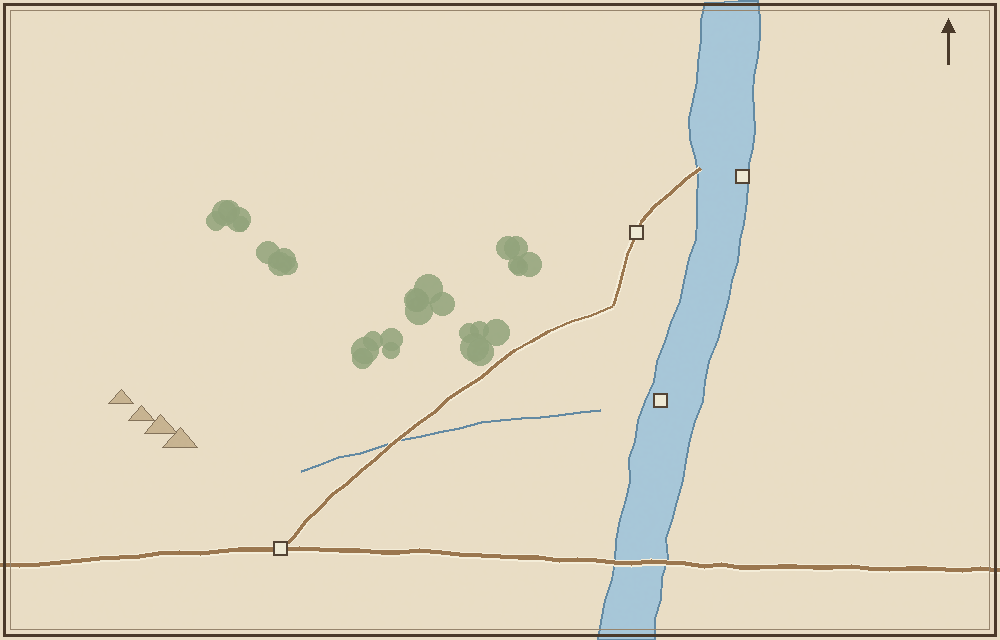 PITTSBURG LANDING
Corinth
Savannah
Crump's Landing
Hamburg
to the Ohio
Tennessee R.
to Memphis (railroad)
railroad to Charleston
PITTSBURG LANDING
Corinth
Savannah
Crump's Landing
Hamburg
to the Ohio
Tennessee R.
to Memphis (railroad)
railroad to Charleston
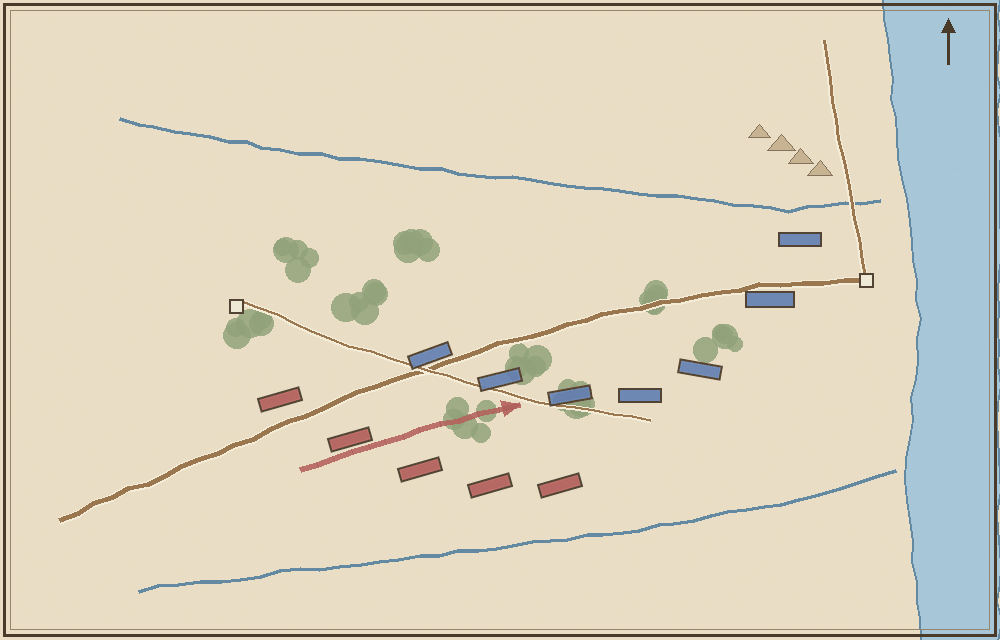 Pittsburg Landing
Shiloh Church
Sunken Road / Hornets Nest
Peach Orchard
Owl Creek
Lick Creek
Tennessee R.
from Corinth
Pittsburg Landing
Shiloh Church
Sunken Road / Hornets Nest
Peach Orchard
Owl Creek
Lick Creek
Tennessee R.
from Corinth