Battle of Anegawa
1570 · Japan Medium
Oda & Tokugawa Army — Azai & Asakura Army · 9 turns · 54 units
Briefing
Kyosetsu tarubeshi
"That must be a lie."
-- Nobunaga's first words on being told that his brother-in-law, Azai Nagamasa, had turned against his rear (Shincho Koki, book 3, Kanegasaki)
This battle has three names. The Oda called it the Battle of Nomura, and the Azai and Asakura called it the Battle of Mitamura. It was the Tokugawa who named it after the river, Anegawa, and only their name has survived.
The 28th day of the sixth month of Genki 1 (1570), northern Omi. Two months earlier, at Kanegasaki, Nobunaga had been taken from behind. This month he is besieging Yokoyama Castle, south of Odani Castle. Judging a direct assault on Odani too costly, he has come first to take the outpost to its south. Tokugawa Ieyasu has arrived from Mikawa with five thousand men. Asakura Yoshikage of Echizen did not come in person, but sent his kinsman Asakura Kagetake with eight thousand. The night before, the Azai and Asakura camped on Mount Oyori in the north-east of the board; at dawn they came down to the north bank of the Anegawa, the Azai to Nomura in the east and the Asakura to Mitamura in the west. So the Oda came to face the Azai, and the Tokugawa the Asakura, separately, across the same river. At six in the morning, both armies go down onto the riverbed.
[The Riverbed] The pink band running east to west across the centre of the board is the riverbed of the Anegawa. There are no villages, woods or hills on it. An attack across the river gives the defender double combat strength, except directly in front of a ford (bridge), where the doubling does not apply. And there are only two fords on the board: the Nomura ford in the east (Oda against Azai; the riverbed there is called Chikawa, "the river of blood") and the Mitamura ford in the west (Tokugawa against Asakura; the riverbed there is called Chihara, "the field of blood"). Chihara and Chikawa are names given after the battle, and they remain on the map today. Both are neutral objectives worth 25 points, and the opening margin is exactly 0 because neither belongs to anyone.
[How to win] The result is decided by a single margin. Margin = (points of objectives you hold - points of objectives the enemy holds) + (losses inflicted - losses suffered). The dividing line is Oda-Tokugawa +55. The Oda-Tokugawa side wins with a lead of +67 or more; the Azai-Asakura side wins by holding the Oda-Tokugawa lead to +43 or less. Anything in between is a draw. A further 100 points beyond the line gives an operational victory, and 200 a strategic victory (for the Azai-Asakura, -45 and -145). The objectives on the board are worth 150 points in all. On the south bank, Tatsugahana (30 points, Nobunaga's headquarters) and Okayama (20 points, Ieyasu's position) belong to the Oda side; on the north bank, Nomura (25) and Mitamura (25) belong to the Azai side; Chikawa and Chihara on the riverbed (25 each) are neutral, and the opening margin is 0. Having met eighteen thousand with twenty-eight thousand, merely pushing the enemy back is not a victory: taking both fords on the riverbed gives only +50, still within the draw band. Only by taking a village on the north bank, or by coming out ahead in the exchange of losses, within eight hours, does the Oda-Tokugawa side win.
The Azai-Asakura side needs only to reach two in the afternoon with the lead held to +43 or less. The Azai have 13 pieces and the Asakura 11, 24 in all, of which 10 may move at once. The enemy has 30 pieces and may move 12, but two of those moves are tied to the castle in the south.
[Yokoyama Castle] In the south of the board, a flag stands on the castle of Yokoyama. It carries no victory points at all. While the Azai side holds the castle, the number of pieces the Oda-Tokugawa side may move at once falls from 12 to 10; that is all. Why did Nobunaga, with twenty-eight thousand men, divide them into thirteen bodies and send them forward one after another? Because behind him one castle had not yet fallen. The three lords of western Mino beside the castle, Inaba Ittetsu, Ujiie Bokuzen and Ando Morinari, hold it in check. Sending them to the river would thicken the line, but once the combat strength watching the castle falls below 9, the garrison (Mitamura Kunisada, Nomura Naotaka and Onogi Hidetoshi) begins to move. Take the castle, and the moves come back. But the men to take it can only be drawn from the river.
[Mount Oyori] In the north-east of the board, a flag also stands on Oyoriyama. It too is worth 0 victory points. If the Oda hold it, the number of pieces they may move at once rises from 12 to 15. This is the mountain where the allies camped the night before. Going to take it means the right wing crosses the river and stretches to the north-east, and the front at Nomura grows thinner by as much. The bait is visible to both sides from the start. It is visible, and still, every turn, one hesitates. The historical Nobunaga did not go.
[Colours of the Counters] Within the same side, each house has its own counter colour: brown for the Oda, green for the Tokugawa, indigo for the Azai, and plum for the Asakura. On this board two separate battles are fought at the same time in the east and the west, and the shape of the battle cannot be seen unless one can tell which house is where.
[Commanders] The Oda side: Oda Nobunaga (his headquarters at Tatsugahana is divided into three pieces). In the forward bodies, first Sakai Masahisa, then Ikeda Tsuneoki, Kinoshita Hideyoshi, Shibata Katsuie, Mori Yoshinari (who will be killed at Usayama in the ninth month), Sakuma Nobumori, Niwa Nagahide and Hachiya Yoritaka. Maeda Toshiie and Sassa Narimasa of the horo-shu guard. Takenaka Shigenori, younger brother of Hanbei, the man who will kill Endo Naotsune. Holding Yokoyama in check, the three lords of western Mino: Inaba Ittetsu, Ujiie Bokuzen and Ando Morinari. The Tokugawa side: Tokugawa Ieyasu (at Okayama, called Katsuyama after the battle), Sakai Tadatsugu, Ishikawa Kazumasa, Honda Tadakatsu, Sakakibara Yasumasa (who will turn the flank of the Asakura), Ogasawara Nagatada and Watanabe Moritsuna. * Sakai Masahisa (Oda) and Sakai Tadatsugu (Tokugawa) share the same surname in kana; please tell them apart by the colour of their counters.
The Azai side: Azai Nagamasa. The vanguard is Isono Kazumasa, lord of Sawayama Castle, the only piece on the board that begins with a foot already in a ford. Endo Naotsune, who will carry a head into Nobunaga's headquarters; Azai Masazumi, Atsuji Sadayuki, Shinjo Naoyori, Anyoji Ujitane, Imamura Ujinao, Yuge Iezumi and Kabuto Soshin. The garrison of Yokoyama Castle is Mitamura Kunisada, Nomura Naotaka and Onogi Hidetoshi: the two villages on the north bank where battle is about to open bear exactly their family names. The Asakura side: the commander Asakura Kagetake (Yoshikage has not left Echizen). Makara Naotaka of the great sword, with his brother Naozumi and his son Takamoto. Maeba Kageatsu, Kurosaka Kagehisa, Kobayashi Tanshuken and Uozumi Kagekata.
[What these eight hours decide] Nobunaga: should he go to take Yokoyama Castle (two moves come back, but to find those two he must draw men from the river)? Should he reach for Mount Oyori (three more moves, but the right wing stretches across the river)? Ieyasu: holding eight thousand with five thousand, can he make an opening to send Yasumasa round the flank? Nagamasa: should he throw Isono into the ford? Only directly in front of the ford does the defender lose his doubling. Kagetake: can he hold Mitamura? The moment the Asakura break, the western shoulder of the Azai lies open.
[Outcome] After noon, Sakakibara Yasumasa came round the flank of the Asakura. The Asakura broke, and then the Azai. The three lords of western Mino, who had been watching Yokoyama, also turned to the river and struck the flank of the Azai. Some eleven hundred heads were taken. The three Makara laid down their great swords and remained on the riverbed, and Endo Naotsune died inside the Oda lines, grappling with Takenaka Shigenori. Nobunaga pursued to within about fifty cho of Odani Castle, then turned back to Yokoyama. The castle surrendered the next day, and Kinoshita Hideyoshi entered it as its keeper: the castle in the southern corner of the board is where Hideyoshi would be three months later. Nobunaga had judged that Odani could not be taken at a stroke. He was right, and this victory ended nothing. Three months later the Azai and Asakura shut themselves up on Mount Hiei, and Nobunaga, surrounding the mountain, could not move for two months. Mori Yoshinari was killed at Usayama Castle in that campaign. The following year Isono Kazumasa, the vanguard of this day, was cut off at Sawayama and surrendered to Nobunaga. Odani Castle fell and the Azai house was destroyed three years after this riverbed. The Asakura house had been destroyed twenty days before.
The man who said "it must be a lie" came out to the river two months later.
Nomura and Mitamura: two names; it was the men of Mikawa who named it after the river.
It is said that Isono came through eleven ranks and stopped at the twelfth.
The three Makara laid down their great swords and remained on the riverbed.
Chihara, Chikawa: the names are still on the map.
Three more years until the Azai fall.
The confrontation of the preceding days, and the pursuit after nightfall and the surrender of Yokoyama Castle the next day, are omitted. The board covers only the eight hours from six in the morning until two in the afternoon. Each body of troops is combined into one to three pieces. In men, the Oda had 23,000 and the Tokugawa 5,000 against 18,000 Azai and Asakura, but on the board combat strength is Oda 81 and Tokugawa 32 against Azai 46 and Asakura 41, because the scale for the Tokugawa, who held eight thousand with five thousand, and for the Azai and Asakura, who fought best that day, has been set above their numbers. Figures vary between sources, which give the Oda anywhere from 10,000 to 35,000. The well-known story that Isono Kazumasa broke through eleven of the thirteen Oda ranks appears only in the late seventeenth-century Azai Sandaiki, and is widely regarded as a later invention. On the board, Isono as vanguard is simply placed north of the ford with a combat strength of 5; whether he can reach the eleventh rank is for the player to decide.
1 hex = 200 m, 1 turn = 60 minutes, 1 CS = about 250 men. T1 = 28th day, 06:00 (both armies go down onto the riverbed), T4 = 09:00, T7 = 12:00 (around the time of Sakakibara Yasumasa's flank attack), T9 = 14:00 (the final turn, ending at 15:00). The Oda-Tokugawa side may move 12 pieces at a time (10 while Yokoyama Castle is held against them, 15 if they take Mount Oyori); the Azai-Asakura side may move 10.
Maps
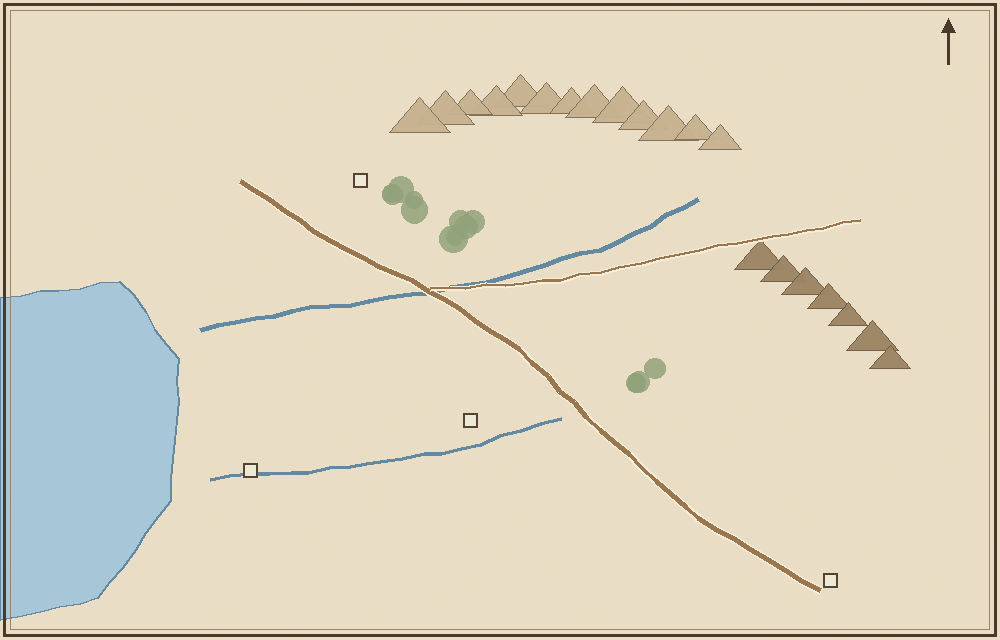 ANEGAWA
Odani castle
Yokoyama castle
Nagahama
to Gifu
Lake Biwa
to Echizen (Asakura)
Ane River
ANEGAWA
Odani castle
Yokoyama castle
Nagahama
to Gifu
Lake Biwa
to Echizen (Asakura)
Ane River
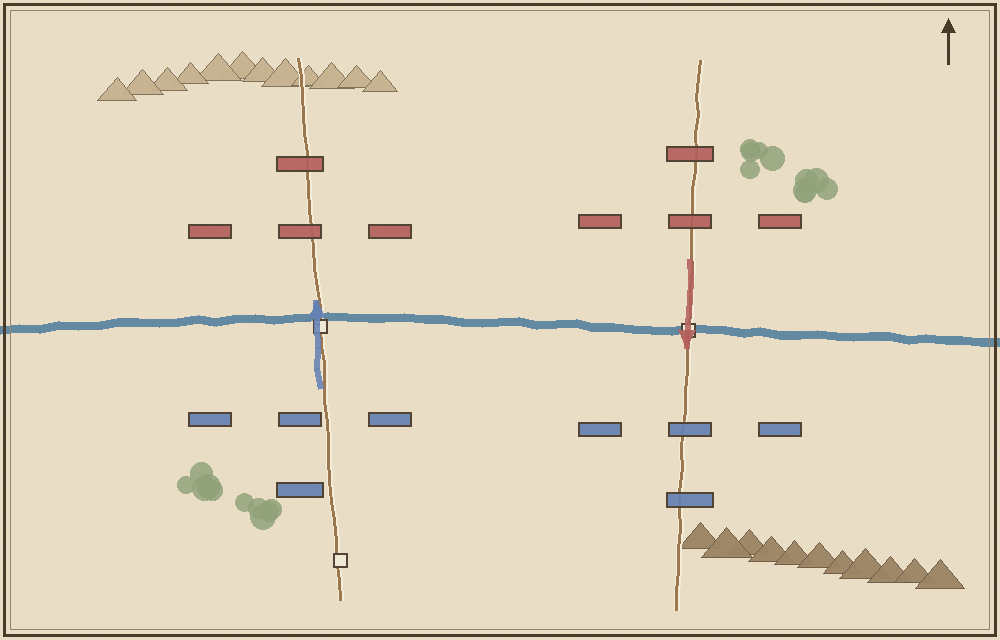 Nomura ford
Mitamura ford
Azai
Asakura
Oda
Tokugawa
Ane River
Yokoyama castle
Nomura ford
Mitamura ford
Azai
Asakura
Oda
Tokugawa
Ane River
Yokoyama castle