Battle of Breitenfeld
1631 · Europe Medium
Swedish-Saxon Army — Imperial-League Army · 10 turns · 56 units
Briefing
Verzage nicht, du Häuflein klein
"Fear not, O little flock"
-- the opening line of the hymn the Swedish army is said to have sung before this battle. The words are attributed both to Gustavus Adolphus himself and to his field chaplain, Jacob Fabricius (by tradition)
The tercio was a formation that had gone on winning for thirty years. The seven and a half hours of this board are the story of how it became obsolete in a single day.
17 September 1631, eight kilometres north of Leipzig. Treeless, gently rolling farmland, the harvest already in. In May, Magdeburg had been burned and twenty thousand people had died. John George I, Elector of Saxony, who until then had remained neutral, at last allied himself with the King of Sweden in the very month that Count Tilly's army entered his lands. Tilly was seventy-two years old and had not been beaten in more than thirty years. He had no intention of fighting that day; he meant to stay where he was and wait for Aldringen's reinforcements. It was Pappenheim who began it. He went out to reconnoitre and simply stayed in front of the enemy. Tilly had no choice but to bring out his army. He set his guns on the low ridge between Breitenfeld and Seehausen and waited, facing north. In the morning the allies crossed the Lober and deployed south of Podelwitz, the Swedes on the right and the Saxons on the left. At noon the guns of both armies opened fire. For two hours, neither side moved.
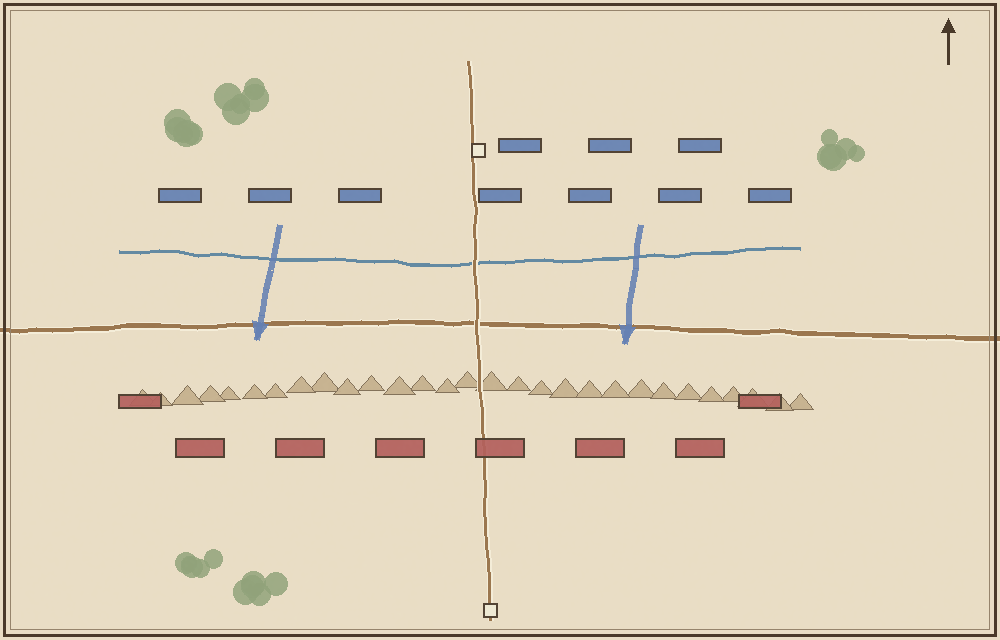
[The Galgenberg] At the centre of the board, on the ridge marked Galgenberg, stand Tilly's guns. This is the heaviest objective on the board (30 points), and at the start it belongs to the Imperials. In history, Gustavus Adolphus led his right wing forward in person, took this battery, turned it round, and fired on the enemy still standing in formation: the lines of tercios. That was what decided the battle.
[How to win] The result is decided by a single margin. Margin = (points of objectives you hold - points of objectives the enemy holds) + (losses inflicted - losses suffered). The dividing line is Allies -52. The Allies win by bringing the margin to -44 or higher; the Imperials win by holding the Allied margin to -60 or lower. Anything in between is a draw. A further 68 points beyond the line gives an operational victory, and 136 a strategic victory (for the Imperials, -120 and -188). The objectives on the board are worth 98 points in all. The board opens at a margin of -64, because nearly everything that scores, ridge and villages alike, is held by Tilly (the Galgenberg 30, Breitenfeld 16, Seehausen 16, Wiederitzsch 14; the Allies hold only Podelwitz, 12). Taking the Galgenberg moves the margin by 60, to -4: the ridge alone carries the Allies across to the winning side. Even without reaching the ridge, taking one village and not losing the exchange of losses with the tercios is enough. For Tilly, it is enough not to be pushed back. The ridge is laid out as "a pair of gentle rises" with flat ground between them. It is not a wall, and holding it requires careful placement. The tercios are strong but slow: only 7 of the 25 pieces may move at once (8 from T3). Once they begin to wheel, they can do nothing else. Night falls after ten turns (T10 begins at 18:45 and ends at 19:30).
[The Sunken Road] Running north to south across the board is the road from Duben to Leipzig, with a deep ditch dug along its eastern side (shown on the board by the fence symbol). The ditch lies on one side only, facing east. Only a side standing here and attacked from the east receives the attack at double combat strength. In history, after the Saxons had vanished and the left lay empty, Gustav Horn turned his whole force in fifteen minutes, took his stand on this ditch, and stopped the oncoming tercios. The road runs exactly along the seam between the Swedish and Saxon armies. What happens when that seam gives way can be read from the board itself.
[The Road to Halle] At the western edge of the board, a flag stands on the Road to Halle. It carries no victory points. While the Imperials hold it, the number of pieces they may move at once rises from 8 to 11; that is all. Going round outside the Swedish right wing gains moves: this is the direction in which Pappenheim, on his own initiative, charged seven times, was thrown back seven times, and then rode away west towards Halle. The bait is visible to both sides. It is visible, and still, every turn, one hesitates.
[Commanders] The Allies: Gustavus II Adolphus, King of Sweden. On the right, Johan Baner, Torsten Stalhandske with the Finnish light horse, Erik Soop and Ake Tott. The musketeers placed between the cavalry squadrons (range 2) are the hallmark of this army. In the centre, Maximilian Teuffel's Yellow Brigade, Hans Georg aus dem Winckel's Blue Brigade, the Oxenstierna Brigade, the Hand Brigade, and James Lumsden's Scots Brigade. In the second line, John Hepburn's Green Brigade, the Thurn Brigade and the Vitzthum Brigade. The artillery under Lennart Torstensson. On the left, Gustav Horn, Baudissin and Kaldenbach. The Saxon army (its pieces have green backgrounds; it is on the same side but is a separate army): Elector John George I. The army was actually directed by Field Marshal Hans Georg von Arnim, with Duke Frederick William II of Saxe-Altenburg in the centre and Bindauf on the left. The household foot of Dam Vitzthum and Bose, and Klitzing, Starschedel, Steinau and Loser. This army had been raised only the previous year and had never yet fought.
The Imperial and Catholic League army: Johann Tserclaes, Count of Tilly. On the left, Gottfried Heinrich zu Pappenheim, Piccolomini, Strozzi, Merode-Waroux and Trcka. In the centre, the veteran tercios of Wangler, Gehlen, Matthias Gallas, Federigo Savelli and Tilly's own regiment. Also Baldiron, Blankart, Wahl, Holstein-Gottorp and Contreras. The arquebusiers of Coronini, Colloredo and Montecuccoli; this Montecuccoli is the very general who would later write down the art of war of his age. On the right, Egon VIII of Furstenberg, Cronberg, Schonburg, Wengersky, and Isolano's Croat light horse.
[What these seven and a half hours decide] Gustavus: the ridge can be climbed head-on. But at the top stand the guns, and the two rises on either side give double combat strength. Striking at the flat ground between them is quick, but invites attack from both sides. He has 31 pieces and may move 10 (12 from T3). The 11 Saxon pieces (green) are grouped at the eastern end, and if they break, the only pieces that can be sent there must be drawn from the ridge. Tilly: waiting costs him no points. But while he waits, the light guns reach him every turn. Moving forward takes him out of their range, but coming down from the ridge loses the doubling. Should he send horse along the Halle road in the west, or not? Doing so gains moves and thins the left wing.
[Outcome] Pappenheim was thrown back seven times and rode away to the west. The Saxons broke at four o'clock, and the Elector fled without stopping as far as Eilenburg. Some of them plundered the Swedish baggage as they fled. The Allied left lay entirely open. Tilly swung all his tercios to the right to exploit it, and in the very midst of that movement Horn turned to face him and Gustavus took the guns on the ridge. The captured guns were re-laid and fired into formations still packed close together. By nightfall the Imperials had lost seven thousand six hundred men, and six thousand had been taken prisoner, many of whom appeared on the Swedish muster rolls the next morning. Only the last four tercios held together in the Linkelwald wood and stood their ground until dark, then withdrew with four thousand one hundred men. Tilly, wounded in the neck and arm, escaped to Halle with the help of the Duke of Saxe-Lauenburg. It was the first defeat of a man who had not been beaten in thirty years. The following year he was beaten once more at the Lech, and died of his wound. German Protestantism was saved from destruction, and Gustavus Adolphus went on to the Rhine and then into Munich. The following November he was killed in the fog at Lutzen. The war that was saved here that day went on for seventeen more years.
From noon, for two hours, both armies fired and did not move.
The Saxons broke at four, and the Elector ran as far as Eilenburg.
Horn turned in fifteen minutes and stood again west of the ditch.
The guns on the ridge were turned round, and now they fired on the tercios.
Six thousand were taken, and many were on the victor's rolls by the next morning.
Fear not, O little flock: the war that was saved this day had seventeen more years to run.
The manoeuvres of the preceding days, and the pursuit after nightfall, are omitted. The board covers only the seven and a half hours from the opening of the cannonade at noon until sunset. Regiments are combined into brigades and tercios: Pappenheim's seven regiments into 5 pieces, and seventeen tercios into 11. The positions of the villages follow the sources' description ("Breitenfeld to the west, Seehausen to the east, Podelwitz to the north, Wiederitzsch to the south") as a schematic layout, not measured distances. In men, the Allies had 40,150 against the Imperials' 31,400 (1.28 to 1), but on the board combat strength is 75 against 69 (1.09 to 1), because the scale for the newly raised and untried Saxon army has been set below its numbers, and that for the tercios, which had fought for thirty years, above.
1 hex = 250 m, 1 turn = 45 minutes, 1 CS = about 500 men. T1 = 17 September 12:00 (the cannonade begins), T5 = 15:00, T10 = 18:45 (the final turn, ending at 19:30 at sunset). The Allies may move 10 pieces at a time and the Imperials 7 (12 and 8 respectively from T3; 11 for the Imperials if they take the Halle road).
Maps
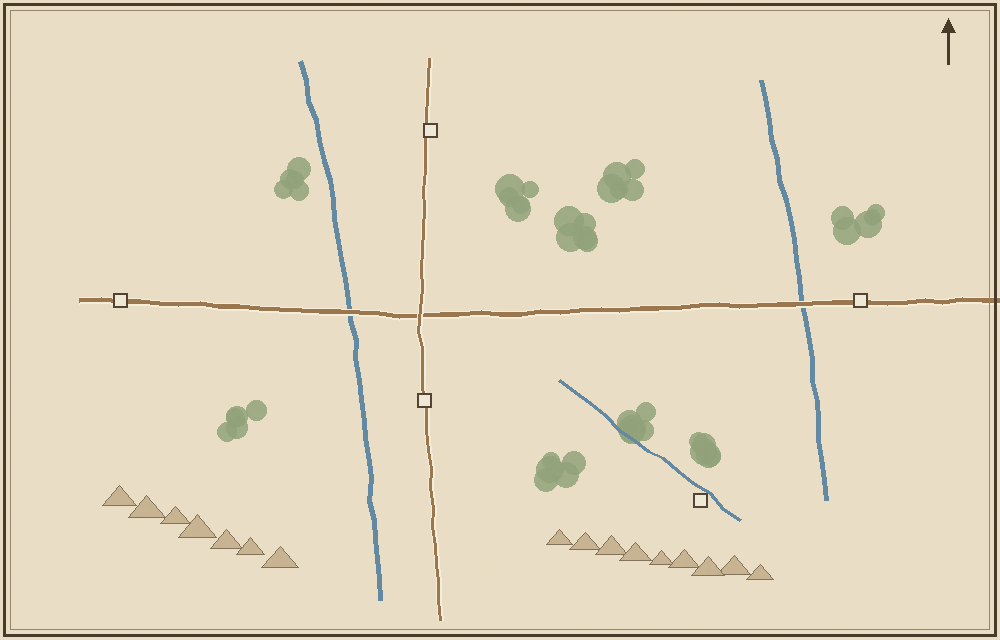 BREITENFELD
Leipzig
Halle
Duben
into Saxony
Wurzen
Elster R.
Mulde R.
BREITENFELD
Leipzig
Halle
Duben
into Saxony
Wurzen
Elster R.
Mulde R.
 Imperial rise
Breitenfeld
Swedes (right)
Saxons (left)
Loberbach
the Halle road
to Leipzig
Imperial rise
Breitenfeld
Swedes (right)
Saxons (left)
Loberbach
the Halle road
to Leipzig