Battle of Wagram 1809
1809 · Europe
6 July 1809 · The Marchfeld north-east of Vienna, around Deutsch-Wagram, Lower Austria, Austria
French Army (Napoleon) — Austrian Army (Archduke Charles) · 12 turns · 69 units
AI personality: French Army (Napoleon) Seize / Austrian Army (Archduke Charles) Breakthrough
See this battle in the battle list
The picture we hope to see
Hold on the left, fill the hole in the centre with guns, and on the right let Davout turn the end of the escarpment.
Briefing
6 July 1809. The Marchfeld north-east of Vienna, around Deutsch-Wagram, Lower Austria, Austria
« Touchez là, Macdonald, sans rancune. »
(Your hand, Macdonald, and no hard feelings.) — Napoleon to Macdonald after the battle of Wagram (Macdonald's memoirs)
The Russbach is a small stream, but its northern bank is a bluff. The bluff runs from Wagram in the west to the tower of Markgrafneusiedl in the east, and there it ends in level wheat fields. Archduke Charles's army stands on that bluff. Napoleon's army, which crossed from the island of Lobau the night before, is spread over the plain below it, the Marchfeld. Two months ago, at Aspern and Essling on this same plain, Napoleon suffered his first defeat at the archduke's hands. At dawn the archduke advances on both wings.
[How the French win] Take Markgrafneusiedl (25 points), Deutsch-Wagram (15 points) and Aderklaa (10 points), and hold the Lobau Bridges at your back (25 points) and Aspern and Essling (10 points each). The Russbach is a river: attack across it and the defenders on the bluff count double. The bluff ends at its eastern tip, beyond Neusiedl. Lauriston's grand battery (Grand Battery) and the Guard artillery have a range of 3. Marmont (Marmont) and Wrede (Wrede) arrive on turns 3 and 4 from the southern edge (Lobau). The victory line is +54: the French win if the score difference from their side is above +54. The French may activate 16 units per turn.
[How the Austrians win] Hold the bluff and threaten the bridges along the Danube with the right wing. If Klenau (Klenau) and Kolowrat (Kolowrat) come down to Aspern and Essling and take the Lobau Bridges, the French are cut off from their rear. The archduke's orders reached his wings late: the Austrians may activate 10 units per turn on turns 1 to 3, and 15 from turn 4.
[Commanders] France: Napoleon (Napoleon) / Davout (Davout, III Corps) with Morand (Morand), Friant (Friant), Gudin (Gudin) and Puthod (Puthod) / Oudinot (Oudinot, II Corps) / Eugène (Eugene, Army of Italy) with Macdonald (Macdonald) / Bernadotte (Bernadotte, IX Corps, Saxons) / Masséna (Massena, IV Corps) with Lasalle (Lasalle) / the cuirassiers of Bessières (Bessieres) and Nansouty (Nansouty) / Lauriston (Lauriston) / Marmont (Marmont) and Wrede (Wrede).
Austria: Archduke Charles (Archduke Charles) / Rosenberg (Rosenberg, IV Korps) / Nordmann (Nordmann, advance guard) / Hohenzollern (Hohenzollern, II Korps) / Bellegarde (Bellegarde, I Korps) / Liechtenstein (Liechtenstein, reserve grenadiers and cavalry) / Kolowrat (Kolowrat, III Korps) / Klenau (Klenau, VI Korps).
Not on the board: Archduke John (who hurried from Pressburg but reached the east of the field only in the evening) / Bertrand (the engineer who bridged the way to Lobau) / Vandamme (who held Vienna and the Danube behind the army with the Württembergers).
[Decisions this board lets you try]
- (French) Swing Davout round the eastern tip of the bluff, or attack the tower of Neusiedl head on?
- (French) When Klenau comes down toward the bridges, send Masséna to the left, or keep him in the centre?
- (Austrians) Wait on the bluff, or press on both wings from turn 4?
- (Austrians) Go for the bridges, or close the open end east of Neusiedl?
[Outcome] Around two in the afternoon, with Davout's men over the tower of Neusiedl and up on the bluff, and Macdonald's column driven into the centre at heavy cost, Archduke Charles ordered the retreat. The Austrian army fell back north without breaking, and six days later an armistice was signed at Znaim. Killed, wounded and prisoners on both sides came to some seventy thousand; Lasalle, the great French cavalry general, fell that day. Napoleon made Macdonald a marshal. By the Treaty of Schönbrunn in October, Austria lost territory and three and a half million subjects, and the next year the archduchess Marie Louise married Napoleon. It was a victory, but the enemy had not run, and an age of wars decided by the weight of guns had begun.
The bluff ended at the tower
Davout went round through the wheat beyond it
A hundred guns filled the gap in the centre
The archduke's men fell back north and did not break
Your hand, Macdonald
The next year, the emperor's daughter went from Vienna to Paris as a bride
Strengths: about 160,000 French and 130,000 Austrians (estimates vary). The evening attacks of the first day (5 July) and the abandonment of Aderklaa during the night are folded into the time before the board. Archduke John's army and the details of the Danube islands and bridges are not shown. Village positions are approximate.
1 hex = 500 m, 1 turn = 60 minutes, 1 CS = about 2,000 infantry or 1,000 cavalry. T1 = 6 July 4:00, T4 = 7:00, T8 = 11:00, T12 = 15:00.
Maps
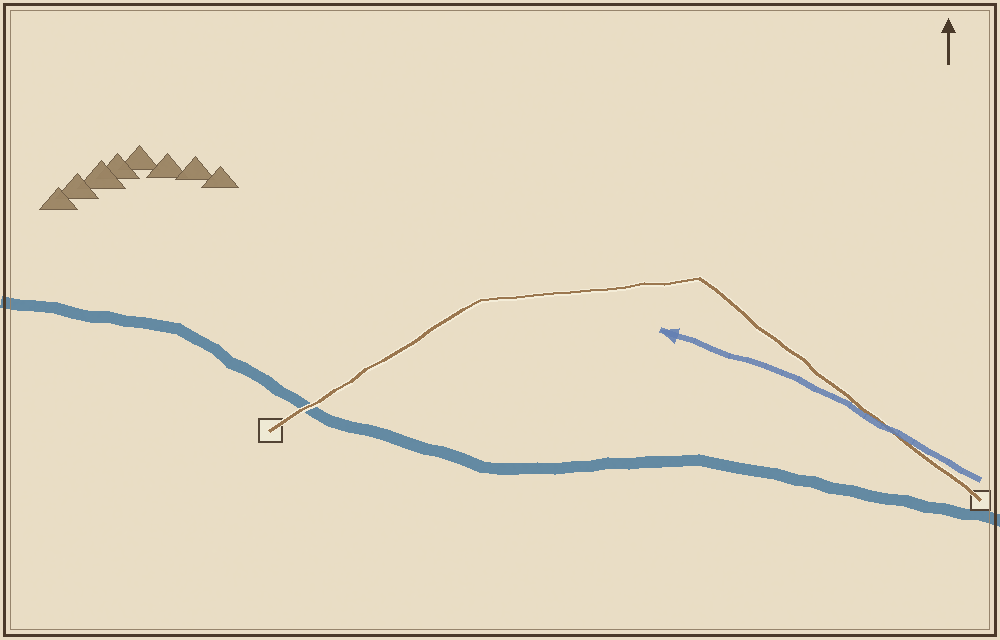 WAGRAM
Vienna (entered by the French in May)
Danube
Lobau island (crossed on the night of 4 July)
Pressburg (Archduke John)
Archduke John's army (arrives too late)
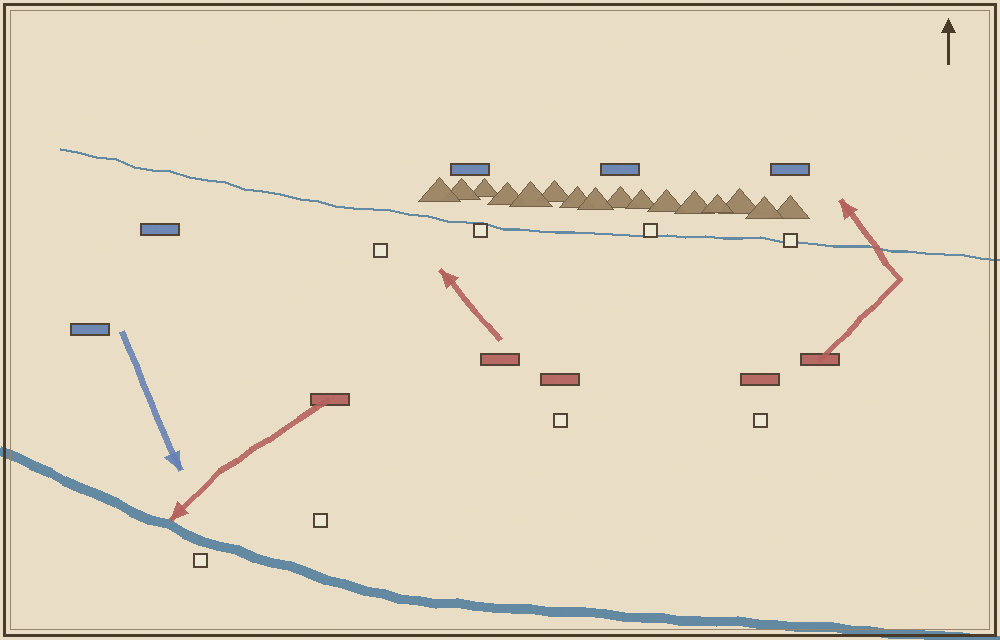 WAGRAM
Russbach heights
Markgrafneusiedl (the tower)
Davout turns the end of the heights
grand battery (over a hundred guns)
Macdonald's great column
Klenau drives down toward the bridges
Masséna marches across the enemy front to the left
Aspern and Essling (scene of the May defeat)
Aderklaa
Danube