Battle of Chancellorsville
1863 · North America Long
Union — Confederate · 10 turns · 374 units
Briefing
"Are you ready, General Rodes?" "Yes, sir." "You can go forward, then."
-- 2 May 1863, 5:15 in the afternoon, north of the Orange Turnpike. Jackson closed his watch, and the five brigades of Rodes's division went into the woods (Rodes's report; Official Records, vol. 25)
The board begins one hour before that signal.
Twenty-eight thousand men who have marched twelve miles have just finished forming three lines astride the turnpike, square on the flank of the Union right. The Union army does not know it. In XI Corps only a handful of regiments face this way; most face south with their arms stacked, cooking supper. Sickles's corps has gone off south as far as Catharine Furnace and is not here.
This board does not ask "Do you make the great flank march?" The flank march is already over. What it asks is whether an army broken by that blow can recover within twenty hours, and, while a second battle is fought at the same time ten miles to the east, which army can first make the two battlefields into one.
[The day and a half on this board] T1 to T3 are the evening and night of 2 May: the flank attack, and the pursuit after dark. T4 to T10 are 3 May: in the west Stuart takes over the attack, and in the east Sedgwick advances on the stone wall at Marye's Heights. The board is cut off that evening at Salem Church.
[The counters on this board are regiments] Three hundred and seventy-four counters. Each counter is roughly one regiment (regiments in May 1863 were under strength, so a Union counter represents about 600 men and a Confederate counter about 450), and 1 point of combat strength is about 150 men. The left of the counter is the brigade commander's surname, and the right is the regiment: Paxto 33Va is the 33rd Virginia of Brigadier Paxton's Stonewall Brigade, and Meagr 69NY is the 69th New York of Meagher's Irish Brigade. Regiments whose real names could not be given are placed by ordinal, as in Kersh 1st (meaning the first regiment of Kershaw's brigade, not that there was a unit of that name).
[How the Union wins] The margin opens at plus 415, because the Union begins holding the crossroads 145, U.S. Ford 110, Hazel Grove 75, Fairview 55, Wilderness Church 55, Ely's Ford 35, Falmouth 35 and Franklin's Crossing 35. The victory line is plus 240. In other words, the moment the crossroads (145 points, or 290 on the margin) is given up, the Union drops below the line. Put the other way, the Union has only one job on this board: not to give up the crossroads. Of 227 counters, only forty can be moved in a turn, but where the forty that need to move are should be clear from a look at the board.
[How the Confederates win] Take the crossroads, and the line is broken. The Confederates can move every one of their 147 counters. But thirty of them are pinned ten miles east at Fredericksburg. While the west goes for the crossroads, Early in the east must hold six miles of thin entrenched line against Sedgwick's fifty-four counters. This subtraction is what Lee did from 2 to 3 May.
[The four flags] Four flags stand on the board that carry no victory points. Taking them changes how many counters can be moved in a turn.
- Talley's Farm: the western end of the turnpike, the far end of XI Corps's right. If the Confederates take it, the Union limit falls from forty to thirty-two. That is what the disappearance of an army's right end looks like on the board.
- Marye's Heights: behind Fredericksburg, the stone wall of the sunken road. If the Union takes it, the Confederate limit falls from 147 to 137. If Early's line is broken, Lee must face two ways.
- Catharine Furnace: at the start, Sickles's corps is spread out around it. If the Confederates take it back, the Union limit falls by five. At the same time, the line of retreat of the Union troops out to the south is squeezed. It was because exactly this was about to happen that the historical Sickles hurried back during the night.
- Banks Ford: on the river. At the start, the Confederate brigade of Wilcox guards it from next door. If the Union takes it, the Union limit rises by eight. If it opens, the distance between the two separated wings shrinks by five miles.
[The rivers and the five crossings] The Rappahannock and the Rapidan are drawn as major rivers: the hex sides themselves cannot be crossed. There are only five crossings: Ely's Ford, U.S. Ford (the only line of retreat for the Union right; a pontoon bridge spans it), Banks Ford, the pontoon bridge in front of Fredericksburg, and the pontoon bridge at Franklin's Crossing. The two Union wings, though on the same side of the same river, fight separately ten miles apart. Hazel Run south of the town is a stream that can be crossed; attacking across it doubles the defence.
[The Wilderness] The western half of the board is a dense second growth of oak and pine. It costs three movement points, doubles the defender's combat strength, and blocks the guns' line of sight. The only clearings are the Chancellorsville crossroads, Fairview, Hazel Grove, Wilderness Church, Talley's Farm and Catharine Furnace, so guns can be placed only there, and the fighting on the morning of 3 May turns around those six places. Hazel Grove stands higher than its surroundings; give it up, and guns there reach both Fairview and the crossroads. In the east, beyond the ridge at Zoan Church, the ground opens into farmland.
[Stone walls and entrenchments] Early's line runs unbroken for six miles, from the stone wall of the sunken road at Marye's Heights south along the ridge by Willis Hill, Howison Hill, Lee Hill and Deep Run to Prospect Hill (facing east, south-east and north-east; eleven thousand men holding such a length are thin everywhere). There are two more in the west: the entrenchments at Zoan Church and Tabernacle Church (facing west; dug by Anderson on the night of 30 April), and the breastworks at the crossroads, Fairview and Hazel Grove (facing south and east; felled and built by the Union on the afternoon of 1 May). All are placed on open ground, because under these rules a palisade placed on terrain that already doubles the defence (town, rocky ground, marsh) does nothing.
[I Corps has not arrived yet] From the northern edge of the board, along the road from Stafford Court House, Reynolds's I Corps enters in three waves on T4 (dawn of 3 May), T5 and T6: the Iron Brigade of Wadsworth's division, Cutler, Phelps and Paul; Root and Baxter of Robinson's division; Rowley and Stone of Doubleday's division; and Wainwright's artillery. They received their orders on the evening of 2 May and marched twenty miles through the night. As they enter, the Union limit rises from forty to fifty-seven.
[Commanders] Union (dull blue-green counters): commanding general, Major General Joseph Hooker. Chief of staff Daniel Butterfield, chief of artillery Henry Hunt, chief topographical engineer G. K. Warren. The right wing at Chancellorsville: V Corps, Meade (the three divisions of Griffin, Sykes and Humphreys; brigades of Barnes, McQuade, Stockton, Ayres, Burbank, O'Rorke, Tyler and Allabach; artillery, Weed); XII Corps, Slocum (Knipe, Ross and Ruger of Williams's division / Candy, Kane and Greene of Geary's division / artillery, Best); XI Corps, Howard (von Gilsa and McLean of Devens's division, Schimmelfennig and Krzyzanowski of Schurz's division, Buschbeck and Barlow of von Steinwehr's division; artillery, Dilger); II Corps, Couch (Caldwell, Meagher, Zook and Brooke of Hancock's division / Carroll and Hays of French's division); III Corps, Sickles (Graham, Ward and Hayman of Birney's division / Carr, Revere and Mott of Berry's division / Franklin, Bowman and Berdan's Sharpshooters of Whipple's division / artillery, Randolph); and Pleasonton's cavalry, Devin and Huey. The left wing at Fredericksburg: VI Corps, Sedgwick (Brown, Bartlett and Russell of Brooks's division / Grant and Neill of Howe's division / Shaler and Wheaton of Newton's division / Burnham's Light Division / artillery, Tompkins), and across the river at Falmouth, Gibbon's division (Sully, Owen and Hall) and Tyler's reserve artillery. The main body of the cavalry has gone south with Stoneman towards Richmond and is not on the board.
Confederates (dull rose counters): commanding general, General Robert E. Lee. II Corps, Lieutenant General Thomas J. Jackson; his chief of artillery Crutchfield; Jedediah Hotchkiss, who drew the maps; and the engineer Boswell. The three lines of the flank march: the first line, Rodes's division (Doles, O'Neal, Ramseur, Colquitt, Iverson); the second, Colston's division (Paxton's Stonewall Brigade, Jones, Nicholls, Warren); the third, A. P. Hill's Light Division (Heth, Pender, Lane, McGowan, Archer, Thomas). Making a demonstration south-east of the crossroads are Anderson's division of I Corps (Wilcox, Mahone, Posey, Wright, Perry) and McLaws's division (Kershaw, Semmes, Wofford; artillery, Alexander). The cavalry: Major General J. E. B. Stuart; Fitzhugh Lee and Wickham appear on the board. At Fredericksburg: Early's division (Hays, Hoke, Smith, Gordon), Barksdale's brigade, and Pendleton's reserve artillery. Lieutenant General Longstreet is at Suffolk with the two divisions of Hood and Pickett and does not arrive in time for this battle.
[What to decide in these twenty hours] Union: where do you stop the right wing as it is rolled up? At Buschbeck's line, at the gun line on Fairview, or at the crossroads itself? Do you call back Sickles's corps from the Furnace, or leave it where it is, behind the Confederates (call it back and your front thickens, but the Furnace flag becomes Confederate)? How long do you hold Hazel Grove? How many times does Sedgwick assault Marye's Heights? Break through and the Confederate limit falls by ten; fail and the west cannot be saved. Confederates: how do you close the two miles to the crossroads in twenty hours? When do you swing the thirty counters in the east round to the west? Who guards Banks Ford?
[Outcome] That night the attack went on after dark. At about nine o'clock, returning from a reconnaissance ahead of the lines, Jackson was shot by his own 18th North Carolina, of Lane's brigade on the board. His left arm was amputated, and eight days later he died of pneumonia. Lee said, "He has lost his left arm, but I have lost my right." On the morning of the 3rd, Stuart took over the attack, and Alexander brought thirty guns up onto Hazel Grove, which Sickles had given up during the night. At 9:15 a shell struck a pillar of the Chancellor house, and Hooker, who was leaning against it, fell unconscious. When he came to, with seventy thousand men still in hand, he gave orders for the whole army to fall back towards the river. That same morning Sedgwick broke through the stone wall at the third assault and hurried west, but that evening he was stopped at Salem Church. On the 4th Lee turned about and pressed Sedgwick into the pocket at Banks Ford, and on the night of the 5th Sedgwick crossed at Scott's Ford to the north bank. Before dawn on the 6th, Hooker's 130,000 withdrew across U.S. Ford. Union losses were 17,197, Confederate 12,764: for the Confederates, twenty-two per cent of the whole army. Lee meant to win this way once more, and six weeks later he marched north.
"Are you ready, General Rodes?" "Yes, sir."
"You can go forward, then."
Deer and rabbits ran out of the woods ahead of the soldiers.
That night, those who fired were his own men.
One man lost a left arm; an army lost its right.
Six weeks later, Lee tried to win this way again.
The period from 27 April to noon on 2 May has been folded away: the river crossings, the advance and pull-back on 1 May, and Jackson's twelve-mile march. The board covers only the twenty hours from four in the afternoon on 2 May, when that march was over, until six in the evening on the 3rd. Stoneman's cavalry raid and Longstreet at Suffolk were absent in history. The turn-about and withdrawal from 4 May onward are told under [Outcome] above. Brigades have been divided into regiments. In men, the Union had 119,700 against 60,900 Confederates, but in combat strength on the board it is 836 against 997: only Jackson's three lines, their flank march complete, have been made heavier per counter, and this represents not numbers but "a force already deployed on the enemy's flank and rear" (this board does not use the surprise rule).
1 hex = 300 m, 1 turn = 120 minutes, 1 CS = about 150 men. Movement: infantry 8, artillery 6, cavalry 10. T1 = 5/2 16:00 (the lines are formed), T2 = 18:00 (the flank attack), T3 = 20:00 (the pursuit continues after dark), T4 = 5/3 06:00 (Stuart's attack, Sedgwick's assault, I Corps enters from the north), T6 = 10:00 (the crossroads and Marye's Heights), T10 = 5/3 18:00 (final turn; Salem Church). The Union can move 40 counters at a time (57 when I Corps enters on T4; 8 more if it takes Banks Ford; 32 if it loses Talley's Farm); the Confederates can move all 147 (137 if they lose Marye's Heights).
Maps
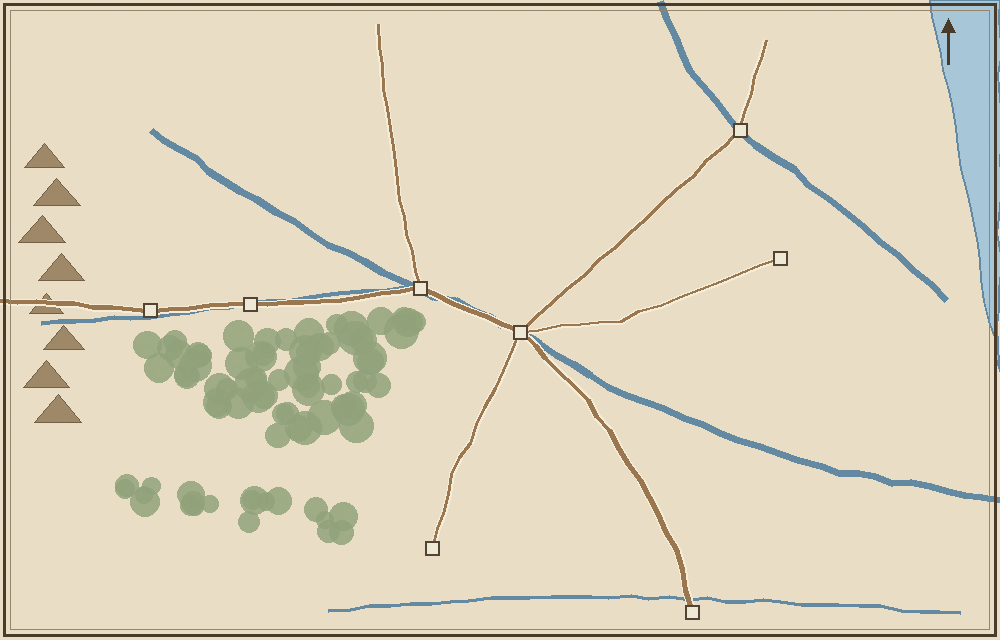 CHANCELLORSVILLE
Fredericksburg
Culpeper
Orange
Washington D.C.
Richmond
Aquia Creek
Spotsylvania C.H.
Rappahannock R.
Rapidan R.
The Wilderness
Potomac R.
Blue Ridge
North Anna R.
CHANCELLORSVILLE
Fredericksburg
Culpeper
Orange
Washington D.C.
Richmond
Aquia Creek
Spotsylvania C.H.
Rappahannock R.
Rapidan R.
The Wilderness
Potomac R.
Blue Ridge
North Anna R.
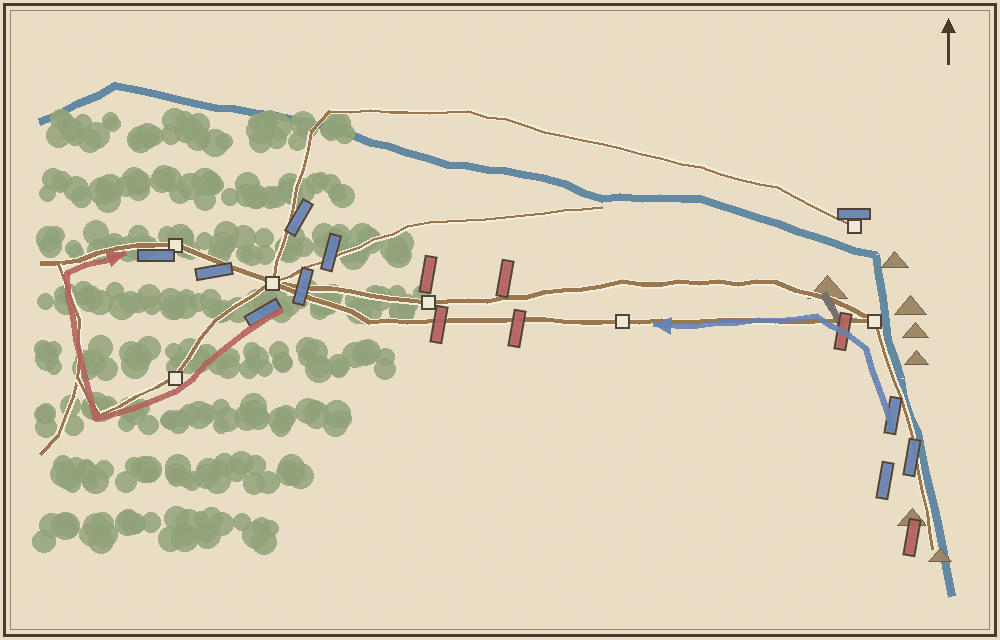 Chancellorsville
Fredericksburg
Maryes Heights
Salem Church
Zoan Church
Falmouth
Wilderness Church
Catharine Furnace
Hazel Grove
United States Ford
Banks Ford
Franklins Crossing
Hamiltons Crossing
Rappahannock R.
The Wilderness
Jacksons flank march
to Orange
Chancellorsville
Fredericksburg
Maryes Heights
Salem Church
Zoan Church
Falmouth
Wilderness Church
Catharine Furnace
Hazel Grove
United States Ford
Banks Ford
Franklins Crossing
Hamiltons Crossing
Rappahannock R.
The Wilderness
Jacksons flank march
to Orange