Battle of Wuzhang Plains 234
234 · China
234 (fourth lunar month, Jianxing 12) · Wuzhangyuan (Wuzhang Plains), Qishan County, Baoji, Shaanxi, China, south of the Wei River
Shu Han Army — Wei Army · 13 turns · 50 units
AI personality: Shu Han Army Breakthrough / Wei Army Line
Briefing
234 (fourth lunar month, Jianxing 12). Wuzhangyuan (Wuzhang Plains), Qishan County, Baoji, Shaanxi, China, south of the Wei River
"If Liang crosses the Wei, climbs onto the plain, links his troops to the northern hills and cuts the Long road, the people and the tribes will be shaken. That is not to the state's advantage." -- Guo Huai, when he alone argued that the Northern Plain must be held (Records of the Three Kingdoms, Book of Wei, Biography of Guo Huai)
Through the middle of the board, the Wei River flows from west to east. The tableland jutting out to its south is Wuzhangyuan; the one jutting out to its north is the Northern Plain (Beiyuan). Both are called "plains", but their roles differ. Wuzhangyuan is where Zhuge Liang came out of the Xie valley and made camp; the Northern Plain is where, if he stands there, the Long road is cut. The Long road links Guanzhong with Longyou, and the whole western half of Wei hangs by this one road. Guo Huai alone saw this, and only Sima Yi agreed. Guo Huai goes up onto the Northern Plain, and before its ditch and rampart are finished, the Shu troops come surging in: the board begins on that day.
The Wei River can be crossed. But attacking across it doubles the defender's combat strength. Three crossings avoid that penalty, at the cost of a longer way round.
[Cut the Long road: how Shu wins] The result is decided by a single margin. Margin = (points of objectives you hold - points of objectives the enemy holds) + (losses inflicted - losses suffered). The victory line is +55. If the margin from Shu's side ends 12 points above +55, Shu wins a tactical victory; 95 above, an operational victory; 190 above, a strategic victory. If it ends 12 points below +55, Wei wins on the same scale. Between these it is a draw. At the start Shu holds Wuzhangyuan 20, Xiegukou 10 and Mengyan's camp 10, 40 points in all. The heaviest objective on the board is the Northern Plain at 30, and an objective counts twice when it changes hands, added to the side that takes it and subtracted from the side that loses it, so the Northern Plain alone moves the margin by 60. That is what Guo Huai alone foresaw.
[Hold the tally: how Wei wins] Wei's way of winning lies at the other end of the same number line. So long as it does not let the margin reach +67, that alone brings a draw. The Wei court ordered Sima Yi to hold firm, and sent the Commandant of the Guards Xin Pi as military adviser to the Grand General, bearing the imperial tally that forbade him to go out and fight. Xin Pi led no troops and is not a counter, but this way of winning, by not moving and not giving up the margin, is his tally.
[The military farms by the Wei] The Biography of Zhuge Liang says: "He divided his troops to farm, as the basis for a long stay. The farmers mingled among the people living by the Wei." The northern expeditions had always ended midway not because they were defeated but because the grain ran out, and on this fifth expedition Liang made fields. On the board there are three military-farm points by the Wei, including Lankeng. While Shu holds them, it can move one more unit for each; if Wei holds them, Shu's limit instead falls by one each. The basic limits are Shu 9 and Wei 8. Shu has 26 units and Wei 24, so each side moves only about a third. If Shu takes every farm it reaches 12; if every farm is burned, 6. But the farms are not victory points. Only moves are gained.
[The bait at Yangsui] In the east of the board, Yangsui on the north bank is not a victory point, but if Shu holds it, Shu's limit rises by as much as 3. And if Wei holds it, nothing happens to Wei. It is there purely to draw Shu in. So it was in history: Sima Yi had the general Zhou Dang camp at Yangsui as bait, while behind it he had Hu Zun and Guo Huai prepare. Liang made a show of heading west, and the Wei generals said he meant to attack the western lines, but Guo Huai alone said, "He is showing us his shape in the west, and means to attack Yangsui." That night the Shu army did attack Yangsui, and because it was prepared, they could not get up. On this board, neither Zhou Dang nor Hu Zun stands on the Yangsui hex itself. They stand beside it. So if you go, you can take it. After you take it, the two of them come back.
[Commanders] Shu Han: Zhuge Liang. Wei Yan, commanding the vanguard (Former Army Adviser and Senior General Who Conquers the West); Jiang Wei, Supervisor of the Central Army (General Who Conquers the West); Zhang Yi, Commander of the Front Army and Grand Administrator of Fufeng; Wang Ping, General Who Suppresses Bandits (his family name was Wang, and from his adoptive family he was also called He Ping); Ma Dai; and Meng Yan, Tiger Guard Supervisor, who held the east of the Wugong River. Units whose names are attested: the Wudang Flying Army, formed from the hardy troops of Nanzhong in five divisions; the Tiger Guard; the unit of Liang's improved repeating crossbow, the "Yuanrong"; the flowing-horse transport train recorded for this year; and the farming soldiers by the Wei. Yang Yi, Chief Clerk to the Chancellor, took charge of all planning and grain, but no record says he led troops, so he is not a counter. Fei Yi, Marshal to the Chancellor, Li Fu, Deputy Director of the Secretariat, who came to ask who should succeed, and Liao Hua, who was on the staff, are absent from the board for the same reason.
Wei: Sima Yi. Guo Huai, Inspector of Yong province; Qin Lang, Protector of the Army against Shu, leading twenty thousand foot and horse; and Hu Zun and Zhou Dang, who prepared at Yangsui. Only these five Wei generals are recorded as leading troops, so the rest are filled in with unit names: Yong province infantry, Liang province cavalry, the farming soldiers of Longyou, and Qin Lang's central army. The Army Supervisor Xin Pi is found in the victory conditions. Sima Shi, Sima Zhao and Xiahou Ba, who appear on this field in the Romance, and Gao Xiang, Wu Ban and Niu Jin, who often find their way into the rosters, are not included: the official history has no record of their serving at Wuzhangyuan, or they belong to Lucheng three years earlier.
[What to decide in thirteen days] Shu: cross, or farm? Go straight for the Northern Plain and you hit Guo Huai's tableland head-on. Go round to the east and you gain Yangsui's 3, but the front of the Northern Plain grows thinner by as much. Leave Sima Yi in the Weinan fort alone and your crossing points will be struck from behind. With 9 moves, you cannot do all of this. Wei: go out, or stay in? The historical Sima Yi stayed in, but this board has MUST ATTACK. Once adjacent, you must fight. You can draw a line, but you cannot refuse. So Wei's problem is not "not fighting" but where to allow contact. If you can draw the line all the way along the north bank, Shu cannot move the margin.
[Retreat to the Xie valley] At the southern edge of the board, below Xiegukou, three hexes jut out. Shu Han units that enter them leave the board. Each unit that gets away scores 1 point per point of combat strength; Zhuge Liang scores forty points, and the flowing-horse train twenty (the coffin and the baggage are returned to Hanzhong). But if on the final turn all three hexes lie under the Wei army's zone of control, the retreat fails and units that got away are counted as destroyed. If even one hex is free, it all succeeds. All Wei can do is pursue and close the three exits.
[Outcome] In the eighth month, Zhuge Liang died in camp. He was fifty-four, after more than a hundred days of standoff. The Shu army kept his death secret and withdrew; when Sima Yi pursued, they turned their banners and came at him, and Sima Yi withdrew. The people made a proverb of it: a dead Zhuge put a living Zhongda to flight. He himself is said to have answered, "I can reckon with the living, but I cannot reckon with the dead." Afterwards Wei Yan and Yang Yi clashed, and Wei Yan was cut down by Ma Dai. The man who dispersed Wei Yan's troops by shouting at them, "Our lord is dead and his body not yet cold, and what are you doing?" was the Wang Ping on this board. The counters' finest moment comes after the board ends. When the Shu army had gone, Sima Yi walked about the remains of its camps and left only one remark: a genius of the realm. The northern expeditions ended there, and Shu lasted another twenty-nine years.
For more than a hundred days, the fields bore fruit.
In those hundred days, the Long road was not cut once.
An army keeping its mourning secret turned its banners, and the pursuers withdrew.
The man who walked the remains of the camps said only: a genius of the realm.
That the road was never cut, no one called a victory.
The hundred-odd days of standoff have been folded away, and only the campaign from the struggle for the Northern Plain to the night attack on Yangsui has been made into 13 turns. The sources give no figure for Wei's total strength; the only certain number is Qin Lang's twenty thousand foot and horse. Against Shu's hundred thousand, combat strength has been set at 103 to 101 (not the raw ratio of numbers; Shu has been given enough quality to attack across the doubling of the Wei). Only the flowing horses appear for transport; the wooden oxen belong to a record three years earlier and have not been mixed in. The gift of women's clothing and the anecdotes of the wooden oxen and flowing horses lean towards the Romance and are not counters.
Of the flags on the counters, the commander's banner marked 帥 follows a convention of novels and comics; it is not a flag attested in the sources. The Four Symbols and Big Dipper banners of the van, rear and centre armies follow the Book of Rites (Quli I). The Shu counters bear 漢, the name of their state.
1 hex = 1,000 m, 1 turn = 1 day, 1 CS = about 1,000 men. T1 = the day the Shu army surges towards the Northern Plain, T4 = Qin Lang's central army enters by the eastern mouth of the Long road, T13 = end.
Maps
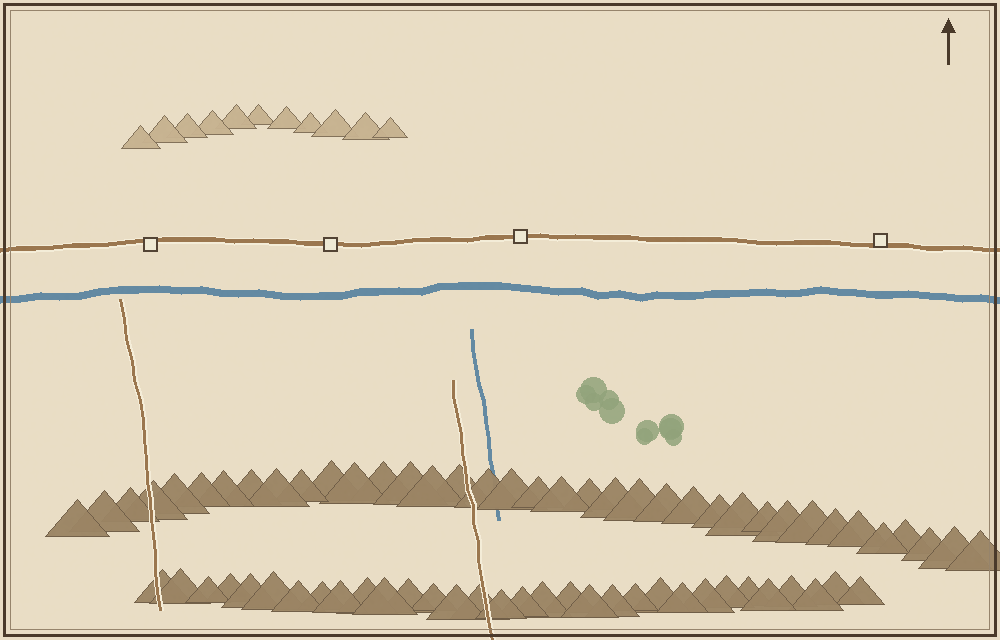 WUZHANGYUAN
Changan
Chencang
Mei
Wugong
Wei River
Qinling / Xiegu road
to Hanzhong
Beiyuan
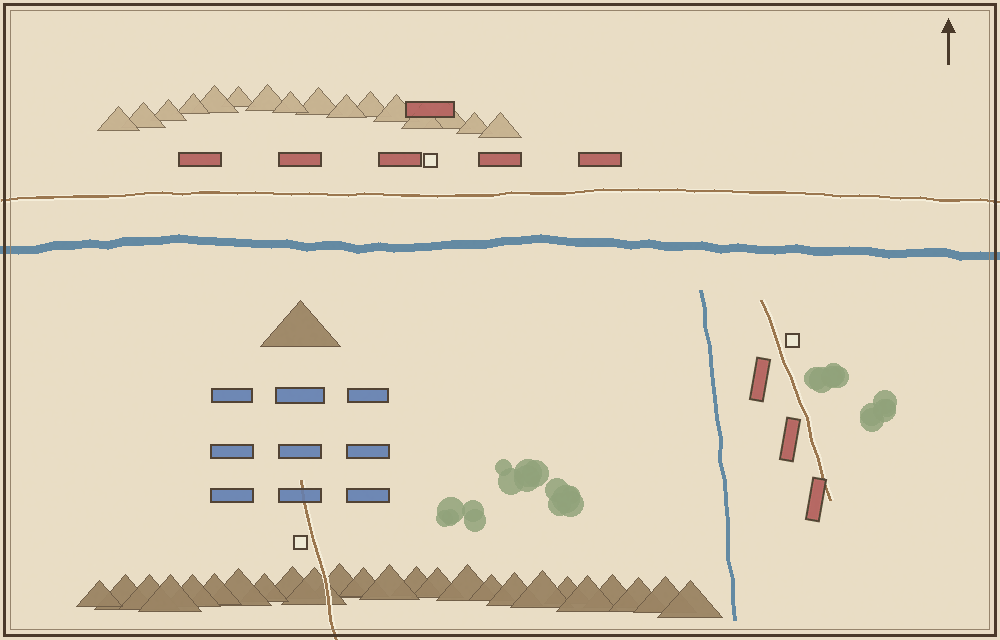 Wuzhangyuan / Shu camp
Wei eastern lines
Sima Yi camp
Wei River
Wugong stream
Qinling Mts.
supply road to Hanzhong
Beiyuan